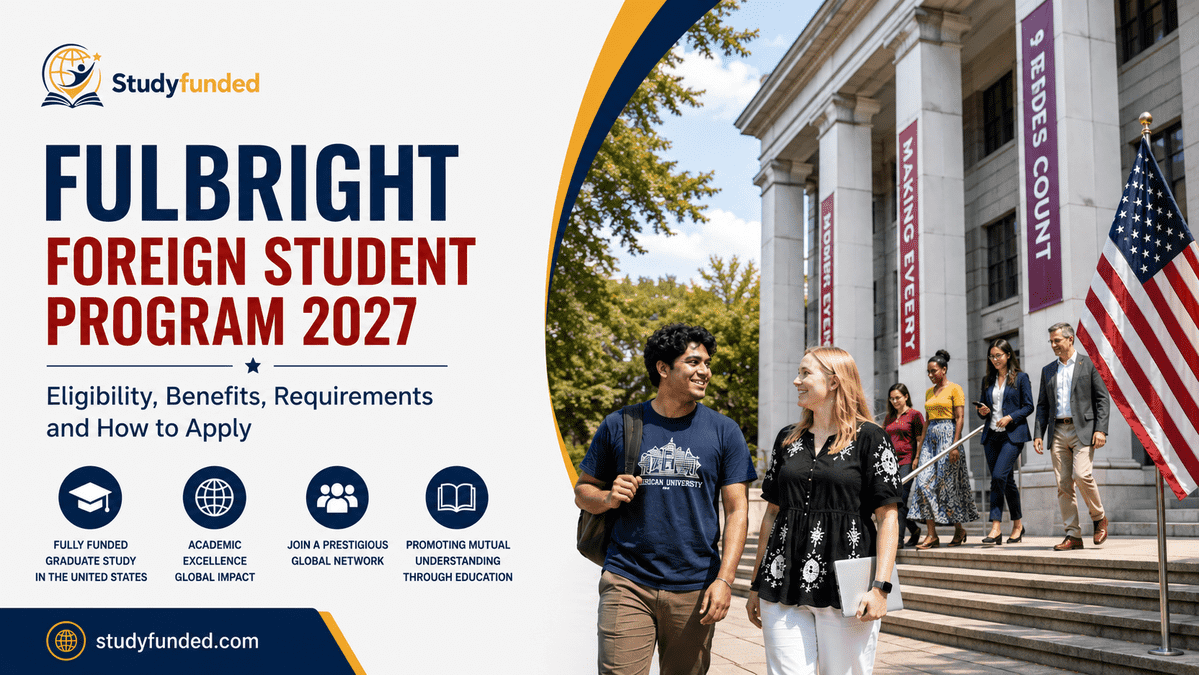
The Fulbright Foreign Student Program is a U.S. Government-sponsored international exchange programme for eligible graduate students, young professionals, and researchers. However, applying for Fulbright differs from applying for a typical scholarship because eligibility requirements, available fields, benefits, application procedures, and deadlines can vary by country.
There is no single universal Fulbright application that every international student submits in the same way. Your country’s Fulbright Commission, Foundation, U.S. Embassy, or other designated office may administer the programme and publish its own requirements and timeline.
This guide explains how the Fulbright Foreign Student Program works, what it may cover, who can apply, how country-specific requirements affect the application, what documents you may need, and how to prepare for the 2027 cycle.
If you are comparing Fulbright with other U.S. funding opportunities, see our broader guide to Fully Funded Scholarships in the USA for International Students.
Quick Takeaways
- Fulbright is sponsored by the U.S. Government as an international academic and cultural exchange programme.
- The Foreign Student Program primarily supports eligible international applicants pursuing graduate study or research in the United States.
- Eligibility, available fields, benefits, application procedures, and deadlines vary by country.
- Applicants should follow the instructions published by the official Fulbright office responsible for their country.
What Is the Fulbright Foreign Student Program?
The Fulbright Foreign Student Program is part of the U.S. Government’s international educational and cultural exchange programmes.
It supports eligible international students, young professionals, and researchers who pursue graduate-level study or research in the United States. The programme is designed around academic study, international exchange, professional development, leadership, and cultural understanding.
Fulbright awards are administered through different country programmes. This means the exact application process depends on where you are applying from.
Fulbright is therefore both an exchange programme and a source of educational funding.
Depending on the country programme and award, participants may have opportunities to engage with U.S. academic institutions, professional networks, cultural activities, and the wider Fulbright community.
The programme’s purpose extends beyond simply funding study in the United States. Applicants are expected to engage with the broader goals of academic and cultural exchange and use their experience meaningfully after the programme.
Why Do Fulbright Requirements Differ Between Countries?
One of the most important things to understand before applying is that Fulbright does not operate through one identical set of requirements worldwide.
The programme is administered through country-specific offices and other designated organisations. As a result, applicants from different countries may encounter differences in:
- Eligibility requirements
- Eligible fields of study
- Degree levels supported
- English-language requirements
- Required documents
- Application procedures
- Selection stages
- Deadlines
- Funding arrangements
Information published for one country may therefore not apply to applicants from another.
If you are applying from Nigeria, for example, follow the current instructions provided for Nigerian applicants rather than relying on requirements published for Ghana, Kenya, South Africa, or another country.
Your country’s official Fulbright office is the most important source for your application.
Fulbright Foreign Student Program 2027 at a Glance
| Feature | Details |
|---|---|
| Programme | Fulbright Foreign Student Program |
| Sponsor | U.S. Government |
| Destination | United States |
| Main focus | Graduate study, research, and international exchange |
| Typical applicants | International graduate students, young professionals, and researchers |
| Funding | Substantial support; exact benefits vary by country and award |
| Eligibility | Country-specific |
| Application | Usually administered through a designated country programme |
| Deadline | Varies by country |
| Selection | Academic preparation, leadership, potential, and other country-specific criteria |
Because Fulbright programmes are country-specific, applicants should confirm all current details with the official Fulbright office responsible for their country.
What Does the Fulbright Foreign Student Program Cover?
Fulbright is generally known for providing substantial financial support, but the exact award package depends on the country programme and type of award.
Depending on the programme, support may include:
- Tuition and mandatory university fees
- Living or maintenance allowance
- Airfare or travel support
- Health or accident coverage
- Orientation
- Professional and cultural activities
Applicants should not assume that every Fulbright award covers every expense.
The official country-specific programme determines the applicable benefits and conditions. Check what is covered, what is not covered, how long the funding lasts, and whether renewal or other conditions apply.
Who Is Eligible for the Fulbright Foreign Student Program?
There is no single eligibility checklist that applies identically to every country.
However, applicants commonly need to satisfy requirements related to academic preparation, citizenship, English proficiency, professional experience, and the proposed field or programme.
Academic Qualification
Applicants generally need an appropriate undergraduate qualification for graduate-level study.
Depending on the country programme, applicants may be eligible for:
- Master’s study
- Doctoral study
- Research programmes
- Other approved graduate or non-degree opportunities
The specific degree level supported varies by country.
Check whether your previous qualification meets the stated requirement and whether your proposed field is eligible.
Citizenship or Residency
Fulbright eligibility is usually connected to the country through which you are applying.
Some programmes specify citizenship requirements, while others may include additional residency or nationality conditions.
Do not assume that being an international student or being from a particular region automatically makes you eligible.
Read the eligibility requirements for your country carefully.
English-Language Requirements
English-language requirements can also differ between country programmes.
Depending on the programme, applicants may need to provide evidence of English proficiency through an accepted test or satisfy another specified requirement.
Do not assume that IELTS, TOEFL, or an exemption applies universally across Fulbright programmes.
Check your country’s current instructions before booking an English-language test.
Professional, Leadership, or Research Experience
Some Fulbright programmes consider professional experience, leadership, community involvement, research preparation, or other evidence of potential.
The type of experience that matters depends on the programme and applicant category.
Focus on evidence rather than simply describing yourself as a leader or high achiever. Show the responsibility you accepted, the work you carried out, the problems you addressed, and the results of your efforts.
What Makes a Competitive Fulbright Applicant?
Meeting the minimum eligibility requirements means you can apply, but it does not guarantee selection.
A strong Fulbright application should present a clear connection between your academic preparation, proposed study, professional or community experience, and future goals.
Strong Academic Preparation
Your academic record should demonstrate that you are prepared for the proposed field of study.
Relevant coursework, academic projects, research, professional preparation, and other experience can help demonstrate that preparation where appropriate.
Clear Academic and Professional Goals
Your proposed study should have a logical purpose.
The application should make it clear what you want to study, why the programme is relevant, and how the knowledge or skills will contribute to your longer-term goals.
Evidence of Leadership and Impact
Leadership does not necessarily mean holding a formal leadership title.
It can include taking responsibility for a project, solving a problem, creating an initiative, improving an organisation, supporting a community, or producing measurable professional results.
Use concrete evidence rather than broad claims.
A Credible Future Contribution
Fulbright is an exchange programme, so your plans should extend beyond simply obtaining a degree.
Explain how your proposed study fits into your professional or academic direction and how you expect to use the experience afterward.
Where the country programme places particular emphasis on community or national contribution, address that requirement directly.
Which Countries Participate in Fulbright?
Fulbright operates through programmes involving many countries and territories around the world.
However, participation does not mean that every country offers exactly the same award.
The programme serving a particular country may determine:
- Which study levels are supported
- Which fields are eligible
- Who can apply
- Which documents are required
- How selection is conducted
- When applications open and close
- What the award covers
Applicants should therefore confirm the current programme information for their own country rather than relying on a general Fulbright description.
How the Fulbright Application Process Works
Although the exact process varies by country, applicants should generally expect several stages.
1. Confirm Your Country’s Eligibility
Start with the official Fulbright office responsible for your country.
Confirm the current eligibility requirements, eligible fields, supported study levels, and application deadline.
2. Review the Official Application Guidelines
Read the instructions before preparing your documents.
Pay particular attention to requirements concerning:
- Degree qualifications
- Work or professional experience
- English proficiency
- Eligible fields
- Required essays
- Recommendation letters
- Transcripts
- Application forms
- Supporting documents
3. Prepare Your Supporting Documents
Gather the documents required by your country’s programme.
Do not rely on a generic Fulbright document checklist from another country.
4. Prepare Your Essays and Study Objectives
Your essays should explain your academic and professional direction and demonstrate why the proposed study is relevant to your goals.
Where the programme requires a study objective, research proposal, or similar document, follow the exact instructions provided.
For detailed guidance on preparing a scholarship personal statement, see our Scholarship Personal Statement Guide.
5. Request Your Recommendations
Choose referees who know your work well enough to provide specific evidence of your academic, professional, research, or leadership ability.
Give them the programme details and deadline early enough for them to prepare and submit their recommendations correctly.
For more detailed guidance, see How to Get a Strong Scholarship Recommendation Letter.
6. Review and Submit
Before submitting, check the application against the official instructions.
Confirm that:
- All required fields are completed.
- Documents are in the correct format.
- Essays answer the required questions.
- Recommendations have been submitted where required.
- You are applying through the correct country-specific route.
- You have submitted before the stated deadline.
Keep a copy of your completed application and submission confirmation.
7. Prepare for the Interview
Some Fulbright programmes include interviews or additional selection stages.
If invited, be prepared to explain your academic background, proposed study, career goals, leadership or professional experience, and how the opportunity fits your longer-term plans.
Your answers should be consistent with the application you submitted.
8. Complete Post-Selection Requirements
Selection does not necessarily mean that every administrative requirement is finished.
Depending on the programme, selected applicants may need to complete additional documentation, medical procedures, university placement or admission requirements, visa-related steps, or other pre-departure requirements.
Follow the instructions provided by the programme administering your award.
Documents You May Need
The exact document list varies by country and award, but applicants may be asked for:
| Document | What to Check |
|---|---|
| Academic transcripts | Required format and whether official copies are needed |
| Degree certificate | Qualification and translation requirements |
| CV or résumé | Current academic and professional experience |
| Personal statement or essays | Exact prompts and word limits |
| Study objective | Academic goals and reason for proposed study |
| Research proposal | Whether required for your field or award |
| Recommendation letters | Number, referee requirements, and submission method |
| English-language results | Accepted tests or exemptions |
| Passport or identity document | Validity and identification requirements |
Do not assume that a document required by one Fulbright country programme is required by another.
For example, credential evaluation, a particular English test, a research proposal, or a specific recommendation format may depend on the programme’s own instructions.
The safest approach is to build your document checklist directly from the official application instructions for your country.
How to Prepare a Strong Fulbright Application
Your Fulbright application should present a coherent academic and professional direction.
Connect Your Proposed Study to Your Goals
Explain why the programme or field you propose to study is relevant to your professional or academic development.
Rather than making broad statements about gaining international exposure, identify the knowledge, training, research environment, or academic opportunity you need and explain why it matters to your future work.
Demonstrate Impact With Evidence
Leadership and community or professional contribution are stronger when supported by evidence.
Describe the responsibility you accepted, what you did, the problem you addressed, and what changed as a result.
Your experience does not have to be extraordinary. It should demonstrate genuine involvement and potential.
Make Your Future Direction Credible
Explain how your proposed study fits into your professional or academic direction and how you expect to use the experience afterward.
Where your country’s Fulbright programme places particular emphasis on community or national contribution, address that requirement directly.
Keep Your Application Consistent
Your CV, essays, recommendations, proposed study, and future plans should present a consistent academic and professional direction.
The goal is not to repeat the same information in every document. Each part of the application should contribute relevant evidence that supports the overall application.
For general guidance on scholarship applications, see our Scholarship Application Mistakes and Increase Your Chances of Winning a Scholarship guides.
How to Prepare Before the Fulbright Application Opens
Because Fulbright deadlines are country-specific, preparation should begin before the application portal opens.
Confirm the Correct Fulbright Office
Identify the official Fulbright Commission, Foundation, U.S. Embassy, or other organisation responsible for applications in your country.
Check the Latest Requirements
Do not prepare your application from an old article, social media post, or previous year’s checklist.
Requirements can change between cycles.
Organise Your Academic Records
Request transcripts and degree documents early, especially if your institution takes time to process requests.
Identify Potential Referees
Approach referees early and confirm that they are willing and able to provide recommendations by the required deadline.
Monitor Official Announcements
Track the official Fulbright source for your country so you know when the 2027 application opens and whether any requirements have changed.
Fulbright for Nigerian and African Students
African applicants should pay particular attention to the country-specific nature of the Fulbright process.
Requirements published for one African country may not apply across the continent.
Before applying, confirm:
- Whether your country is currently participating in the relevant Fulbright programme
- Which study levels and fields are available
- The local eligibility requirements
- The application deadline
- The correct application portal or submission route
- Required English-language evidence
- Required documents
- Any country-specific selection stages
For Nigerian applicants, the appropriate U.S. Embassy or designated Fulbright programme source should take precedence over generic scholarship websites.
African students considering U.S. study should also investigate university financial aid, fellowships, departmental funding, and graduate assistantships rather than relying exclusively on Fulbright.
For a broader funding strategy, see our guide to Mastercard Foundation Scholars Program: Eligibility & How to Apply
Final Thoughts
The Fulbright Foreign Student Program is a U.S. Government-sponsored exchange programme that provides substantial support to eligible applicants, but the application process is not identical in every country.
The most important point is that Fulbright is country-specific. Your eligibility, available fields, application process, benefits, and deadline may differ from those of an applicant in another country.
Start with the official Fulbright source for your country. Confirm the requirements before preparing your documents, build a coherent application around your academic and professional goals, and give yourself enough time to complete each stage carefully.
Most importantly, do not treat Fulbright as a generic scholarship application. Follow your country’s instructions and make a clear case for why your proposed study matters to your academic or professional direction and future contribution.
Frequently Asked Questions About the Fulbright Foreign Student Program
Is the Fulbright Foreign Student Program fully funded?
Fulbright generally provides substantial financial support, but the exact benefits vary by country and award.
Depending on the programme, support may include tuition, living expenses, travel, health or accident coverage, and other benefits.
Check the official programme for your country to determine exactly what is covered.
Who is eligible for the Fulbright Foreign Student Program?
Eligibility varies by country.
Applicants may need an appropriate academic qualification, citizenship or residency status, English proficiency, and relevant professional, leadership, or research experience.
Check your country’s official Fulbright requirements rather than relying on a universal checklist.
Do I need IELTS or TOEFL for Fulbright?
Not necessarily.
English-language requirements vary between country programmes. Some may require a recognised English-language test, while others may have different requirements or exemptions.
Check the current instructions for your country before taking a test.
How competitive is the Fulbright scholarship?
Fulbright is highly competitive because programmes receive applications from qualified candidates.
Meeting the minimum eligibility requirements does not guarantee selection. Applicants should therefore focus on presenting strong academic preparation, clear goals, relevant experience, and a coherent proposed study plan.
When does the Fulbright Foreign Student Program 2027 application open?
There is no single worldwide opening date for every applicant.
The application timeline is determined by the Fulbright programme responsible for your country. Monitor the official country-specific source for the 2027 announcement and deadline.
Where can I apply for the Fulbright Foreign Student Program?
You should apply through the official Fulbright programme or designated organisation responsible for your country.
There is no single universal application portal that every international applicant uses.
Start with the official Fulbright information for your country to identify the correct application route.
Official Fulbright Resources
Before applying, verify the latest information through official sources, including:
- U.S. Department of State Fulbright resources
- Fulbright Program information
- Fulbright Commissions and Foundations
- U.S. Embassy information for your country
Always use the official country-specific Fulbright instructions as the final authority for eligibility, deadlines, application procedures, and award benefits.