A scholarship CV is more than a list of your education and work history. It helps a scholarship committee assess your academic preparation, relevant experience, achievements, leadership, and potential.
A strong scholarship CV does not include everything you have ever done. Instead, it presents the most relevant evidence for the scholarship and programme you are applying for.
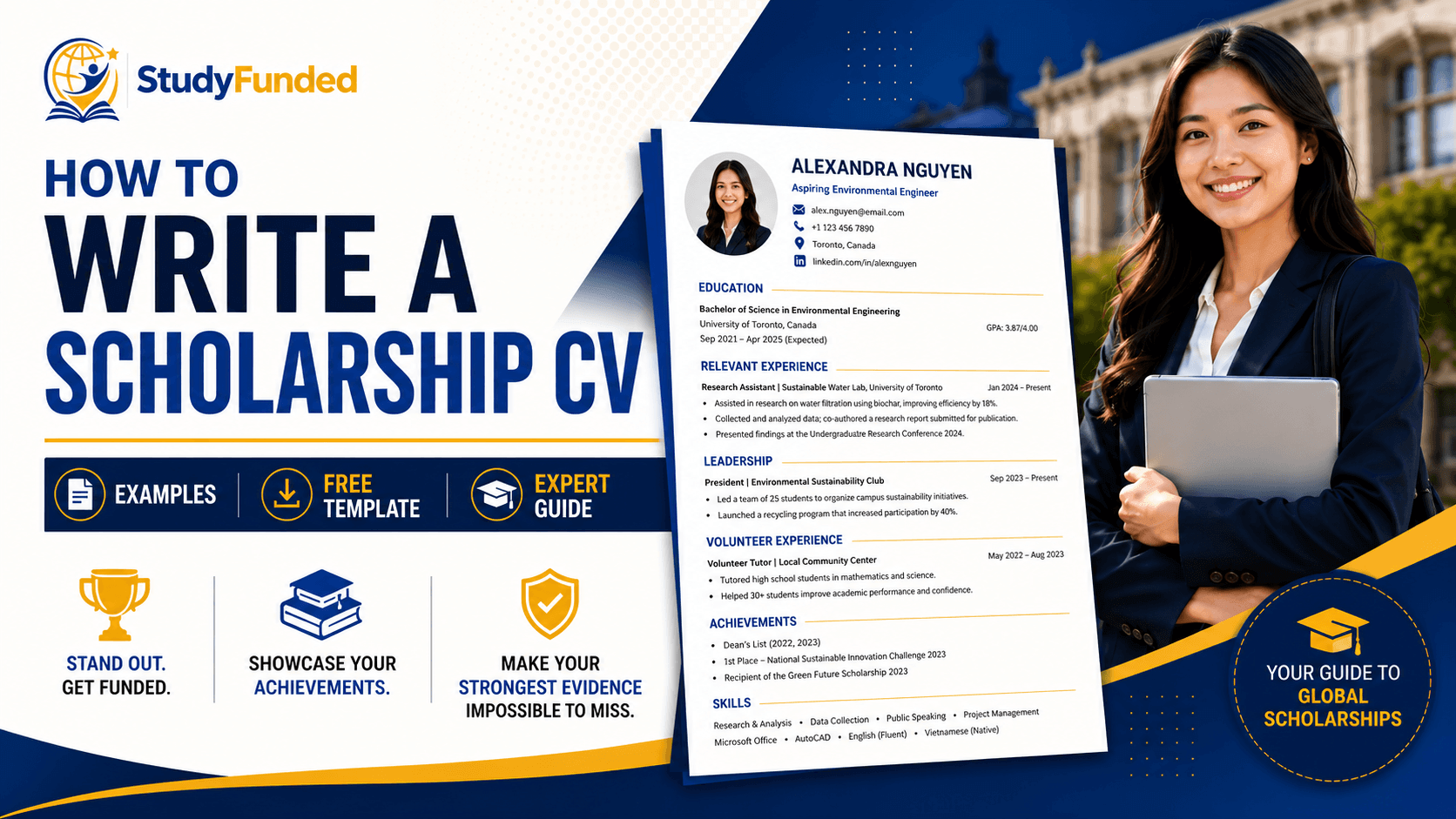
This guide explains how to structure and write a scholarship CV, what to include in each section, how to present your achievements effectively, and how to tailor your CV to different opportunities. It also includes practical examples and a free editable scholarship CV template.
Your CV should complement the other documents in your application. For guidance on presenting your personal experiences and motivation, see How to Write a Winning Scholarship Personal Statement (With Examples).
What Is a Scholarship CV?
A scholarship CV is a curriculum vitae prepared specifically for a scholarship or academic funding application.
Although it may contain many of the same sections as a professional CV, its emphasis is different. It should make it easy for a selection committee to assess your:
- Academic preparation
- Research experience and interests
- Relevant professional experience
- Leadership and initiative
- Community or volunteer involvement
- Awards and achievements
- Publications, projects, or other academic work
- Skills relevant to your proposed programme
Your CV provides evidence of your qualifications and accomplishments. It should help the reviewer understand how your background relates to the opportunity.
What Do Scholarship Committees Look For in a CV?
There is no universal checklist for every scholarship. Some programmes prioritise academic performance and research potential, while others place greater emphasis on leadership, professional experience, or community service.
Your CV should make the evidence most relevant to the particular opportunity easy to find.
Academic Preparation
Include your qualifications, institutions, relevant academic distinctions, and substantial research or project work. Add relevant coursework when it helps demonstrate your preparation for the proposed field.
Relevant Experience
Professional employment, research, teaching, internships, and academic projects can demonstrate that you have already developed useful knowledge and skills.
Leadership and Initiative
Show where you took responsibility, led a team, solved a problem, established an initiative, or contributed to meaningful change.
Achievements
Awards, publications, presentations, completed projects, competitive selections, and measurable improvements provide evidence of what you have accomplished.
Community and Service
Where relevant to the scholarship, include volunteering, mentoring, community development, advocacy, or professional service.
Programme Relevance
The reviewer should be able to see how your previous preparation relates to your intended programme and future goals.
How Long Should a Scholarship CV Be?
There is no universal page limit for every scholarship.
For many applicants, one to two pages may be sufficient. Research-oriented Master’s and PhD applications may require additional pages when the programme permits them and the extra information is relevant.
The objective is not to reach a particular page count. Keep information that helps demonstrate your qualifications and remove details that add little value.
Always follow the scholarship’s specific page limit and formatting instructions when provided.
Scholarship CV vs Résumé: What’s the Difference?
The terms CV and résumé are used differently across countries, institutions, and application systems.
A scholarship may request a CV, résumé, academic CV, or a prescribed format. Do not assume that the document’s name determines its required length or structure.
If the scholarship does not provide a specific format, prepare a clear academic and professional document that prioritises the evidence most relevant to the opportunity.
How to Structure a Scholarship CV
A scholarship CV does not need to contain every possible section. Treat the structure as a flexible framework and include only sections that strengthen your application.
A common structure is:
- Name and contact information
- Professional or academic profile — optional
- Education
- Research experience — where relevant
- Work experience
- Leadership experience — where relevant
- Volunteer or community experience — where relevant
- Projects — where relevant
- Awards and honours
- Certifications — where relevant
- Technical and professional skills
- Publications and conferences — where relevant
- References — only when requested
Reorder the sections according to the scholarship’s priorities. For example, a research-focused applicant may place research experience and publications near the top, while an applicant with substantial leadership experience may give that section greater prominence.
1. Name and Contact Information
Place your full name at the top of the document, followed by the contact details the scholarship requires.
Include:
- Full name
- City and country
- Professional email address
- Phone number, where appropriate
- LinkedIn profile, if relevant
- Portfolio or professional website, if relevant
Use an email address you check regularly.
Unless specifically requested, avoid unnecessary personal information such as marital status, religion, national identification numbers, passport numbers, or salary details.
2. Professional Profile — Optional
A short profile can introduce your academic focus, research interests, or professional direction. It is most useful when it adds information that the rest of the CV does not communicate immediately.
Weak example:
Passionate and hardworking graduate seeking an opportunity to further my education and make a positive impact in society.
This statement is too general to distinguish the applicant.
Stronger example:
Electrical and Electronics Engineering graduate with research interests in renewable energy systems and sustainable power solutions. Interested in expanding access to reliable clean energy through engineering innovation, applied research, and practical energy-system development.
Keep the profile specific and concise. If your education and experience already communicate your direction clearly, you can omit it.
3. Education
For most scholarship applicants, education is one of the most important sections.
List qualifications in reverse chronological order, beginning with the most recent. Include:
- Degree or qualification
- Institution and location
- Dates of study
- CGPA or degree classification, where relevant
- Academic honours, where relevant
- Thesis, dissertation, or final-year project, where relevant
Example
B.Eng. Electrical and Electronics Engineering
University of Example, Nigeria
2019–2024
Second Class Upper Division
Final-Year Project: Designed and evaluated a solar-powered monitoring system for improving energy management in small-scale applications.
The institution, dates, degree classification, and project above are illustrative. Replace them with your actual details.
Do not list every course you have taken. Include coursework only when it helps demonstrate preparation for your proposed programme.
4. Research Experience — Optional
Research experience can be particularly important for research-oriented Master’s and PhD applications.
For each relevant position or project, identify your role, institution, dates, research topic, methods, and contributions.
Example
Research Assistant
Department of Environmental Engineering, University of Example
June 2023 – May 2024
- Collected and analysed field data from 120 household energy-use surveys.
- Developed a dataset used to evaluate household adoption patterns for renewable-energy technologies.
- Presented findings at a departmental research seminar.
This is an illustrative example. Use figures and outcomes only when they accurately reflect your own work.
Publications, conference presentations, laboratory work, and substantial dissertations may also demonstrate research ability. If you have no formal research experience, you can include relevant academic projects elsewhere in the CV rather than creating an empty section.
5. Work Experience
Include professional experience that demonstrates your skills, achievements, responsibilities, or relevance to the scholarship. You do not necessarily need to list every job you have held.
For each position, provide:
Job Title
Organisation | Location
Dates
Use concise bullet points to explain your contributions.
Weak example:
- Responsible for managing customer accounts.
- Responsible for preparing reports.
- Worked with other members of the team.
These statements describe routine duties but provide little evidence of your contribution.
Stronger examples:
- Managed a portfolio of 45 customer accounts and improved follow-up procedures to reduce unresolved service requests.
- Prepared monthly performance reports that helped management identify recurring operational issues.
- Coordinated with a five-member team to improve customer response procedures.
These examples are illustrative. Do not invent numbers or claim results you cannot substantiate. If you do not have measurable outcomes, describe your actual contribution clearly.
6. Leadership Experience — Optional
Scholarships that value leadership need more than a list of titles. Explain what you did in the role and what changed as a result.
Example
President, Engineering Students Association
University of Example
2022–2023
- Led a 12-member executive team responsible for academic and professional development activities.
- Organised three industry-focused events attended by more than 300 students.
- Introduced a peer mentoring programme connecting final-year students with first- and second-year students.
The figures and activities are illustrative. Your own entries should accurately describe your responsibilities and achievements.
7. Volunteer and Community Experience — Optional
Include community or volunteer work when it supports your scholarship application. Relevant activities may include mentoring, educational outreach, non-profit work, community development, advocacy, and professional service.
Example
Volunteer Tutor
Community Learning Initiative
2023–2024
- Provided weekly mathematics tutoring to secondary-school students preparing for national examinations.
- Developed revision materials for students attending weekend sessions.
Focus on your contribution rather than simply naming the organisation.
8. Projects — Optional
Projects can be especially valuable for applicants with limited formal employment or research experience.
For each project, explain what you worked on, your role, the methods or skills you used, and the outcome or significance.
Example
Solar Energy Monitoring System
Final-Year Engineering Project | 2024
- Designed a prototype system for monitoring household solar-energy generation and consumption.
- Applied circuit design, sensor integration, data analysis, and system testing.
- Evaluated the prototype under different operating conditions and documented the results.
Projects do not have to be technical. Academic, research, policy, community, entrepreneurial, and interdisciplinary projects can also strengthen your CV when relevant.
9. Awards and Honours — Optional
Include meaningful academic, professional, leadership, competition, or community awards.
Examples
- Best Final-Year Engineering Project — Faculty of Engineering, University of Example, 2024
- Academic Excellence Award — Engineering Students Association, 2023
- Leadership Recognition Award — Student Development Initiative, 2022
Prioritise distinctions that demonstrate relevant achievements. If an award is unfamiliar, add a brief explanation where necessary.
10. Certifications — Optional
Include credible certifications that add value to your application.
Examples
- AI Career Essentials — ALX, 2025
- Project Management Fundamentals — Example Institute, 2024
- Data Analysis with Excel — Example Academy, 2023
The examples are illustrative. List your actual qualifications and issuing organisations.
Do not fill this section with every short online course you have completed. Relevance and credibility matter more than quantity.
11. Technical and Professional Skills
Keep this section concise and specific.
Instead of listing vague qualities such as “hardworking,” “teamwork,” and “problem-solving” without evidence, identify concrete competencies.
Example
- Software: MATLAB, AutoCAD, Microsoft Excel
- Technical: Solar PV system design, electrical installation, load analysis
- Data: Excel data analysis, basic Python
- Languages: English — Fluent; French — Intermediate
Only claim skills you can genuinely demonstrate. Where a skill is essential to the programme, your experience or project entries should provide supporting evidence.
12. Publications and Conferences — Optional
This section is particularly useful for research-oriented applicants.
List relevant publications, conference papers, presentations, posters, or other academic outputs in a consistent format.
Examples
- Title of Research Paper. Journal of Renewable Energy Studies, 2025.
- Presentation Title. International Conference on Sustainable Energy, 2024.
These are placeholders, not real publications. Include the actual title, publication or event, and date. If you have no publications or conference activity, omit the section.
13. References — Only When Requested
Include references only when the scholarship or application instructions request them.
If required, provide the referee’s:
- Full name
- Position
- Institution or organisation
- Professional email address
- Phone number, where appropriate
Ask permission before listing someone as a referee, and ensure their details are accurate. Do not add “References available upon request” merely to fill space.
For more guidance, see How to Get a Strong Scholarship Recommendation Letter (With Examples).
How to Turn Duties Into Strong Scholarship CV Statements
A useful way to improve your CV is to replace vague descriptions of routine duties with evidence of your contribution.
Use this formula as a guide:
Action + What You Did + Context + Result or Impact
For example:
| Weak statement | Stronger statement |
|---|---|
| Managed social media accounts. | Managed content across three platforms using a structured publishing schedule to improve consistency and audience engagement. |
| Organised student events. | Coordinated student development events and worked with university partners to arrange speakers and logistical support. |
| Helped students with their studies. | Provided weekly academic support to secondary-school students and developed revision materials for examination preparation. |
The stronger versions explain the work more clearly. Where possible, add verifiable results, such as the number of participants, the size of a project, or a measurable improvement.
Do not manufacture statistics. Accurate descriptions of your contribution are more valuable than impressive but unsupported claims.
How to Tailor Your Scholarship CV
Do not submit the same CV to every scholarship without reviewing it first.
Start by checking the scholarship’s:
- Objectives and selection criteria
- Programme requirements
- Requested documents and format
- Intended field of study
- Preferred evidence of academic achievement, research, leadership, or service
Then adjust the order and emphasis of your CV without changing the facts.
For example, a research-focused application might prioritise:
Education → Research Experience → Publications → Projects → Awards
A leadership-focused application might prioritise:
Education → Leadership Experience → Community Experience → Professional Experience → Awards
Applicants with limited employment history can emphasise relevant academic projects, research, volunteering, leadership, awards, and skills. Experienced professionals can give more space to career achievements, projects, leadership, and relevant professional development.
The objective is to make your strongest relevant evidence easy to find.
How to Format Your Scholarship CV
A scholarship CV should be easy to scan. Unless the scholarship specifies otherwise, use a clean, professional layout.
Recommended Formatting
- Name: Approximately 16 pt, bold
- Contact details: Approximately 11 pt
- Section headings: Approximately 12–14 pt, bold
- Institution or position: Approximately 11–12 pt, bold
- Body text: Approximately 10.5–11 pt
- Margins: Approximately 1 inch (2.54 cm)
- Line spacing: Approximately 1.0–1.15
- Font: Calibri, Arial, or another readable professional font
- Colour: Black text is a safe default
These are general recommendations, not universal requirements. Follow the scholarship’s instructions whenever they specify a different format.
If a scholarship specifically requires the Europass format, consult the official Europass CV guidance before preparing your document.
Keep Formatting Consistent
Use a consistent style for dates, job titles, institution names, bullet points, spacing, and section headings.
Avoid excessive colours, decorative graphics, multiple font families, and complicated layouts unless the application specifically calls for them. Save the final document in the file format requested by the scholarship provider.
Common Scholarship CV Mistakes to Avoid
1. Including Irrelevant Information
A long CV is not automatically a strong CV. Remove unrelated work experience, hobbies, certificates, or personal details that do not support your application.
2. Listing Duties Without Showing Contributions
Describe what you accomplished, improved, developed, or contributed rather than simply copying responsibilities from a job description.
3. Using Generic Claims
Statements such as “hardworking,” “passionate,” and “excellent team player” are less persuasive without evidence. Support your claims through relevant experiences and achievements.
4. Using the Same CV for Every Scholarship
Different scholarships may prioritise different qualifications. Adjust the order and emphasis to reflect the selection criteria while keeping every claim accurate.
5. Inventing Achievements or Ignoring Instructions
Never manufacture statistics or exaggerate qualifications. Also check page limits, file formats, naming conventions, and any prescribed structure before submitting.
Free Scholarship CV Template
StudyFunded provides a free editable scholarship CV template to help you organise your qualifications and experience.
Get Your Free Scholarship CV Template
Use the template as a flexible framework. Keep relevant sections, remove those that do not apply to you, and adjust the order to suit the scholarship.
📥 Get Your Free Scholarship CV Template
Keep the sections that strengthen your application, remove sections that do not apply to you, and reorder them according to the priorities of the scholarship or programme.
A free Google account is required to edit and save your copy.
What the Template Includes
- Professional profile
- Education
- Research experience
- Work experience
- Leadership experience
- Volunteer experience
- Projects
- Awards and honours
- Certifications
- Technical and professional skills
- Publications and conferences
- References, where required
How to Use the Template
- Replace the placeholder text with your actual information.
- Remove sections that do not apply to your background.
- Reorder sections according to the scholarship’s priorities.
- Use specific examples and verifiable evidence where available.
- Check the scholarship’s instructions before finalising the document.
- Save the final version in the required format.
What to Leave Out of Your Scholarship CV
Unless the scholarship specifically requests them, you generally do not need:
- Irrelevant work experience
- Hobbies that do not strengthen your application
- Salary or expected salary
- Unnecessary personal details
- Passport or national identification numbers
- Long lists of unrelated certificates
- References when they are not requested
- Unsupported claims about your abilities
The objective is not to produce the longest CV. It is to present the clearest evidence of why your background fits the opportunity.
Final Scholarship CV Checklist
Before submitting your CV, confirm that:
- My name and contact information are accurate.
- My education and qualifications are presented correctly.
- I have included relevant research, projects, leadership, or professional experience.
- My bullet points explain contributions rather than listing only duties.
- I have removed irrelevant information and unsupported claims.
- The order and emphasis reflect the scholarship’s selection criteria.
- Dates, titles, and formatting are consistent.
- Spelling and grammar have been checked.
- Every achievement, number, and qualification is accurate.
- I have followed the required page limit, file format, and submission instructions.
A final review can help you catch errors before they undermine an otherwise strong application.
Final Thoughts
A strong scholarship CV does not need to make you look extraordinary. It needs to make your real preparation, achievements, experience, and potential easy to understand.
Focus on relevance rather than volume. Replace vague claims with evidence, tailor the document to the scholarship, and remove information that does not help the reviewer assess your fit.
Your CV is one part of the application, not the entire application. It should provide a clear record of your qualifications and complement your other documents rather than attempting to tell your entire story.