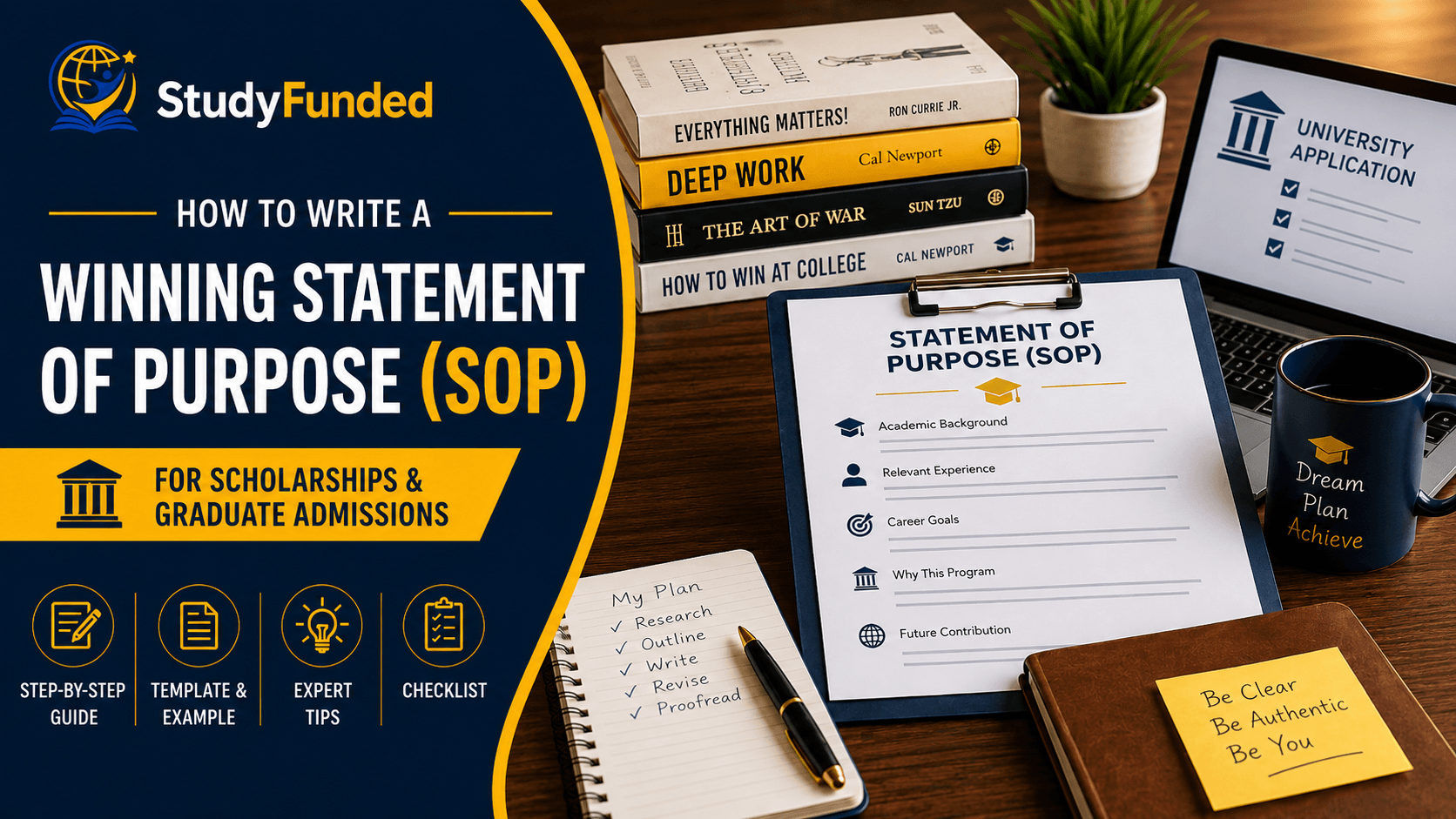
A Statement of Purpose (SOP) helps admissions committees understand your academic background, relevant experience, career goals, and reasons for applying to a particular programme. Unlike a transcript or CV, it allows you to explain how your experiences have prepared you for further study and how the opportunity fits your future plans.
Writing a strong SOP does not require sophisticated vocabulary or a dramatic personal story. It requires clear reasoning, relevant evidence, and a convincing connection between your background and the programme you want to pursue.
In this guide, you’ll learn what an SOP should contain, how to structure one, and how to improve your draft. You’ll also find a practical template, a worked example, common mistakes to avoid, and a final submission checklist.
Quick Answer
To write a strong Statement of Purpose, explain your academic interests, demonstrate your preparation with relevant examples, outline realistic career goals, and show why the programme suits those goals. Follow the application instructions, use specific evidence instead of generic claims, and tailor the final document to each application.
What Is a Statement of Purpose?
A Statement of Purpose is a formal application essay that explains your academic development, relevant experience, future objectives, and reasons for choosing a particular programme.
Your transcript records your academic performance, while your CV summarises your qualifications and achievements. Your SOP connects this information into a clear explanation of your readiness for further study.
A strong SOP does more than list accomplishments. It explains why those experiences matter and how they support your next academic or professional step.
Statement of Purpose vs Personal Statement vs Motivation Letter vs Study Plan
These documents may overlap, and some institutions use their names interchangeably. However, they can serve different purposes.
| Document | Primary focus | Common uses |
|---|---|---|
| Statement of Purpose (SOP) | Academic preparation, career goals, and programme fit | Master’s and PhD applications, graduate scholarships |
| Personal Statement | Personal experiences, values, and character | University admissions and some scholarships |
| Motivation Letter | Interest in a specific opportunity | Scholarships, internships, and exchange programmes |
| Study Plan | Academic objectives and proposed study or research direction | Government scholarships and research programmes |
A useful distinction is the main question each document answers:
- SOP: How have your experiences prepared you for this programme, and why does it fit your goals?
- Personal Statement: What experiences have shaped you and your values?
- Motivation Letter: Why are you interested in this particular opportunity?
- Study Plan: What do you intend to study, and how will you approach it?
Always follow the institution’s instructions. The required content matters more than the document’s title.
If you’re preparing a personal statement rather than an SOP, our guide to How to Write a Winning Scholarship Personal Statement (With Examples) explains how to approach that document.
What Admissions Committees Look For
Admissions committees want evidence that you are prepared for the programme, understand your academic direction, and have realistic reasons for applying. Your SOP should address six important areas.
1. Clear Academic Motivation
Explain how your interest in the field developed. Use a relevant course, research experience, project, or professional responsibility to demonstrate that your interest has a foundation.
Avoid relying on statements such as “I have always been passionate about this subject” without explaining what supports that claim.
2. Relevant Preparation
Discuss the coursework, research, employment, internships, projects, or training that have prepared you for further study. Select experiences that demonstrate relevant knowledge, skills, or readiness rather than listing everything you have done.
3. Well-Defined Career Goals
Explain what you hope to achieve after graduation and how the programme will help you progress. Your goals should connect logically to your background and the training you intend to receive.
4. Strong Programme Fit
Show that you have researched the institution and programme. Relevant courses, faculty expertise, research facilities, or programme objectives can help explain why the opportunity suits your interests.
Mention only details you have verified and can connect meaningfully to your plans.
5. Authenticity
Use your actual experiences and achievements. Avoid exaggerated claims, invented accomplishments, and clichés that could describe almost any applicant.
6. Clear Communication
Organise your ideas logically and use concise, professional language. Each paragraph should contribute something important to your explanation of academic preparation, programme fit, or future goals.
How to Write a Strong Statement of Purpose: Five Steps
Step 1: Understand the Application Requirements
Read the instructions before writing. Confirm the required word count, formatting rules, submission method, and any specific questions the institution expects you to answer.
Then identify the experiences and achievements most relevant to the application. This will help you avoid including details simply because they are impressive or personally important.
Step 2: Explain Your Academic Development
Introduce your academic interests and show how your education or experience prepared you for the proposed programme.
Instead of listing qualifications, explain the experiences that influenced your direction or helped you develop relevant skills. If you discuss a project or research experience, clarify what you did and what you learned from it.
Step 3: Connect Your Background to Your Career Goals
Describe your short- and long-term objectives. Explain how the proposed study will help you develop the knowledge, skills, or expertise needed to pursue them.
Keep your goals specific enough to be meaningful but realistic enough to follow from your previous experience.
Step 4: Explain Why You Chose the Programme
Identify the programme features that make it relevant to your goals. These might include particular courses, research opportunities, faculty expertise, or specialist facilities.
Avoid generic praise such as calling a university “world-class” without explaining why its specific programme is suitable for you.
Step 5: Write a Focused Conclusion
End by reinforcing the connection between your preparation, goals, and chosen programme. Avoid introducing new achievements or repeating your entire introduction.
Your conclusion should leave the reader with a clear understanding of why you are applying and what you hope to accomplish.
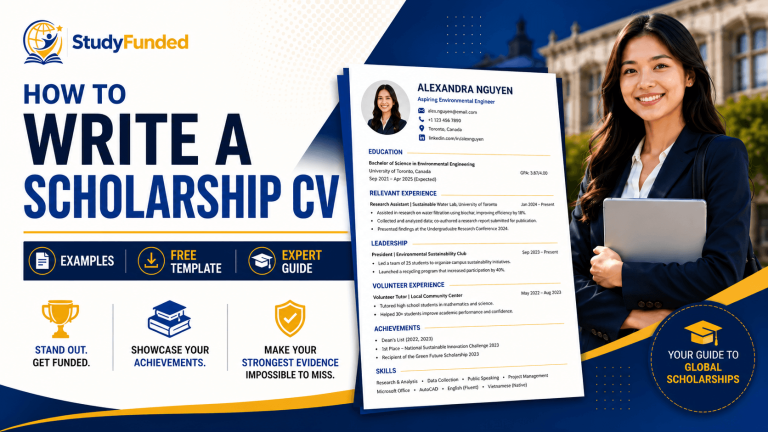
Your SOP should complement your academic CV rather than repeat it. For help preparing that document, see our guide to How to Write a Scholarship CV (With Examples & Free Template).
Statement of Purpose Template
Use this six-part structure as a starting point. Adapt it to the application requirements rather than treating it as a rigid formula.
- Introduction: Introduce your academic interest and the reason you want to pursue the programme.
- Academic Background: Explain the education, coursework, research, or training that prepared you.
- Relevant Experience: Discuss selected projects, employment, internships, or other experiences that support your application.
- Career Goals: Outline your future objectives and connect them to the proposed study.
- Why This Programme: Explain how the programme’s verified features align with your academic interests and goals.
- Conclusion: Reinforce your readiness and motivation.
Not every SOP needs six separate paragraphs. Follow the required format and give more space to the areas most relevant to your application.
Statement of Purpose Example
The following sample illustrates how an applicant can connect academic motivation, practical experience, programme fit, and career goals. Use it to understand the structure and reasoning, not as a statement to copy. Replace its details with your own experiences and the specific programme you intend to pursue.
Sample Statement of Purpose
Growing up in a community where unreliable electricity affected education, healthcare, and small businesses inspired my interest in renewable energy. During my undergraduate studies in Electrical and Electronic Engineering, I developed this interest through coursework, research, and practical projects focused on improving energy reliability. These experiences strengthened my technical skills and confirmed my desire to pursue advanced study in Renewable Energy Engineering.
Beyond the classroom, I gained practical experience working on renewable energy projects that exposed me to the challenges of designing reliable power systems for underserved communities. These opportunities improved my problem-solving, teamwork, and project management skills while reinforcing my commitment to developing sustainable energy solutions.
I am applying for this Master’s programme because its emphasis on renewable energy research and practical innovation aligns with my academic interests and long-term career goals. Learning from researchers and collaborating on relevant projects would help me develop the expertise needed to contribute to expanding access to clean, reliable electricity in developing countries.
After completing my studies, I intend to apply the knowledge and skills I gain to support sustainable energy development through research, policy, and engineering practice. I hope to use the programme as a foundation for contributing to the energy sector and the communities I aim to serve.
The example establishes the applicant’s motivation, demonstrates relevant preparation, explains programme fit, and connects the proposed study to future goals. In a real application, the programme-fit paragraph should name verified features of the actual course.
Tips to Make Your Statement of Purpose Stronger
Replace Generic Claims with Specific Evidence
Broad claims are less persuasive when they lack supporting examples. Show the reader what you did, learned, or achieved.
| Weak statement | Stronger alternative |
|---|---|
| “I have always been passionate about engineering.” | “My interest in engineering developed through practical projects that showed me how reliable energy systems can improve everyday life.” |
| “This university is one of the best in the world.” | “The programme’s research in smart-grid technologies aligns with my goal of improving electricity infrastructure in developing communities.” |
| “I am hardworking and determined.” | “Balancing full-time work with my final year of study strengthened my time-management skills while I completed my academic responsibilities.” |
Use measurable results when they are available and relevant. Never invent figures or achievements to make an example sound more impressive.
Use AI to Improve Your Draft, Not Invent Your Story
AI tools can help you brainstorm, improve grammar, refine sentence structure, identify repetition, and review clarity. However, the experiences, achievements, and goals in your SOP must be accurate and genuinely yours.
Do not use AI to invent qualifications, exaggerate your responsibilities, or generate generic paragraphs that you cannot substantiate. Check the university’s rules on AI assistance and follow any disclosure requirements.
Treat AI as an editing aid, not a substitute for your own judgement or the institution’s application instructions.
Common Statement of Purpose Mistakes to Avoid
1. Writing a Generic Statement
An SOP that could be sent unchanged to several universities does not demonstrate a clear understanding of the chosen programme.
Instead: Identify specific, verified programme features and explain how they connect to your goals.
2. Repeating Your CV
Simply listing qualifications and responsibilities wastes space that could explain your readiness for further study.
Instead: Select relevant experiences and explain what they taught you or how they prepared you for the programme.
3. Making Unsupported Claims
Calling yourself passionate, hardworking, or exceptionally qualified does not establish that those descriptions are accurate.
Instead: Support your claims with concrete examples from academic, professional, research, or leadership experiences.
4. Ignoring the Application Requirements
A well-written SOP can still fail to meet the application requirements if it exceeds the word limit or overlooks a required question.
Instead: Check the instructions before writing and review them again before submission.
5. Submitting Without Editing
Repetition, unclear transitions, grammatical errors, and unnecessarily complicated sentences can weaken your message.
Instead: Revise the draft for content and structure first, then proofread it. Where possible, ask a trusted lecturer or mentor to review the final version.
SOP Submission Checklist
Before submitting your Statement of Purpose, check each item:
- Have I explained my academic interests and motivation?
- Have I selected experiences relevant to this application?
- Are my career goals realistic and connected to the programme?
- Have I explained why this specific programme is suitable?
- Have I followed the required word count and formatting?
- Does the SOP complement my CV instead of repeating it?
- Have I removed generic claims and unnecessary repetition?
- Have I checked spelling, grammar, and clarity?
- Have I answered all required questions?
- Have I followed the institution’s submission and AI-use rules?
If you need a recommendation letter for the same application, read our guide to How to Get a Strong Scholarship Recommendation Letter (With Examples).
Frequently Asked Questions About Statement of Purpose
How Long Should a Statement of Purpose Be?
Some universities and scholarship providers request around 500–1,000 words, while others specify a different length or format. Follow the instructions for your particular application rather than treating a general word range as a universal rule.
Can I Use the Same SOP for Multiple Applications?
You can reuse relevant background information and core career goals, but you should tailor each SOP to the specific programme. Update the programme-fit discussion and any other details required by the application.
Is a Statement of Purpose the Same as a Personal Statement?
Not always. Some institutions use the terms interchangeably, while others expect different content. Check the application instructions to determine which document is required. Our scholarship personal statement guide explains the different approach that document may require.
Can I Use AI to Help Write My SOP?
AI can help you improve grammar, clarity, organisation, and readability. Your experiences and claims must remain accurate, and you should follow the institution’s rules on AI-assisted writing.
Final Thoughts
A strong Statement of Purpose connects your academic preparation, relevant experience, career goals, and chosen programme into one clear argument. Start with the application requirements, use specific evidence to support your claims, and revise until every paragraph serves a purpose.
Remember that your SOP should complement your CV and recommendation letters, not repeat them. It should help the admissions committee understand your readiness for further study, why you have chosen the programme, and how it fits your future plans.
A well-written SOP cannot guarantee admission or a scholarship, but it can help reviewers understand your potential beyond your grades and qualifications.
A great Statement of Purpose doesn’t try to impress admissions committees with elaborate language. It helps them understand why you’re prepared for the opportunity and what you intend to do with it.
For additional guidance on academic writing and editing, consult Purdue OWL.