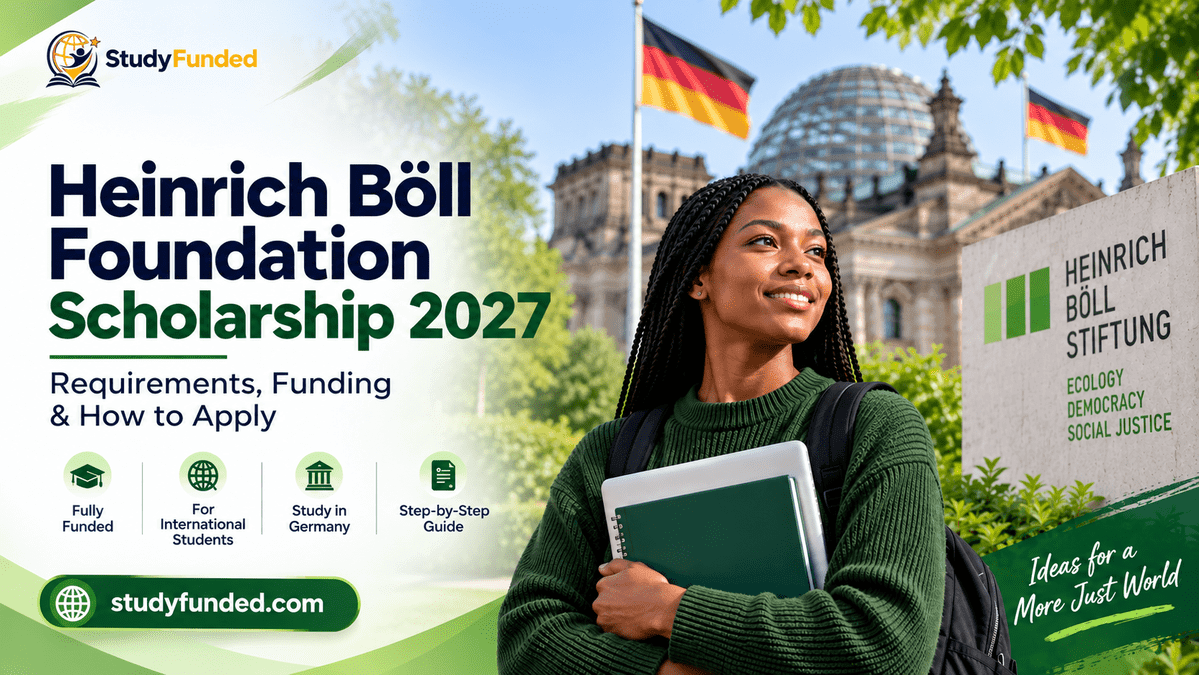
The Heinrich Böll Foundation Scholarship provides financial support to selected students and doctoral candidates pursuing full-time study in Germany. For international applicants, academic performance is only part of the picture. The Foundation also considers social engagement, political interest, and the reasons behind an applicant’s choice of programme.
One requirement that can easily catch international applicants off guard is the German-language requirement. The Foundation currently requires international applicants to demonstrate B2 or DSH II-level German, even when their intended degree programme is taught in English.
The 2027 cycle also introduces an important change for Master’s applicants: from the March 1, 2027 application round, international Master’s applications will be limited to first-cycle Master’s programmes.
This guide covers the scholarship’s funding, eligibility requirements, documents, 2027 deadlines, application process, selection stages, and practical ways to build a stronger application.
Heinrich Böll Foundation Scholarship at a Glance
| Programme Feature | Current Details |
|---|---|
| Scholarship provider | Heinrich Böll Foundation |
| Study destination | Germany |
| International applicants | Yes |
| Study levels | Master’s and PhD |
| Study mode | Full-time study |
| University requirement | State-recognized university in Germany |
| Application method | Online |
| Application rounds | Two per year |
| 2027 application windows | January 15–March 1 and July 15–September 1 |
| German requirement | B2 / DSH II |
The Foundation has separate provisions for international Master’s and PhD applicants. Because requirements and deadlines can change between cycles, always confirm the current information before submitting an application.
What Is the Heinrich Böll Foundation Scholarship?
The Heinrich Böll Foundation awards scholarships to students and doctoral candidates whose academic work is accompanied by social engagement and an interest in political and societal issues.
For international applicants, the scholarship can support full-time Master’s or PhD study at a state-recognized university in Germany, subject to the requirements for the relevant applicant category. International applicants from DAC countries receive particular consideration under the Foundation’s current provisions.
The programme therefore differs from scholarships that assess applicants primarily through grades and academic credentials.
The Foundation’s published selection information highlights academic performance, social commitment, political interest, and convincing reasons for applying among the factors considered during selection.
A competitive application should connect your academic preparation with your experience, engagement, proposed study, and future direction.
What Does the Scholarship Cover?
Financial support varies according to the applicant’s category and individual circumstances. The Foundation publishes different scholarship rates and additional allowances, so recipients should not assume that everyone receives exactly the same amount.
For international Master’s students, the current funding information includes a basic monthly scholarship, with additional support potentially available for areas such as health insurance and other eligible costs.
The scholarship therefore provides substantial financial support toward study and living expenses in Germany, but the exact amount and applicable allowances depend on the recipient’s circumstances and current funding regulations.
Is the Heinrich Böll Foundation Scholarship Fully Funded?
The scholarship is best understood as a comprehensive funding package, rather than a guarantee that every possible expense will be covered for every recipient.
Check the current funding regulations for your applicant category before making your financial plans.
Who Can Apply for the Scholarship?
The Foundation has separate requirements for international Master’s and PhD applicants.
International Master’s Applicants
Students who have completed their first degree abroad can apply for funding for a Master’s programme in Germany, provided they meet the relevant requirements.
The intended programme must be full-time at a state-recognized university in Germany, and the Foundation currently states that the Master’s programme must have a standard duration of at least four semesters.
A significant change applies to the 2027 cycle:
Important: From the March 1, 2027 application round, the Foundation states that international Master’s applications will only be accepted for first-cycle Master’s programmes. Check the current official definition and requirements before submitting your application.
Applicants from DAC countries who have not yet taken up residence in Germany receive particular consideration under the Foundation’s current scholarship provisions.
International PhD Applicants
Those who completed their graduate degree abroad can also apply for funding for doctoral study in Germany, subject to the Foundation’s current requirements.
As with Master’s applicants, candidates from DAC countries who have not yet taken up residence in Germany receive particular consideration under the Foundation’s current scholarship provisions.
Heinrich Böll Foundation Scholarship Requirements
Meeting the formal requirements does not guarantee selection. A strong application should demonstrate that your academic background, engagement, and proposed study form a convincing fit.
Academic Performance
The Foundation considers academic performance, but it does not publish one universal minimum GPA that automatically determines eligibility.
Present your academic record as part of the wider case for your application rather than treating grades as the only measure of your suitability.
Social Commitment
Social engagement is one of the Foundation’s published selection criteria. Demonstrate meaningful involvement rather than simply stating that you care about social issues.
Relevant evidence could include community involvement, civic activities, professional initiatives, volunteering, advocacy, or other sustained contributions.
Focus on what you did, who benefited, and what changed rather than relying on broad claims about your commitment to social change.
Political and Social Interest
The Foundation also considers political interest.
You do not need to manufacture political activities that are not part of your background. Instead, discuss genuine interests and experiences that demonstrate your awareness of issues affecting your community, profession, country, or wider society.
Do You Need German if Your Degree Is Taught in English?
Yes.
The Foundation currently requires international applicants to demonstrate B2 or DSH II-level German proficiency, even when the intended degree programme is taught in English. It also states that selection interviews are generally conducted in German.
Finding an English-taught Master’s programme therefore does not remove the Foundation’s German-language requirement.
If you are comparing German scholarship opportunities based on language requirements, see our guide to Study in Germany Without IELTS: Scholarships, Requirements & Alternatives. IELTS and German proficiency are separate requirements, so meeting one does not automatically satisfy the other.
What Documents Do You Need?
Prepare the documents required for your applicant category before starting the application. The Foundation’s current application information includes academic documentation, an expert report, a reference concerning your social engagement, and proof of German-language proficiency for international applicants.
Depending on your stage of study and applicant category, you may also need documentation relating to university admission or enrolment.
Academic Documents
Prepare clear copies of the academic documents requested in the current application instructions, including evidence of your previous degree and academic performance.
Your CV should complement these records rather than substitute for them.
Expert Report and Reference
The application includes an expert report and a reference concerning your social commitment.
Choose people who can provide specific evidence about your academic ability, development, and engagement rather than simply confirming that you are a good candidate.
For additional guidance, see How to Get a Strong Scholarship Recommendation Letter.
Proof of German Proficiency
International applicants must provide evidence of the required German proficiency. The Foundation currently specifies B2 or DSH II.
Because this is an eligibility requirement, plan your language preparation well before the application deadline.
Admission or Enrolment Evidence
The timing of university admission documentation can depend on your application stage. The Foundation’s current information allows certain applicants to submit their certificate of enrolment or university admission confirmation later, but they must provide it by the specified stage of the selection process.
Always follow the instructions for your specific application round rather than relying on an older checklist.
Heinrich Böll Foundation Scholarship 2027 Deadlines
The Foundation currently lists two application windows for 2027:
| 2027 Application Round | Application Period |
|---|---|
| Spring round | January 15 – March 1, 2027 |
| Fall round | July 15 – September 1, 2027 |
Confirm the current deadline on the official Heinrich Böll Foundation website before submitting your application.
Start early. Preparing documents, obtaining references, and completing the online application can take considerably longer than expected.
How to Apply for the Heinrich Böll Foundation Scholarship
Submit your application online through the official Heinrich Böll Foundation application portal.
1. Confirm Your Eligibility
Check your study level, academic status, country or applicant category, German-language proficiency, and the requirements applicable to your intended programme.
2. Check the Current Application Requirements
Read the instructions for the specific application round carefully. Requirements can differ between applicant categories, so do not rely on a generic checklist from another scholarship website.
3. Prepare Your Documents
Obtain your academic records, references, expert report, language evidence, and any other required documents before beginning the final submission.
4. Register in the Online Portal
The Foundation states that registration opens approximately six weeks before the application deadline.
Register early so you have time to resolve any issues before the submission window closes.
5. Complete the Application
Enter your information carefully and upload the required supporting documents.
Make sure your responses connect your academic background, social engagement, proposed studies, and reasons for applying.
6. Submit Before the Deadline
Review the completed application and confirm that all required fields and documents are present before submitting.
Keep copies of your application and supporting documents for your records.
How Does the Heinrich Böll Foundation Selection Process Work?
The Foundation’s selection process has three stages.
Stage 1: Review of the Written Application
The initial application is assessed against the Foundation’s requirements and selection criteria.
Academic performance, social commitment, political interest, and convincing reasons for applying are among the factors identified by the Foundation.
Stage 2: Interview With an Academic Adviser
Candidates who progress attend an interview with a liaison lecturer or academic adviser.
Prepare to discuss your academic background, proposed study, professional direction, and motivation.
You should be able to explain not only what you want to study, but why that field matters to your development and future plans.
Stage 3: Selection Committee Interview
The final stage involves an interview with a selection committee.
International applicants should remember that the Foundation states that selection interviews are generally conducted in German.
How Should You Prepare?
Rather than memorising artificial answers, understand your application well enough to discuss your experiences naturally and support your claims with specific examples.
Be prepared to explain:
- Why you chose your field of study
- How your academic background prepared you for it
- What your social or civic engagement has involved
- What you want to achieve through your studies
- Why the Heinrich Böll Foundation is a suitable fit
- How you intend to use your education and experience in the future
Your written application, supporting documents, and interview responses should tell the same underlying story.
How to Build a Strong Heinrich Böll Foundation Scholarship Application
Formal eligibility is only the starting point. A strong application should connect your academic background, social engagement, proposed studies, and future direction.
Connect Your Academic Background to Your Goals
Explain why your proposed field of study makes sense given what you have already studied, researched, or experienced.
For example, instead of writing:
“I want to study environmental policy because I am passionate about climate change.”
Show the connection:
“My undergraduate research examined the challenges of waste management in my community, while my subsequent work with a local environmental initiative exposed me to the limitations of existing municipal policies. I now want to develop the policy expertise needed to contribute to more effective waste-management systems.”
This example gives the reviewer a clearer picture of how previous experience has led to the proposed field of study.
Show Your Social Engagement With Evidence
A statement such as:
“I have always wanted to make a difference in my community.”
does not tell the reviewer much about your actual contribution.
Instead, identify:
- What problem did you identify?
- What action did you take?
- Who benefited?
- What responsibility did you personally assume?
- What changed as a result?
Your involvement does not need to come from a formal political organisation. Community work, volunteering, professional initiatives, advocacy, mentoring, and other sustained contributions may provide relevant evidence.
Do not invent activities simply because you believe they will impress the Foundation. A modest but genuine contribution is more credible than an exaggerated record.
Explain Why the Heinrich Böll Foundation
Avoid treating the scholarship as interchangeable with every other funding opportunity in Germany.
Show that you have considered what the Foundation represents and why its scholarship programme fits your academic and personal direction.
Instead of simply saying:
“The scholarship will help me study in Germany and achieve my career goals.”
explain how your proposed studies, engagement with social or political issues, and future plans connect with the kind of development you seek through the programme.
Prepare for the Interviews
If you reach the interview stages, expect to discuss themes already presented in your written application.
Review your application beforehand and be ready to explain the experiences behind your academic interests, social engagement, and future plans.
A useful way to organise your thinking is:
Experience → Lesson → Development Need → Relevance → Future Application
You do not need to memorise a speech. Understand your application well enough to explain your experiences naturally and support your answers with specific examples.
That is enough. It fixes the repetitive “What…” openings, keeps the original section’s size and purpose, and avoids turning a short interview-preparation subsection into another mini-guide.
Mistakes to Avoid in Your Application
Some mistakes apply to almost every scholarship application, so rather than repeating them here, see our guide to Common Scholarship Application Mistakes.
For the Heinrich Böll Foundation specifically, pay particular attention to:
- Ignoring the German-language requirement: An English-taught degree does not remove the current B2/DSH II requirement for international applicants.
- Relying only on academic results: The Foundation also considers social commitment, political interest, and reasons for applying.
- Using vague claims about social engagement: Give concrete evidence of your actual contribution.
- Using outdated information: Check the requirements and deadlines for the specific 2027 application round.
Your objective is not to make every sentence sound impressive. It is to present a credible, coherent application supported by evidence.
Heinrich Böll Foundation Scholarship: Frequently Asked Questions
Can international students apply for the Heinrich Böll Foundation Scholarship?
Yes. The Foundation has scholarship provisions for international Master’s and PhD applicants, subject to the requirements for the relevant applicant category.
Do I need German if my Master’s programme is taught in English?
Yes. The Foundation currently requires international applicants to demonstrate B2 or DSH II-level German, even when the intended degree programme is taught in English.
Does the scholarship have a minimum GPA?
The Foundation does not publish one universal minimum GPA for all applicants. Academic performance is considered alongside the applicant’s broader circumstances and other selection criteria.
When can I apply for the 2027 scholarship?
The Foundation currently lists two 2027 application windows: January 15–March 1, 2027, and July 15–September 1, 2027. Always verify the current dates before applying.
Final Takeaway
The Heinrich Böll Foundation Scholarship is not simply an opportunity to receive funding for study in Germany. Its selection criteria also place importance on social commitment, political interest, academic performance, and convincing reasons for applying.
Your strongest application will connect what you have already studied and done with what you want to learn, why that development matters, and how you intend to use it afterward.
Before applying, check the latest requirements, deadlines, and application instructions directly with the Heinrich Böll Foundation.