An Erasmus Mundus Scholarship can help international students pursue a Master’s degree through an Erasmus Mundus Joint Master (EMJM), an international programme delivered by a consortium of higher education institutions.
These programmes can allow students to study at multiple institutions and in different countries. Competitive Erasmus Mundus scholarships can also provide substantial financial support to selected students.
However, Erasmus Mundus is not one scholarship with one universal application form, deadline, or eligibility checklist. Each Joint Master’s programme has its own consortium, curriculum, mobility structure, admission requirements, and application process.
That makes programme selection an important part of the application. Before preparing your CV or motivation letter, you need to establish whether the programme fits your academic background, experience, and career direction.
This guide explains how Erasmus Mundus Joint Masters work, how to find suitable programmes, what requirements to check, how scholarships work, and how to prepare and submit your application.
What Is an Erasmus Mundus Joint Master?
An Erasmus Mundus Joint Master (EMJM) is an international Master’s programme delivered by a consortium of higher education institutions.
Unlike a conventional Master’s programme at one university, an EMJM can involve study periods at different participating institutions and in different countries. The exact mobility pathway depends on the individual programme.
Students may receive a joint or multiple Master’s degree, depending on the programme’s structure.
An Erasmus Mundus Joint Master normally lasts one to two academic years and can carry 60, 90, or 120 ECTS credits. Current Erasmus+ information also requires participating programmes to include study periods in at least two countries, subject to the programme rules.
When you apply, you are therefore choosing both an academic programme and, where available, its associated scholarship opportunity.
How Erasmus Mundus Scholarships Work
Erasmus Mundus scholarships are attached to eligible Joint Master’s programmes rather than offered through one central scholarship application.
A programme may offer a limited number of competitive scholarships to selected students. Therefore, eligibility for a Joint Master’s does not automatically guarantee a scholarship.
You normally apply directly to the consortium responsible for the programme, following its published instructions.
Two Erasmus Mundus programmes can have different:
- Admission requirements
- Academic prerequisites
- Language requirements
- Application documents
- Deadlines
- Selection procedures
- Scholarship arrangements
For that reason, do not rely on a general Erasmus Mundus checklist when applying. The current information published by the individual programme should remain your final reference.
What Does an Erasmus Mundus Scholarship Cover?
For eligible Erasmus Mundus Joint Masters, scholarships can provide substantial financial support.
Depending on the applicable funding conditions, support can contribute to:
- Travel
- Visa-related costs
- Installation expenses
- Living costs
- Insurance
- Other eligible costs associated with the study period
The current Erasmus+ programme information sets the EU scholarship contribution at €1,400 per month for up to 24 months, depending on the duration and conditions of the Master’s programme.
Erasmus Mundus scholarship holders also benefit from specific programme funding conditions, including protection against student application fees and tuition or mandatory participation costs charged by selected projects.
However, you should not assume that every student receives the same funding package. Always check the scholarship arrangements for the specific Joint Master’s programme.
How to Find Erasmus Mundus Joint Master’s Programmes
Finding the right programme involves more than searching for “Erasmus Mundus scholarships.”
The official Erasmus Mundus catalogue provides a starting point for discovering eligible Joint Master’s programmes. Once you find a programme that interests you, move to its official website and verify the current requirements.
A useful rule is:
Catalogue = discovery. Programme website = verification.
Start With the Official Programme Catalogue
Use the official catalogue to identify programmes related to your academic background, career interests, and intended field of study.
At this stage, check:
- Programme subject
- Participating universities
- Degree structure
- Countries involved
- General programme description
- Scholarship availability
Then visit the individual programme website before making any application decisions.
Search Beyond Your Exact Degree Title
One easy way to miss a suitable programme is to search only for the exact name of your Bachelor’s degree.
For example, an Electrical and Electronics Engineering graduate interested in renewable energy could search only for:
“Electrical Engineering”
and miss programmes described as:
Renewable Energy Systems
Sustainable Energy Systems
Smart Energy
Energy and Environmental Engineering
The same principle applies to other disciplines.
A Computer Science graduate, for example, may find relevant programmes under Artificial Intelligence, Data Science, Cybersecurity, or related fields.
Use broader subject searches to discover programmes, then use the admission requirements to determine whether your academic background qualifies.
Verify the Programme Website
Once you find a promising programme, check its official website carefully.
Confirm:
- Academic eligibility
- Required subjects or coursework
- Curriculum
- Mobility structure
- Language requirements
- Required documents
- Application procedure
- Scholarship availability
- Application deadline
Also confirm that the programme is accepting applications for the intake you intend to join.
This verification step can prevent you from spending time preparing an application for a programme you do not qualify for.
How to Choose the Right Erasmus Mundus Programme
Finding several programmes that look interesting is only the beginning.
A strong programme choice should make sense across four areas:
Academic Fit → Experience Fit → Career Fit → Evidence Fit
Check the Mobility Structure
Do not evaluate an Erasmus Mundus programme simply by counting the number of countries involved.
Instead, examine what each participating institution contributes to the programme.
Ask:
- Which universities host each study period?
- What subjects does each institution teach?
- Where does the programme’s specialisation take place?
- Does the mobility pathway support your academic interests?
- Where can you conduct research or complete your thesis?
A programme involving three countries is not automatically more suitable than one involving two.
The important question is whether the mobility structure adds meaningful academic value to your goals.
Test Your Academic Fit
Your previous degree should provide a credible foundation for the programme.
Read the admission requirements carefully rather than relying on the programme title.
Check whether your degree and coursework satisfy the stated academic requirements.
Some programmes may require specific subjects, credits, academic preparation, or a particular disciplinary background.
Assess Your Experience Fit
Your academic, professional, research, or project experience can strengthen your application when it relates directly to the programme.
Ask:
Can I demonstrate that my previous experience has prepared me for this particular Joint Master’s?
For example, an applicant with an engineering background and practical experience in energy systems may have relevant preparation for a renewable-energy programme if the application clearly connects that experience with the proposed course.
The important factor is not simply having experience. It is relevance.
Consider Your Career Fit
A suitable programme should also make sense in relation to your future direction.
Ask:
Can I explain how this Joint Master’s supports my intended career direction?
You do not need to predict your entire career. However, your application should establish a credible connection between what you have done, what you want to study, and what you intend to do afterward.
Check Your Evidence Fit
Finally, consider whether your application contains evidence to support your claims.
If you describe yourself as experienced in a particular area, can your CV, academic record, projects, employment history, or other documents demonstrate that experience?
If you explain why a particular specialisation matters to your career, can you support that explanation with specific examples?
This is where programme fit becomes more than a good-sounding story. Your application should contain evidence that makes the story credible.
Erasmus Mundus Application Requirements
There is no universal application checklist for every Erasmus Mundus Joint Master.
Depending on the programme, you may need:
- A qualifying Bachelor’s degree or equivalent
- Academic transcripts
- Degree certificate or proof of graduation
- Curriculum vitae
- Motivation letter or statement
- Language proficiency evidence
- Recommendation letters
- Passport or identification document
- Evidence of relevant academic or professional experience
- Additional programme-specific documents
Some programmes may also impose subject prerequisites, minimum academic standards, language conditions, or other eligibility requirements.
Final-year Bachelor’s students may qualify for some programmes if they can complete their degree before the required enrolment date.
Always check the current requirements of the specific Joint Master’s programme rather than assuming that another Erasmus Mundus programme follows the same rules.
How to Prepare Your Erasmus Mundus Application
Once you have selected a suitable programme, your application materials should reinforce the case for your programme fit.
CV and Europass
Some Erasmus Mundus programmes may request or accept a Europass CV, but Europass is not automatically compulsory for every programme.
Follow the consortium’s stated CV format, page limit, or template.
Whatever format the programme requires, tailor your CV to the programme rather than submitting the same generic document everywhere.
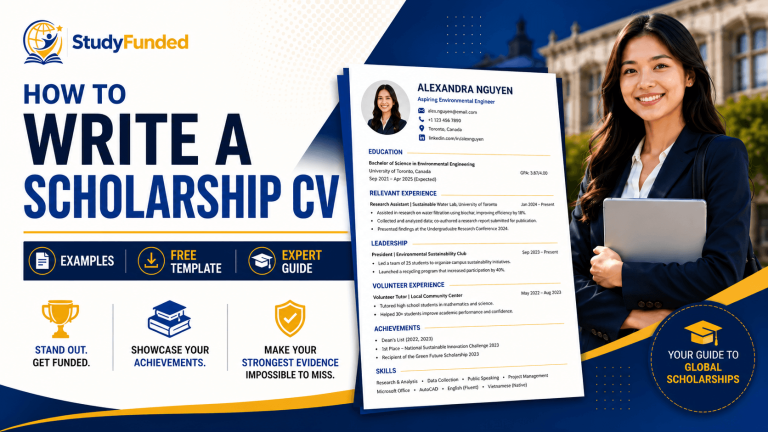
For detailed guidance, see our How to Write a Scholarship CV guide.
Motivation Letter
If the programme requires a motivation letter, use it to explain why the particular Joint Master’s fits your academic background, experience, and career direction.
Focus on specific features of the programme, such as its curriculum, specialisation, mobility structure, or research opportunities.
Avoid submitting a generic explanation of why you want to study in Europe.
For detailed guidance, see our Scholarship Personal Statement and Statement of Purpose (SOP) Guide resources.
Recommendation Letters
Where recommendations are required, follow the consortium’s instructions carefully.
Choose referees who can provide relevant evidence of your academic, professional, or research preparation.
For broader guidance, see our Scholarship Recommendation Letter guide.
How to Apply for an Erasmus Mundus Scholarship
Apply through the individual Joint Master’s programme according to its published instructions.
1. Identify the Programme
Start with the official Erasmus Mundus programme catalogue and create a shortlist of programmes that match your background and goals.
2. Read the Official Programme Requirements
Visit the programme’s official website and read the current eligibility, admission, scholarship, and application instructions.
Do not rely on an old blog post or a general Erasmus Mundus checklist when the programme provides its own current instructions.
3. Confirm Your Eligibility
Check:
- Your degree background
- Academic requirements
- Language requirements
- Nationality or residency conditions, where applicable
- Subject prerequisites
- Graduation requirements
If you are unsure whether your degree qualifies, examine the programme’s stated subject and coursework requirements carefully.
4. Prepare Your Documents
Prepare each document according to the consortium’s format and submission requirements.
Check file types, page limits, translations, certifications, and other instructions before uploading your application.
5. Complete the Consortium’s Application
Complete the application according to the programme’s instructions and upload the required documents in the specified format.
6. Submit Before the Deadline
Erasmus Mundus deadlines are set by individual Joint Master’s programmes and can differ from one consortium to another.
There is therefore no single universal Erasmus Mundus application deadline.
Submit your application before the deadline published on the official programme website and allow enough time to resolve technical or document-related problems.
Common Erasmus Mundus Application Mistakes
Choosing a Programme Without Checking Eligibility
A programme can appear closely related to your degree while still requiring prerequisites you do not meet.
Check the actual admission requirements before preparing the application.
Ignoring the Mobility Structure
Choosing a programme simply because it involves several countries overlooks an important part of the Joint Master’s structure.
Examine what each participating institution contributes academically.
Applying Based on the Programme Title Alone
A familiar programme title does not automatically mean that your academic background qualifies.
Read the curriculum and entry requirements carefully.
Reusing the Same Application Everywhere
Different consortia can have different academic structures and priorities.
A generic application may fail to explain why a particular programme fits your background and goals.
Ignoring Consortium-Specific Instructions
Application formats, documents, deadlines, and submission procedures can vary.
Follow the instructions published by the programme you are actually applying to.
For broader guidance, see our Scholarship Application Mistakes guide.
Frequently Asked Questions About Erasmus Mundus Scholarships
Is a Europass CV Required for Erasmus Mundus?
Not necessarily.
Some programmes may request or accept a Europass CV, while others specify a different format.
Follow the CV instructions of the individual Joint Master’s programme.
Can I Apply to More Than One Erasmus Mundus Programme?
Potentially, but application rules can vary.
If you are considering multiple programmes, check the current instructions for each consortium and make sure you can meet their individual requirements.
Can Final-Year Bachelor’s Students Apply?
Some programmes may allow final-year students to apply if they can complete their Bachelor’s degree before the required enrolment date.
Check the eligibility and graduation requirements of the programme you want to join.
Does Every Erasmus Mundus Programme Include Germany?
No.
Erasmus Mundus is not a Germany-only programme. If studying in Germany is important to you, confirm that the selected consortium includes a participating German institution.
Final Thoughts
The Erasmus Mundus application process starts with choosing the right programme.
Look beyond the scholarship itself and consider whether the Joint Master’s fits your academic preparation, relevant experience, and career direction.
Once you find a suitable programme, follow the consortium’s requirements carefully and make sure your application provides clear evidence of your preparation and motivation.
Most importantly, verify the current information directly with the programme before submitting your application. Requirements, scholarship availability, and deadlines can change between application cycles.
Official Erasmus Mundus Resources
Before applying, verify current information using official sources.
- Erasmus Mundus Joint Masters catalogue — Use the official Erasmus Mundus catalogue to discover eligible Joint Master’s programmes.
- Official programme website — Use the individual consortium’s website to verify eligibility, curriculum, mobility, scholarship information, documents, and deadlines.
- Erasmus+ Programme information — Check the current Erasmus+ information for official details about Erasmus Mundus Joint Masters and scholarship funding.
Programme requirements, scholarship availability, funding conditions, and deadlines can change between application cycles. Always verify the current information on the official source before submitting an application.