
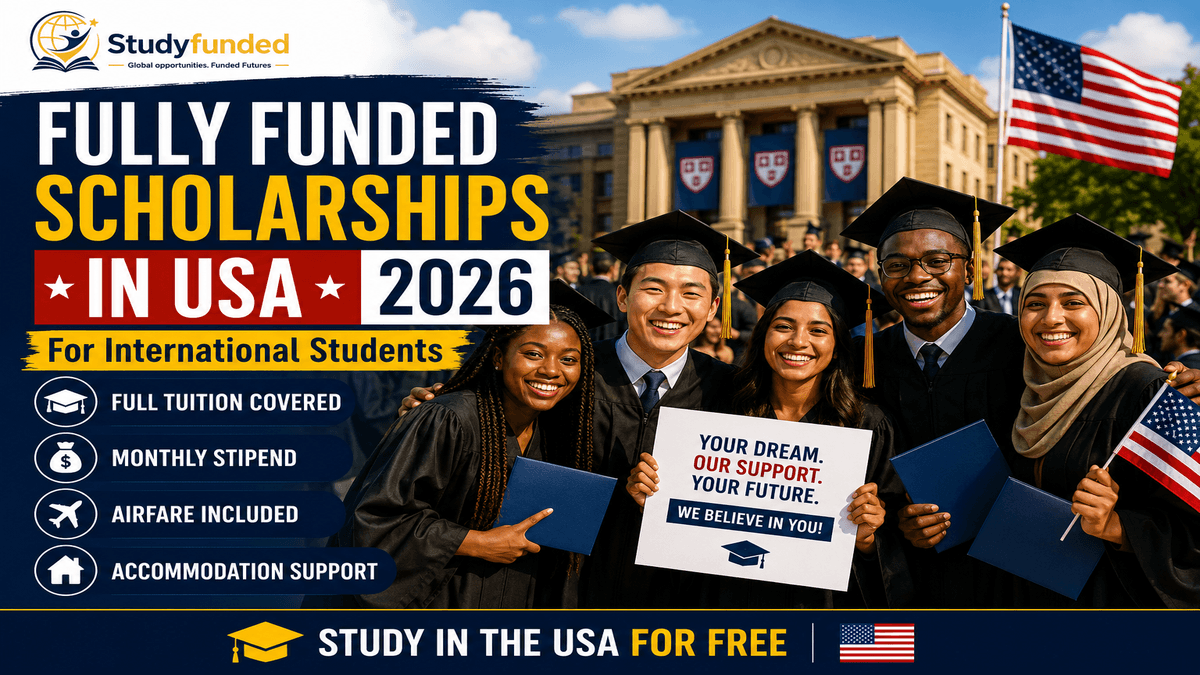
For students searching for fully funded scholarships in the USA for international students, the biggest question is often not whether they are qualified to study abroad. It is whether they can afford the enormous cost of studying in the United States.
Tuition fees can range from $20,000 to $80,000 per year. Add accommodation, health insurance, books, transportation, and daily living expenses, and the dream of studying in America can quickly feel financially out of reach.
The good news?
Every year, governments, universities, private foundations, and international organizations invest millions of dollars in talented students from around the world.
Many of these opportunities are not partial scholarships.
They are fully funded.
That means tuition, accommodation, health insurance, travel costs, and even monthly living expenses may be covered, depending on the scholarship or financial aid program.
This guide explores some of the best opportunities available, how they work, who can apply, and practical ways to strengthen your chances of being selected.
Whether you’re planning to pursue a Bachelor’s degree, Master’s program, PhD, or professional fellowship, you’ll find funding opportunities worth exploring here.
Quick Summary of Fully Funded Scholarships in the USA 2026
Students seeking fully funded scholarships in the USA 2026 for international students can apply for opportunities such as the Fulbright Foreign Student Program, Knight-Hennessy Scholars at Stanford University, Yale Financial Aid, Harvard Financial Aid, Princeton Financial Aid, MIT Financial Aid, AAUW International Fellowships, and the Hubert H. Humphrey Fellowship Program.
Depending on the scholarship, benefits may include:
- Full tuition coverage
- Monthly living stipends
- Accommodation support
- Health insurance
- Airfare
- Research funding
- Leadership development programs
The best strategy is to apply early, prepare strong application documents, and submit multiple scholarship applications rather than relying on a single opportunity.
Why Study in the United States?
The United States remains one of the most attractive destinations for international students because it offers:
- World-renowned universities
- Cutting-edge research facilities
- Strong academic reputation
- Diverse learning environments
- Global networking opportunities
- Better career prospects
- Access to innovation and entrepreneurship ecosystems
Many of the world’s leading institutions—including Harvard, Stanford, MIT, Yale, Princeton, Columbia, and the University of Chicago—are based in the United States.
The challenge isn’t finding a good university.
The challenge is finding a way to pay for it.
That’s where fully funded scholarships become life-changing.
What Does a Fully Funded Scholarships in the USA Cover?
Not all scholarships are created equal.
Some scholarships may only reduce tuition costs.
A fully funded scholarship typically covers most or all of the following:
Academic Costs
- Full tuition fees
- Mandatory university fees
- Research expenses (where applicable)
Living Expenses
- Monthly stipend
- Housing allowance
- Meal allowance
Travel Costs
- Round-trip airfare
- Travel grants
Health Coverage
- Medical insurance
- Emergency health benefits
Additional Support
- Conference funding
- Research grants
- Book allowance
- Leadership training
- Professional development programs
The exact benefits depend on the scholarship.
Top Fully Funded Scholarships in USA 2026 Comparison Table
The following opportunities are among the most prestigious and valuable scholarships available to international students.
| Scholarship | Study Level | Funding Type | Coverage |
|---|---|---|---|
| Fulbright Foreign Student Program | Master’s & PhD | Fully Funded | Tuition, living expenses, airfare, insurance |
| Knight-Hennessy Scholars | Graduate Programs | Fully Funded | Tuition, stipend, travel allowance |
| Yale Financial Aid | Undergraduate | Need-Based Full Funding | Demonstrated financial need |
| AAUW International Fellowship | Master’s & Doctoral | Fully Funded Support | Tuition and academic expenses |
| Hubert H. Humphrey Fellowship | Mid-Career Professionals | Fully Funded | Tuition, travel, living allowance |
Top Fully Funded Scholarships in USA for International Students 2026
1. Fulbright Foreign Student Program
The Fulbright Foreign Student Program is one of the best-known international scholarship opportunities funded by the U.S. government. It supports selected students from participating countries who want to pursue graduate study, research, or related academic opportunities in the United States.
What the Fulbright Scholarship Covers
Funding varies by country and program, but Fulbright awards commonly include:
- Tuition and required university fees
- A monthly living allowance
- Health insurance
- International travel support
- Books or academic materials, where applicable
Eligible Study Levels
Fulbright opportunities commonly support:
- Master’s degree programs
- PhD programs
- Research programs
Who Should Apply?
This opportunity is a strong fit for applicants who can demonstrate:
- Strong academic performance
- Leadership potential
- Community involvement
- A commitment to positive impact after their studies
Why Fulbright Stands Out
While academic achievement matters, Fulbright also evaluates applicants through a broader lens. Leadership, service, cross-cultural understanding, and a clear plan for future impact can all strengthen an application.
Fulbright’s selection process goes far beyond meeting basic academic requirements. Understanding the country-specific eligibility rules, application documents, essay expectations, recommendation letters, and selection process can help you prepare a more competitive application through the Fulbright Foreign Student Program 2027 Guide
2. Knight-Hennessy Scholars Program at Stanford University
The Knight-Hennessy Scholars Program supports graduate students at Stanford University who demonstrate independence of thought, purposeful leadership, and a civic mindset.
Funding Benefits
Selected scholars receive funding that may include:
- Tuition support for the graduate degree
- A living stipend
- Travel funding
- Leadership development opportunities
Eligible Programs
Applicants may pursue eligible Stanford graduate programs in areas such as:
- Business and MBA programs
- Engineering
- Medicine
- Law
- Education
- Humanities
- Sciences
Why Students Value This Scholarship
The program offers more than financial support. Scholars also take part in leadership development, mentorship, interdisciplinary learning, and a global peer community.
Ideal Candidate Profile
Competitive applicants often demonstrate:
- Intellectual curiosity
- Leadership experience
- Community engagement
- Independent thinking
- A willingness to work across disciplines
3. Yale University Financial Aid for International Students
Many students assume Ivy League universities are automatically unaffordable. Yale offers need-based financial aid to admitted international undergraduate students and meets 100% of demonstrated financial need.
Key Benefits
Depending on a student’s financial circumstances, aid may help cover:
- Tuition
- Accommodation
- Meals
- Academic expenses
Who Can Apply?
International undergraduate applicants from any country can be considered for admission and need-based financial aid.
Why This Opportunity Is Often Overlooked
Some students decide not to apply because they assume the cost will be impossible to manage. For admitted students with significant financial need, Yale’s aid can make attendance far more affordable than expected.
4. Harvard University Financial Aid
Harvard University is one of the world’s most selective institutions, so gaining admission is highly competitive. For international students who are admitted, however, the cost can be far more manageable than many expect.
Need-based financial aid is available to eligible students, with support assessed according to each family’s demonstrated financial circumstances. This means the university does not offer one fixed scholarship package to every applicant; instead, financial aid is tailored to the admitted student’s level of need.
What Harvard Financial Aid May Cover
Depending on demonstrated need, financial aid may help with:
- Tuition fees
- Housing costs
- Meal plans
- Academic expenses
- Other support required to make attendance affordable
Why This Opportunity Matters
Many talented students never apply because they assume Harvard is beyond their financial reach. For admitted students from low-income families, need-based aid can make studying at one of the world’s leading universities more realistic.
5. Princeton University Financial Aid
Princeton University provides need-based financial aid and meets 100% of demonstrated financial need for admitted students. Its aid model is widely recognized for replacing loans with grant support, helping students graduate with less financial pressure.
Key Benefits
Eligible students may receive support for:
- Demonstrated financial need
- Tuition and required costs
- Housing and living expenses
- A loan-free financial aid package, where applicable
Ideal Candidates
Princeton looks for academically strong applicants who also show intellectual curiosity, leadership potential, and a clear sense of purpose.
6. Massachusetts Institute of Technology (MIT) Financial Aid
MIT is a leading institution for science, engineering, technology, and innovation. International students who are admitted may qualify for need-based financial aid designed to make attendance affordable based on their family’s financial circumstances.
Best For
MIT may be particularly attractive to students interested in:
- Engineering
- Computer science
- Technology and innovation
- Scientific research
Why MIT Is Highly Competitive
Admission is highly selective because MIT seeks students with strong academic ability, curiosity, problem-solving skills, and the potential to contribute meaningfully to society.
7. Amherst College Financial Aid
Amherst College is sometimes overlooked by international applicants, despite its strong academic reputation and generous need-based financial aid approach.
The college supports admitted students from around the world and works to meet demonstrated financial need.
What Makes Amherst Unique?
Amherst offers:
- Small class sizes
- A personalized learning environment
- Strong need-based financial support
- Flexible liberal arts education
- Strong graduate and career outcomes
Students who want a highly selective U.S. education outside the largest university settings should consider Amherst carefully.
8. AAUW International Fellowships
AAUW International Fellowships support eligible women who are pursuing postgraduate study in the United States. The program is designed to invest in academic excellence, professional development, and leadership among women from around the world.
Eligible Applicants
Applicants generally must:
- Identify as women
- Be non-U.S. citizens or non-permanent residents
- Demonstrate academic excellence
- Pursue eligible full-time postgraduate study in the United States
Supported Fields
Current AAUW International Fellowships place particular emphasis on STEM fields, although applicants should always review the official program requirements for the relevant cycle.
Why This Fellowship Matters
Beyond financial support, the fellowship recognizes applicants who show a commitment to using their education, professional skills, and leadership to benefit women, girls, and their wider communities.
9. Hubert H. Humphrey Fellowship Program
Unlike a traditional degree scholarship, the Hubert H. Humphrey Fellowship is a non-degree professional development program. It brings accomplished mid-career professionals from eligible countries to the United States for graduate-level study, leadership development, and professional collaboration.
Funding Coverage
The fellowship includes support such as:
- Tuition and fees at the assigned host university
- A living allowance
- International and program-related travel
- Health coverage
- Professional development funding
- A computer subsidy
- Support for conferences, field visits, and professional activities
Eligibility Requirements
Applicants generally need:
- A bachelor’s degree or equivalent
- At least five years of full-time professional experience
- Demonstrated leadership qualities
- A record of public service or community involvement
- Strong English-language ability
- Citizenship in an eligible country
Best For
This fellowship is particularly suitable for:
- Government professionals
- NGO leaders
- Educators
- Development practitioners
- Public policy professionals
- Community and social-sector leaders
Scholarship Benefits Comparison Table
| Benefit | Fulbright | Knight-Hennessy | Yale Aid | AAUW | Humphrey |
|---|---|---|---|---|---|
| Full Tuition | Yes | Yes | Yes | Partial/Varies | Yes |
| Living Stipend | Yes | Yes | Need-Based | Yes | Yes |
| Airfare | Yes | Yes | No | Varies | Yes |
| Health Insurance | Yes | Varies | Varies | Varies | Yes |
| Leadership Training | Yes | Extensive | Limited | Moderate | Extensive |
The Biggest Mistake Most Scholarship Applicants Make
Most applicants spend months searching for scholarships.
Very few spend enough time becoming scholarship-worthy.
This is where many strong students lose out.
Selection committees are not simply asking:
“Who needs funding?”
They are asking:
“Who will create the greatest impact with this opportunity?”
The strongest applications often combine:
- Academic excellence
- Leadership experience
- Community impact
- Clear career goals
- Strong personal story
How Scholarship Committees Actually Select Winners
Many applicants believe scholarships are awarded primarily based on grades.
That’s only partially true.
Strong academic performance gets your application noticed.
What often determines who gets selected is everything beyond the transcript.
Most scholarship committees evaluate candidates across four major areas:
1. Academic Excellence
This includes:
- GPA
- Academic achievements
- Research experience
- Publications (if applicable)
- Academic awards
You don’t necessarily need a perfect GPA.
Many successful applicants are selected because they demonstrate growth, resilience, and intellectual potential.
2. Leadership Potential
Scholarship providers are investing in future leaders.
They want evidence that you’ve:
- Led projects
- Organized events
- Started initiatives
- Solved community problems
- Influenced positive change
Leadership doesn’t require a title.
Sometimes, helping solve a problem in your community carries more weight than holding a position in a student organization.
3. Community Impact
One question scholarship committees quietly ask is:
“What happens after we invest in this person?”
Applicants who demonstrate measurable impact often stand out.
Examples include:
- Volunteer projects
- Social initiatives
- Non-profit involvement
- Teaching or mentoring
- Environmental programs
- Entrepreneurship
The more evidence you provide, the better.
Numbers help.
Instead of saying:
“I volunteered in my community.”
Say:
“I coordinated a literacy program that helped 120 secondary school students improve examination performance.”
Specificity wins.
4. Future Vision
Many applications fail because career goals are vague.
Weak answer:
“I want to become successful.”
Strong answer:
“I intend to specialize in renewable energy systems and develop affordable solar solutions for underserved rural communities across West Africa.”
Notice the difference?
One focuses on personal gain.
The other demonstrates impact.
2026 Application Timeline for Fully Funded Scholarships in the USA
One of the biggest reasons students miss opportunities is late preparation.
The strongest applicants often start 6–12 months before deadlines.
Recommended Timeline
| Timeline | What To Do |
|---|---|
| 12 Months Before | Research scholarships and universities |
| 10 Months Before | Prepare academic documents |
| 8 Months Before | Take IELTS, TOEFL, GRE, or GMAT if required |
| 6 Months Before | Draft personal statements |
| 5 Months Before | Contact referees |
| 4 Months Before | Gather transcripts and certificates |
| 3 Months Before | Complete applications |
| 2 Months Before | Review and improve essays |
| 1 Month Before | Submit applications |
| After Submission | Prepare for interviews |
Most applicants underestimate how long document preparation takes.
Don’t be one of them.
How to Write a Personal Statement That Gets Attention
Your personal statement can make or break your application.
Many students treat it like a biography.
That’s a mistake.
Scholarship committees already know your academic history from your transcript.
The essay should explain:
Where Have You Been?
Start by giving the reader a clear sense of the experiences that shaped your academic journey and ambitions.
You might reflect on:
- A personal experience that influenced your choice of field
- A challenge you faced and how you responded to it
- A problem in your community that motivated you to take action
- An academic, volunteer, or work experience that clarified your goals
- The values or responsibilities that continue to drive you
You do not need to share every detail of your life. Choose one or two meaningful experiences, explain what they taught you, and connect them naturally to the goals you are pursuing now.
Where Are You Now?
Describe:
- Current achievements
- Academic strengths
- Professional experience
- Leadership activities
Where Are You Going?
Explain:
- Your goals
- Why this scholarship matters
- How the opportunity fits your plans
The Golden Formula
A strong scholarship essay often follows this pattern:
Challenge → Action → Result → Future Impact
Example:
Challenge:
Growing up in a community with unreliable electricity.
Action:
Studying electrical engineering and working in renewable energy.
Result:
Delivering solar solutions to homes and businesses.
Future Impact:
Expanding sustainable energy access across underserved regions.
This structure creates a memorable narrative.
A memorable narrative is only the beginning. What ultimately gets attention is the way you connect your experiences, achievements, and future goals into a clear case for why you deserve support.
Many applicants have strong stories but lose impact by making their essays too general, too descriptive, or disconnected from the scholarship’s purpose.
Learning how to write a Winning Scholarship Personal Statement (With Examples) can help you turn your story into an application that stays with the selection committee.
Example of a Strong Scholarship Essay Opening
Many students struggle with how to begin a scholarship essay.
A strong opening immediately creates context, emotion, and purpose.
Example:
“Growing up in a community where power outages were a daily reality, I witnessed firsthand how limited access to electricity affected education, businesses, and quality of life. These experiences inspired my interest in Electrical and Electronics Engineering and motivated me to pursue solutions that can expand access to sustainable energy in underserved communities.”
Notice what makes this introduction effective:
- It tells a story.
- It reveals motivation.
- It connects personal experience to academic goals.
- It hints at future impact.
Scholarship committees remember authentic stories far more than generic statements.
Recommendation Letter Secrets Most Applicants Don’t Know
Many students ask lecturers or supervisors for recommendation letters at the last minute.
That reduces quality.
Strong recommendation letters are specific.
Weak letters are generic.
Weak Recommendation
“Emmanuel was a good student and performed well academically.”
This tells the committee almost nothing.
Strong Recommendation
“Emmanuel demonstrated exceptional initiative by leading renewable energy projects that improved electricity access while consistently ranking among the top-performing students.”
Specific examples create credibility.
Best Referees to Choose
Choose people who know your work closely:
- Lecturers
- Academic advisors
- Project supervisors
- Research mentors
- Employers
- Professional supervisors
Avoid choosing people solely because they hold important positions.
A detailed recommendation from a lecturer who knows you well is often stronger than a generic letter from a senior official.
Choosing the right referee is only part of the process. Knowing how to approach them, what information to provide, and how to help them write a detailed, evidence-based recommendation can significantly improve the quality of your application. These strategies are explained in How to Get a Strong Scholarship Recommendation Letter (With Examples)
Why Scholarship Applications Get Rejected
This section alone can save applicants months of frustration.
Many qualified students are rejected not because they lack potential, but because their applications fail to show it clearly. Here are some of the most common reasons.
Generic Essays
Scholarship committees may read hundreds or even thousands of applications.
When an essay uses broad statements such as “I am hardworking and passionate about education,” it becomes difficult to remember. A strong essay uses specific experiences, measurable achievements, and clear future goals to show why the applicant stands out.
Poor Alignment
Applicants are often rejected when their academic background, chosen program, and career goals do not connect naturally.
For example, someone applying for a renewable energy scholarship should be able to explain how their studies, experience, interests, and long-term plans relate to the field. Reviewers want to see a clear reason why that particular opportunity makes sense for the applicant.
Weak Leadership Evidence
Simply claiming to be a leader is rarely enough.
Selection committees want proof of initiative and impact. Describe the project you led, the people you supported, the problem you addressed, and the result you achieved. Numbers make this even stronger: mention how many students you mentored, how much money was raised, or what measurable change your work produced.
Missing Documents
Some applications are rejected before the selection committee even reviews the candidate’s story.
Common issues include:
- Missing transcripts
- Incomplete application forms
- Missing recommendation letters
- Incorrect document uploads
- Expired passports or test results
- Documents submitted after the deadline
Create a checklist early and review every upload carefully before submitting.
Applying Too Late
Starting a scholarship application a few weeks before the deadline often leads to rushed essays, weak recommendation letters, and avoidable errors.
Strong applicants usually begin preparing months ahead. Early preparation gives you time to research the scholarship, gather documents, write multiple essay drafts, ask referees properly, and submit a polished application before the deadline.
Hidden Eligibility Factors Most Students Overlook
Scholarship websites usually list official requirements.
But there are hidden factors that often influence selection.
Consistency of Story
Your application should tell one coherent story.
Your:
- Academic background
- Career goals
- Volunteer work
- Leadership activities
should all support the same narrative.
Demonstrated Impact
Committees prefer evidence over promises.
Show what you’ve already done.
Don’t focus only on what you hope to do.
Long-Term Potential
Many scholarship providers view applicants as future ambassadors.
They’re looking for:
- Influence
- Character
- Commitment
- Vision
Not just grades.
How to Win a USA Scholarship as an African Student
Many African students mistakenly believe they are competing at a disadvantage.
In reality, scholarship providers often seek applicants from diverse backgrounds and countries, including Nigeria, Ghana, Kenya, Uganda, South Africa, Rwanda, and many others.
The key is understanding what scholarship committees value.
Focus on Impact, Not Just Grades
Strong grades are important.
But scholarship committees are often more interested in what you’ve done with your knowledge.
Ask yourself:
- Have you solved a problem?
- Have you led a project?
- Have you volunteered?
- Have you helped your community?
Evidence of impact can make your application stand out.
Build a Clear Personal Story
Many winning applications follow a simple narrative:
Challenge → Growth → Achievement → Future Impact
The clearer your story, the easier it becomes for reviewers to understand why investing in you makes sense.
Many International students have powerful experiences, ambitions, and evidence of resilience, but those strengths only help when they are communicated clearly.
A well-written personal statement can turn your challenges, growth, achievements, and plans into a compelling reason for a scholarship committee to invest in you.
This is exactly what a How to Write a Winning Scholarship Personal Statement (With Examples) can help you do.
Show What You Plan to Do After Graduation
Scholarship committees often invest in students who will return home and create meaningful change.
Your application should clearly answer:
“What problem do you hope to solve after earning your degree?”
The stronger your answer, the stronger your application becomes.
Apply for Multiple Opportunities
One of the biggest mistakes students make is applying for only one scholarship.
Treat scholarships like opportunities, not lottery tickets.
Apply strategically across several programs to improve your chances of success.
While many of these opportunities are open to applicants worldwide, eligibility criteria, application routes, and supporting documents can differ for students applying from African countries. If you are applying from Nigeria, Ghana, Kenya, Uganda, South Africa, or another African nation, Fully Funded Scholarships in USA for African Students 2026 provides a more focused overview of opportunities and application considerations relevant to your background.
Scholarship Application Checklist
Before submitting any application, confirm that you have:
Academic Documents
- ☐ Passport
- ☐ Academic transcripts
- ☐ Degree certificates
- ☐ CV/Resume
Test Results
- ☐ IELTS
- ☐ TOEFL
- ☐ GRE (if required)
- ☐ GMAT (if required)
Application Materials
- ☐ Personal statement
- ☐ Study plan
- ☐ Research proposal (if required)
- ☐ Motivation letter
References
- ☐ Recommendation letter 1
- ☐ Recommendation letter 2
- ☐ Recommendation letter 3 (if required)
Final Review
- ☐ Proofread application
- ☐ Checked eligibility
- ☐ Verified deadline
- ☐ Submitted before deadline
Scholarships Similar to Fully Funded Scholarships in the USA
A strong scholarship strategy does not depend on one country or one application. Expanding your search to other study destinations can uncover funding opportunities that may be a better fit for your academic background, goals, and preferred programme.
Students who are open to multiple destinations may also find valuable opportunities through Fully Funded Scholarships in Canada and Fully Funded Scholarships in the USA for African Students.
If you are particularly interested in pursuing a master’s degree in the UK, understanding the eligibility requirements, essay strategy, and selection process for the Chevening Scholarship 2027 Guide & How to Apply can help you prepare a stronger application.
The more well-matched scholarships you apply for, the greater your chances of receiving an offer.
Remember: most scholarship winners are not necessarily the smartest applicants. They are often the most prepared—those who start early, apply strategically, and give every application the attention it deserves.
Frequently Asked Questions About Fully Funded Scholarships in the USA 2026
1. Can international students study in the USA for free?
Yes.
Several universities, government-funded programs, and private organizations offer scholarships that cover full tuition, accommodation, health insurance, travel expenses, and living costs.
Examples include:
- Fulbright Foreign Student Program
- Knight-Hennessy Scholars
- Yale Financial Aid
- Princeton Financial Aid
- Harvard Financial Aid
- Humphrey Fellowship Program
Students who secure these opportunities may complete their studies with little or no out-of-pocket expenses.
2. Which scholarship is easiest to get in the USA?
There is no truly “easy” fully funded scholarship.
However, some university-funded scholarships may have larger award pools than highly competitive programs such as Fulbright or Knight-Hennessy.
Your chances improve when you:
- Apply early
- Meet all requirements
- Submit a strong personal statement.
- Demonstrate leadership and impact
- Apply to multiple opportunities
3. Can I get a fully funded scholarship in the USA without IELTS?
Yes.
Many U.S. universities now accept alternative proof of English proficiency.
Some institutions may waive IELTS if:
- Your previous education was conducted in English,
- Your country qualifies for a waiver,
- Or they accept another recognised English-language test.
Since these policies vary by university and programme, applicants from African countries should also consider the opportunities outlined in Fully Funded Scholarships in USA for African Students 2026.
4. What GPA is required for a fully funded scholarship in the USA?
Requirements vary.
Highly competitive scholarships often favor applicants with strong academic records.
Generally:
- Undergraduate scholarships: strong secondary school performance
- Master’s scholarships: good bachelor’s degree results
- PhD scholarships: strong academic and research background
A lower GPA does not automatically disqualify you if other parts of your application are exceptional.
5. Do fully funded scholarships cover accommodation?
Many do.
Coverage often includes:
- University housing
- Housing allowance
- Living stipend
- Meal support
Always review scholarship benefits carefully because coverage varies.
6. Can undergraduate students get fully funded scholarships in the USA?
Absolutely.
Several U.S. universities provide substantial financial aid packages for international undergraduate students.
Examples include:
- Yale University
- Harvard University
- Princeton University
- Amherst College
These institutions may meet 100% of demonstrated financial need for admitted students.
7. How competitive are fully funded scholarships in the USA?
Extremely competitive.
Top scholarships receive thousands of applications from around the world.
Selection committees often look beyond grades and evaluate:
- Leadership
- Community impact
- Research potential
- Personal character
- Future goals
This is why a strong application strategy matters.
8. Can working professionals apply for fully funded opportunities in the USA?
Yes.
Programs such as the Hubert H. Humphrey Fellowship specifically target experienced professionals seeking leadership development and professional growth.
These opportunities often value work experience as much as academic achievements.
9. When should I start preparing for USA scholarships?
Ideally, 8–12 months before the application deadline.
This gives enough time to:
- Research opportunities
- Prepare documents
- Request recommendation letters
- Take language tests
- Write compelling essays
Early preparation significantly increases your chances of success.
10. How many scholarships should I apply for?
There is no fixed number.
Many successful applicants submit between 5 and 20 high-quality applications.
Focus on:
- Eligibility
- Scholarship fit
- Application quality
Ten strong applications are often better than fifty rushed ones.
Additional Funding Opportunities Worth Exploring
Although the scholarships discussed earlier are among the most prestigious, they are not the only opportunities available.
International students should also research:
Harvard University Financial Aid
Harvard offers generous need-based financial aid and is committed to ensuring that admitted students can afford attendance regardless of financial circumstances.
Princeton University Financial Aid
Princeton is known for one of the most generous undergraduate financial aid systems in the world and meets demonstrated financial need without student loans.
Massachusetts Institute of Technology (MIT)
MIT provides substantial need-based financial aid and remains one of the most attractive destinations for students pursuing science, engineering, and technology programs.
Amherst College
Amherst is one of the few U.S. institutions that practice need-blind admissions for international applicants while meeting demonstrated financial need.
Stanford University Graduate Funding
Beyond Knight-Hennessy, many Stanford graduate departments provide fully funded research assistantships, fellowships, and teaching assistantships.
If you are open to studying outside the USA, you may also consider scholarship opportunities in Canada and the United Kingdom, where several universities offer alternative English language requirements.
Final Thoughts on Fully Funded Scholarships in the USA
The biggest mistake many students make is assuming they cannot afford education in the United States.
Every year, thousands of international students receive life-changing funding that covers tuition, accommodation, travel, insurance, and living expenses.
The opportunities exist.
The challenge is preparation.
Start researching early.
Build your academic profile.
Develop leadership experience.
Create meaningful impact in your community.
Craft a compelling personal story.
Most importantly, apply.
Many students eliminate themselves before a scholarship committee ever gets the chance.
Don’t be one of them.
The fully funded scholarships in the USA 2026 for international students listed in this guide could be the opportunity that changes the trajectory of your education, career, and future.
Your journey starts with a single application.
Official Scholarship Resources for Fully Funded Scholarships in the USA
Scholarship requirements, funding coverage, eligibility rules, and application deadlines can change from one cycle to another. Before applying, review the official page for each opportunity to confirm the current requirements, available study levels, and application process.
Use the resources below to begin your research:
Fulbright Foreign Student Program— Visit the official Fulbright page to check whether your country participates, review local application instructions, and confirm the current deadline.
Knight-Hennessy Scholars Stanford University— Review the official program page for eligible Stanford graduate programs, funding details, selection criteria, and application dates.
Yale International Students Admission — Check Yale’s international admissions and financial aid information, including how need-based support works for admitted undergraduate students.
Harvard Financial Aid — If Harvard is your target, review Harvard’s official financial aid guidance to understand how the university assesses demonstrated financial need for international students.
Princeton Financial Aid— Also, visit Princeton’s financial aid page to learn how its need-based grant system works and which documents applicants may need to submit.
Stanford Graduate Funding: — Explore Stanford’s graduate funding information for department-based fellowships, assistantships, and other financing options beyond Knight-Hennessy.