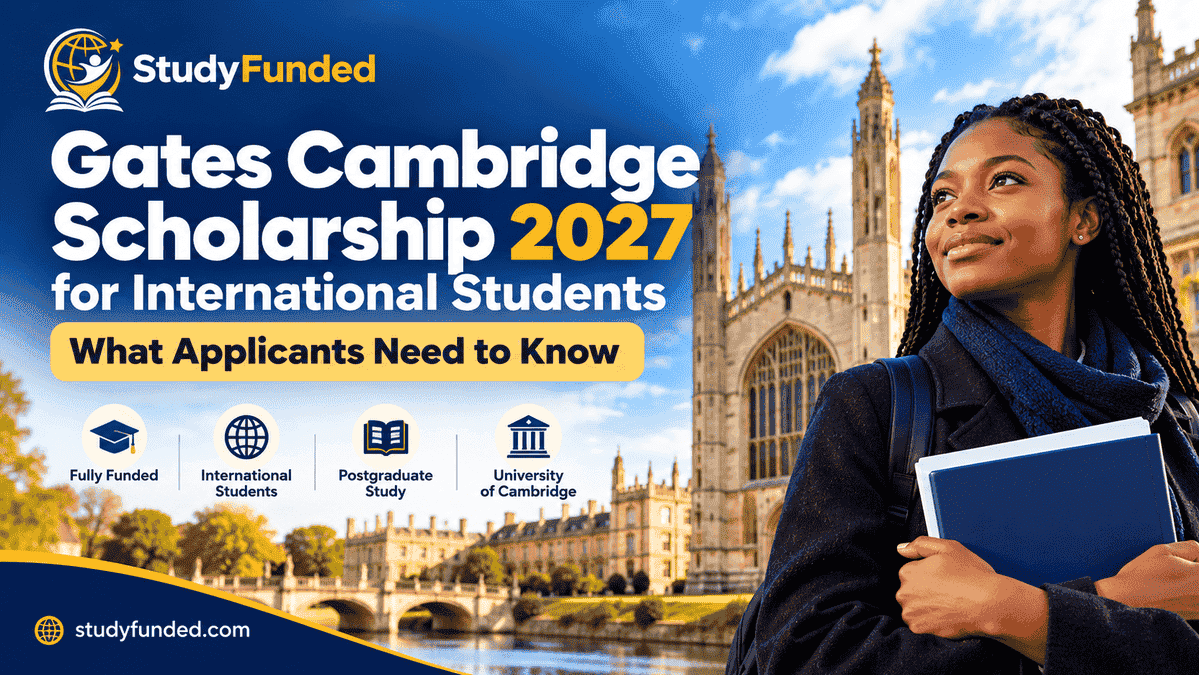
The Gates Cambridge Scholarship 2027 allows outstanding international students to pursue a postgraduate degree at the University of Cambridge with full-cost financial support.
However, Gates Cambridge is not simply a scholarship for students with excellent grades. The programme looks for applicants who combine academic excellence with a strong reason for choosing their course, a commitment to improving the lives of others, and leadership capacity.
For the 2027/28 academic year, Gates Cambridge expects to offer about 75 full-cost scholarships to eligible applicants from outside the UK. Approximately 55 awards are available through the main international round, while about 20 are reserved for US citizens living in the United States. Around two-thirds of the total awards are expected to go to PhD students.
If you are considering Cambridge for a master’s or PhD, understanding how the scholarship works can help you decide whether it fits your academic plans and prepare your application around what the selection process actually values.
What Is the Gates Cambridge Scholarship?
The Gates Cambridge Scholarship is a full-cost postgraduate scholarship for eligible applicants from countries outside the United Kingdom who want to study at the University of Cambridge.
The programme was established through a major donation from the Bill and Melinda Gates Foundation. Its wider mission is to build a global network of future leaders committed to improving the lives of others.
For 2027/28, the scholarship is available for eligible master’s and PhD study in subjects offered at Cambridge. The scholarship is highly competitive, and receiving admission to Cambridge does not automatically mean receiving Gates Cambridge funding.
Applicants must satisfy the admission requirements of their chosen Cambridge course while also demonstrating why they are strong candidates for the scholarship.
Gates Cambridge Scholarship 2027 at a Glance
| Feature | Details |
|---|---|
| Scholarship | Gates Cambridge Scholarship |
| Academic year | 2027/28 |
| University | University of Cambridge |
| Study level | Postgraduate |
| Main eligible levels | Master’s and PhD |
| Total awards | About 75 |
| Main international round | About 55 awards |
| US round | About 20 awards |
| Award value | Approximately £35,000–£68,000 annually |
| Award duration | Length of eligible course |
| Main selection criteria | Academic excellence, course choice, improving lives, leadership |
| Main funding deadlines | 8 December 2026 or 6 January 2027, depending on course |
| US Gates deadline | 14 October 2026 |
The exact funding deadline depends on the Cambridge course, so applicants should check the deadline attached to their specific programme.
What Does the Gates Cambridge Scholarship Cover?
Gates Cambridge is designed to cover the major costs associated with studying at Cambridge.
The scholarship provides:
- The University Composition Fee
- A maintenance allowance
- Travel costs to and from the UK
- Student visa costs
- The Immigration Health Surcharge
Additional discretionary support may also be available. This can include Academic Development Funding and support for eligible scholars with dependent children.
For 2027/28, the award value is approximately £35,000 to £68,000 per year, depending on the scholar’s circumstances and the funding components involved.
However, fully funded does not mean that every possible expense is automatically covered. Applicants should review the scholarship’s current funding terms before making financial plans.
Who Can Apply for Gates Cambridge?
The main Gates Cambridge Scholarship is intended for eligible applicants from outside the UK who are applying for an eligible postgraduate course at Cambridge.
For 2027/28, the scholarship supports master’s and PhD study, subject to the eligibility of the particular course.
Being an international applicant, however, is only the starting point.
Applicants must also:
- Apply for an eligible Cambridge postgraduate course.
- Meet the academic requirements of that course.
- Meet any course-specific requirements.
- Request Gates Cambridge funding through the Cambridge application.
- Provide the additional information required for scholarship consideration.
- Submit the application by the applicable funding deadline.
The specific requirements can vary by programme. Some courses may require an additional Gates Cambridge reference or a research proposal, particularly for PhD applicants.
Which Cambridge Courses Are Eligible?
Gates Cambridge supports postgraduate study across a wide range of subjects at the University of Cambridge.
However, applicants should still verify the eligibility and requirements of their specific course.
The course page determines important details such as:
- Academic entry requirements
- English-language requirements
- Supporting documents
- Application deadline
- Funding deadline
- Research proposal requirements, where applicable
This makes course selection an important part of the scholarship strategy.
The proposed programme should make sense in relation to the applicant’s academic background, professional experience and future plans. That matters because reasons for choosing your course is one of the criteria Gates Cambridge uses when assessing candidates.
Choosing a Cambridge course simply because of the University’s reputation is not enough. Applicants need to explain why that particular programme is relevant to what they want to achieve.
How to Apply for the Gates Cambridge Scholarship
The Gates Cambridge Scholarship is closely connected to the Cambridge postgraduate application process.
Applicants apply for their chosen Cambridge course through the University’s postgraduate application system and request consideration for Gates Cambridge funding as part of that application.
The process is broadly:
Choose an eligible course → check its requirements → prepare your Cambridge application → request Gates Cambridge funding → complete the additional scholarship requirements → submit by the funding deadline.
Cambridge admission and Gates Cambridge selection remain separate decisions. Meeting the admission requirements of a course does not guarantee that the scholarship will be awarded.
What Do You Need to Submit?
The exact requirements depend on the course. A Cambridge postgraduate application may require academic transcripts, references, a scholarship CV, evidence of English proficiency where applicable, and a statement or other course-specific documents.
Explore our guide to How to Write a Scholarship CV (With Examples & Free Template)
Applicants seeking Gates Cambridge funding also need to provide a Gates Cambridge Reference. For some PhD applications, a research proposal may also be required.
The important point is to check the requirements for the specific course rather than assume that every Cambridge applicant submits exactly the same documents.
Gates Cambridge Scholarship 2027 Deadlines
The funding deadline is one of the most important details to understand.
For 2027/28 entry, the main University funding deadlines are:
- 8 December 2026
- 6 January 2027
The deadline that applies depends on the course.
US citizens who are resident in the United States and applying through the Gates Cambridge US round have an earlier deadline of 14 October 2026.
Do not confuse the course application deadline with the funding deadline.
Some Cambridge programmes may continue accepting applications after the funding deadline has passed. Anyone seeking Gates Cambridge consideration must meet the funding deadline that applies to their programme.
What Gates Cambridge Looks for in Applicants
Gates Cambridge assesses candidates against four main criteria:
- Academic excellence
- Reasons for choosing the course
- Commitment to improving the lives of others
- Leadership capacity
These criteria show what separates Gates Cambridge from a scholarship that focuses primarily on academic performance.
1. Academic Excellence
Academic excellence is the first of the four selection criteria, but it should not be interpreted as meaning that only applicants with perfect grades can compete.
A strong academic record should demonstrate the intellectual ability needed to succeed at Cambridge and make meaningful use of the opportunity.
Evidence may come from:
- Undergraduate grades and degree classification
- Master’s-level performance, where applicable
- Academic awards or distinctions
- Research achievements
- Publications or significant academic projects
- Strong performance in subjects relevant to the proposed Cambridge course
- Other evidence of intellectual achievement
Academic achievement becomes more persuasive when it connects logically with the proposed course.
2. Reasons for Choosing Your Course
Gates Cambridge wants to understand why you have chosen your particular course.
This goes beyond saying that Cambridge is prestigious.
A convincing application should establish a clear connection between previous experience, what the applicant needs to learn, the chosen course and what comes afterwards.
This connection also matters when developing a strong scholarship personal statement, particularly when you need to explain your academic direction and future goals.
A useful way to think about it is:
Past experience → current gap or opportunity → Cambridge course → future direction
The more naturally those elements connect, the stronger the case for why the course is necessary for the next step.
3. Commitment to Improving the Lives of Others
Gates Cambridge also looks for applicants who demonstrate a genuine commitment to improving the lives of others.
This does not mean that an applicant must have founded a major organisation or worked on a globally recognised project.
Evidence could come from professional work, research, entrepreneurship, education, healthcare, community projects, public service, technology or other activities.
What matters is the substance of the contribution.
Rather than simply saying that you want to “help your country” or “change Africa”, explain the problem you have encountered, what you have done about it, what resulted from those actions and how future plans build on that experience.
4. Leadership Capacity
Leadership is not necessarily about having a senior job title.
It can be demonstrated by taking initiative, leading a project, influencing decisions, solving problems, mentoring others, building partnerships or creating something that produces a useful result.
The key distinction is between participation and influence.
Being part of a project tells the selection panel what you participated in. Explaining the problem you identified, the action you took, the people you influenced and the result you achieved provides evidence of leadership.
How the Four Criteria Work Together
The four criteria should not be treated as unrelated boxes to tick.
A strong Gates Cambridge application should show how they connect.
Academic achievement demonstrates the ability to succeed.
Course choice explains what needs to be learned next.
Commitment to improving lives shows why the ambition extends beyond personal advancement.
Leadership capacity demonstrates the potential to turn that ambition into action.
Together, they create a clearer picture of why Gates Cambridge should invest in the applicant.
There is also no need to manufacture a perfect profile. The stronger approach is to identify experiences that genuinely demonstrate these qualities and explain what was learned from them.
Common Mistakes to Avoid
Treating Gates Cambridge as a Grades-Only Scholarship
Excellent academic performance matters, but it is only one part of the assessment.
Choosing a Course Because Cambridge Is Prestigious
The chosen course should have a clear connection to the applicant’s academic background and future direction.
Confusing Admission With Scholarship Selection
Admission to Cambridge does not guarantee Gates Cambridge funding.
Making Vague Leadership Claims
A leadership title is not evidence by itself. Show what you actually did and what changed as a result.
Using Generic Claims About Social Impact
Broad statements about changing society are less convincing than specific evidence from personal experience.
Missing the Funding Deadline
The final course application deadline may be later than the funding deadline. Missing the funding deadline can mean losing consideration for Gates Cambridge.
Frequently Asked Questions
Is the Gates Cambridge Scholarship fully funded?
Yes. It covers the University Composition Fee and provides a maintenance allowance, with additional support available for approved costs and circumstances.
Can international students apply for Gates Cambridge?
Yes. The main scholarship is for eligible applicants from outside the UK seeking eligible postgraduate study at Cambridge.
Can Nigerian students apply?
Yes. Nigerian applicants can apply provided they meet the relevant nationality, academic, course and scholarship requirements.
Does Gates Cambridge fund master’s degrees?
Yes. The 2027/28 scholarship is available for eligible master’s and PhD programmes.
Does Gates Cambridge fund undergraduate study?
No. Gates Cambridge is a postgraduate scholarship.
Do I need IELTS for Gates Cambridge?
There is no single IELTS requirement that applies independently to every Gates Cambridge applicant. English-language requirements depend on the Cambridge course, so applicants should check the requirements for their specific programme.
Does Cambridge admission guarantee the scholarship?
No. Cambridge admission and Gates Cambridge selection are separate decisions.
What is the Gates Cambridge deadline for 2027?
For 2027/28 entry, the main University funding deadlines are 8 December 2026 and 6 January 2027, depending on the course. The US Gates Cambridge round has a separate deadline of 14 October 2026.
Final Thoughts
The Gates Cambridge Scholarship 2027 for International Students offers exceptional funding, but the scholarship is looking for more than academic achievement.
The strongest candidates can explain why their chosen Cambridge course is the right next step, demonstrate meaningful evidence of leadership and contribution, and show how they intend to use their education to create value beyond themselves.
Start by finding an eligible course that genuinely fits your academic and professional direction. Then work backwards from its requirements and funding deadline.
Most importantly, build the application around evidence rather than adjectives. Instead of simply describing yourself as a leader, show what you have led. Instead of claiming that you want to improve people’s lives, show what you have already done and where you intend to go next.
Because scholarship requirements and deadlines can change, verify the latest information before submitting your application.
Official Resources