Applying for scholarships when you have a 2.0–3.0 GPA can be challenging, but a lower academic record does not automatically put a scholarship out of reach. Some scholarships have strict academic requirements, while others assess applicants using a broader combination of academic performance, leadership, experience, community involvement, and other qualities.
The difference matters.
A low GPA can reduce the number of scholarships available to you, but it does not automatically mean you cannot win one. The smarter approach is to determine where you are eligible, understand what each scholarship values, identify the strongest evidence in your profile, and focus your effort on opportunities where you have a credible case.
Here are seven strategies to help you do exactly that.
Can You Get Scholarships With a 2.0–3.0 GPA?
Yes, but your options depend on the scholarship’s requirements and selection criteria.
There is no universal GPA that determines whether someone can receive a scholarship. Providers set their own requirements, and those requirements can vary considerably. For example, RMIT’s Academic Merit Scholarship for Africa currently requires an Australian-equivalent GPA of 2.5 or a 70% average, while other scholarships have higher academic thresholds.
So instead of asking, “Can someone with my GPA get a scholarship?”, ask:
“Which scholarships am I eligible for, and how competitive is my profile once I meet the requirements?”
With a 3.0 GPA
A 3.0 GPA may satisfy the minimum requirement for some scholarships, but meeting the minimum does not guarantee selection. Your other qualifications and how closely your profile matches the scholarship’s priorities can still matter.
With a 2.5 GPA
A 2.5 GPA can narrow your options, particularly for highly academic awards, but it does not automatically disqualify you from every opportunity. Some scholarships accept applicants at or around this level. RMIT’s current Africa scholarship is one example. (rmit.edu.au)
With a 2.0 GPA
A 2.0 GPA presents a more difficult situation because many merit-based scholarships set minimum requirements above this level. Your priority should therefore be careful screening rather than submitting applications indiscriminately.
The key distinction is simple:
Failing a mandatory GPA requirement makes you ineligible. Meeting the requirement but having a lower GPA than some competitors makes you less competitive.
Those are different problems and require different strategies.
Assess Your Scholarship Position Before Applying
Before spending hours on an application, answer four questions:
- Do I meet every mandatory requirement?
- What qualities does this scholarship value beyond GPA?
- What evidence do I have that demonstrates those qualities?
- Is this opportunity worth the time required to apply?
You can use this simple filter:
| Opportunity | Your position | Action |
|---|---|---|
| Strong fit | Eligible with several relevant strengths | Prioritize |
| Possible fit | Eligible but less aligned or highly competitive | Consider carefully |
| Poor fit | You fail a mandatory requirement | Do not apply |
This prevents one of the most common low-GPA mistakes: treating every scholarship as though it offers the same opportunity.
7 Strategies to Win Scholarships With a 2.0–3.0 GPA
A low GPA requires a more deliberate approach. You cannot change the grades already on your transcript, but you can control how you identify opportunities, what evidence you present, and where you invest your application time.
1. Target Scholarships You Are Actually Eligible For
Start with the official eligibility criteria, not a social media post or a third-party list.
Check the minimum GPA, degree level, nationality, field of study, work experience, language requirements, and other mandatory conditions.
If you do not meet a mandatory requirement, move on.
This is especially important for a low-GPA applicant because time spent trying to overcome an eligibility barrier is time that could have been invested in a realistic opportunity.
Do not confuse “low GPA” with “no GPA requirement.” A scholarship described online as friendly to students with lower grades may still have a specific academic threshold.
2. Use an Upward Academic Trend to Your Advantage
Your cumulative GPA does not always tell the whole story.
Imagine an applicant with a 2.6 cumulative GPA whose record looks like this:
| Academic period | GPA |
|---|---|
| Earlier semesters | 2.2 |
| Middle semesters | 2.5 |
| Final semesters | 3.2 |
The cumulative GPA remains 2.6, but the record shows clear improvement.
That does not erase the 2.6. It gives the reviewer additional evidence about the applicant’s recent academic performance.
Look for meaningful improvement in your own record, such as stronger final-year grades, better performance in relevant courses, or successful completion of demanding academic work.
Don’t simply state that your grades improved. Show the evidence that makes the improvement visible.
3. Build Evidence of Strengths Your GPA Does Not Show
Your GPA is one piece of your academic record. It does not necessarily capture your professional ability, leadership, research experience, community contribution, or achievements outside the classroom.
Identify evidence that is actually relevant to the scholarship.
For example, an applicant with a 2.5 GPA might also have:
- relevant professional experience;
- research experience;
- leadership responsibilities;
- meaningful community involvement;
- professional certifications; or
- measurable results from a project or initiative.
The question is not:
“What achievements can I add to make my GPA look better?”
Ask:
“What evidence demonstrates the qualities this scholarship is looking for?”
If leadership matters, demonstrate leadership. If community impact matters, show what you did and what resulted from it.
Evidence is stronger than adjectives. Demonstrating what you have accomplished is more useful than simply describing yourself as hardworking, resilient, or passionate.
4. Put Your GPA in Context—Without Making Excuses
Not every low GPA needs a lengthy explanation.
If the application asks about academic difficulties, answer honestly. If there is an appropriate opportunity to provide additional context and your circumstances genuinely help explain the record, use it carefully.
A useful structure is:
Context → Responsibility → Change → Evidence
Briefly explain the relevant circumstances, acknowledge your responsibility where appropriate, show what changed, and provide evidence of that change.
The goal is not to persuade the committee that your GPA does not matter. It is to help them understand the full context of your academic record.
If there is no meaningful context to provide, don’t manufacture one. Your application should spend more time demonstrating what you can offer than defending a number that is already visible on your transcript.
5. Choose Recommenders Who Can Add Evidence Your Transcript Cannot
Your transcript already shows your grades. A recommendation can provide another perspective on your abilities.
Instead of asking only, “Who has the most impressive title?”, ask:
“Who can credibly provide specific evidence of my strengths?”
A professor might be able to discuss your research ability or academic improvement. A supervisor might provide evidence of your professional performance, leadership, problem-solving, or contribution to a significant project.
Compare:
“She is a hardworking person.”
with a specific example describing how she led a project, solved a difficult problem, or delivered measurable results.
The second gives the selection committee something concrete to evaluate.
The purpose is not to make your recommender ignore your GPA. It is to add credible evidence about capabilities that a transcript cannot fully capture.
If you need help choosing a referee, preparing them properly, and obtaining a detailed recommendation, see our guide to getting a strong scholarship recommendation letter
6. Prioritize Scholarships Where Your Overall Profile Makes Sense
A low-GPA applicant has even more reason to avoid applying indiscriminately.
Strategic scholarship selection matters because being eligible is only the beginning; your overall fit with what a scholarship values can determine how competitive your application becomes.
Our guide on how to increase your chances of winning a scholarship explores this broader principle in greater depth.
Consider each opportunity in terms of fit.
An applicant with a 2.7 GPA and substantial leadership experience, for example, may have a stronger reason to pursue a scholarship that explicitly values leadership than an award focused almost entirely on academic merit.
Before committing several hours to an application, ask:
- Do I meet the requirements?
- What does this scholarship value most?
- Which parts of my profile demonstrate those qualities?
- What weaknesses could make me less competitive?
- Is the opportunity worth the time required to apply?
The objective is not to apply more often. It is to apply more intelligently.
7. Make Your Whole Application Tell One Consistent Story
A strong scholarship application should feel like one coherent case for your candidacy, not a collection of unrelated documents.
Your CV, personal statement, essay, SOP, recommendation, and supporting evidence should reinforce the same central picture: who you are, what you have done, why your proposed study matters, and why you are prepared for it.
For example, an applicant with a 2.6 GPA might also have:
- improved academically in the final year;
- gained relevant professional experience;
- led a community project; and
- developed a clear career objective.
Those facts become more persuasive when they connect:
Academic improvement → relevant experience → demonstrated impact → clear future goal
Your personal statement, for example, should not present a completely different picture from your CV, while your recommendation should ideally provide credible evidence that supports the strengths you claim elsewhere in the application.
For a deeper guide to building a compelling narrative around your experiences, goals, preparation, and potential impact, see our guide on how to write a scholarship personal statement.
Before submitting, ask:
“If I temporarily set aside my GPA, does the rest of my application provide convincing evidence that I am prepared for this opportunity?”
A low GPA remains part of your record. Your objective is not to erase it. Your objective is to make sure it is not the only evidence the committee has about you.
What Not to Do When Applying With a Low GPA
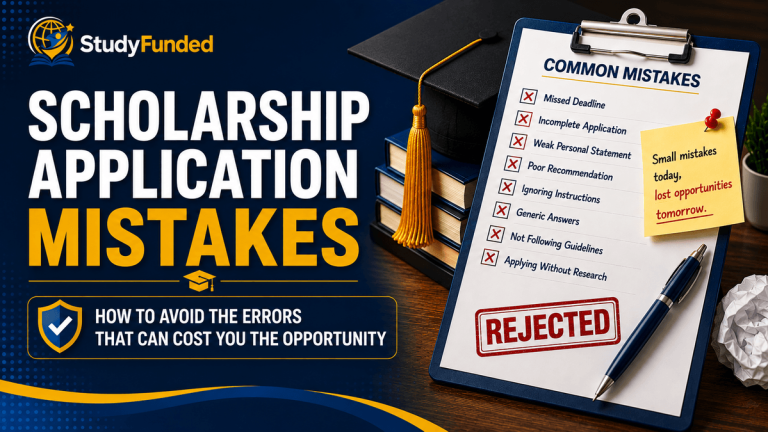
A low GPA can make applicants feel pressured to apply everywhere and explain everything. That approach can weaken an otherwise good strategy. These mistakes are especially important to avoid when your academic profile is already a potential weakness. For a broader look at application errors that can lead to rejection, see our guide to common scholarship application mistakes
Avoid these five mistakes:
- Applying when you fail a mandatory GPA requirement. A stronger essay cannot normally make you eligible.
- Assuming “no GPA requirement” means grades do not matter. Academic performance may still form part of the overall assessment.
- Making your entire application about your low GPA. Give the committee reasons to consider your strengths and potential, not only explanations for your past performance.
- Hiding or misrepresenting your academic record. Submit accurate information and address weaknesses honestly when necessary.
- Applying to everything you can find. Prioritize opportunities where you meet the requirements and have a credible reason to compete.
Frequently Asked Questions About Scholarships With a Low GPA
Can I get a scholarship with a 2.0 GPA?
It is possible, but your options may be more limited. Many competitive scholarships have higher academic thresholds, so focus on opportunities where you meet the stated requirements and can demonstrate relevant strengths beyond your GPA.
Can I get a scholarship with a 2.5 GPA?
Yes. Some scholarship programs accept applicants around this level, while others require higher grades. Check the actual eligibility requirements for each opportunity.
Can I get a scholarship with a 3.0 GPA?
Yes. A 3.0 GPA may satisfy some scholarship minimums, but meeting the minimum does not guarantee selection. Your overall profile and the scholarship’s selection criteria still matter.
What is the lowest GPA required for a scholarship?
There is no universal minimum. Each scholarship provider establishes its own eligibility requirements.
Can I get a fully funded scholarship with a low GPA?
It is possible, although your options may be more limited because fully funded scholarships can be highly competitive. Pay particular attention to mandatory academic requirements and prioritize opportunities where your overall profile is a credible match.
Key Takeaways
A 2.0–3.0 GPA does not automatically end your scholarship prospects, but it does require a more deliberate strategy.
Check eligibility. Don’t spend time on opportunities you cannot qualify for.
Look for academic improvement. A stronger recent record can provide useful additional evidence.
Build your case around evidence. Identify the experiences and achievements that demonstrate what the scholarship values.
Choose strategically. Prioritize opportunities where your profile has a genuine point of alignment.
Make the application coherent. Your documents should collectively demonstrate why you are prepared for the opportunity.
A low GPA is part of your academic record, but it does not have to become the entire story of your application. Understand where it limits your options, identify where your profile is strongest, and direct your effort accordingly.
Your GPA may influence which scholarships you pursue. It does not have to determine every scholarship you can win.