If you’re wondering how to write a scholarship essay, the first step is understanding what scholarship committees want to learn about you. If scholarship essays could talk, they would probably complain about being misunderstood.
Some applicants treat them like English tests. Others see them as a place to retell their life story. A few simply search for a winning sample online and hope changing a few words will be enough.
None of those approaches captures what a scholarship essay is really for.
Think about it this way.
A scholarship provider already knows your grades. They can see your certificates, your academic records, and sometimes even your recommendation letters. If those documents already tell them what you’ve achieved, why ask you to write an essay as well?
Yet that’s the question many applicants never stop to ask—and the answer changes everything about how you should approach your essay.
A scholarship essay isn’t there to repeat your CV. It’s there to fill the gap between what you’ve done and who you are. It helps a selection committee understand the person behind the application—the decisions you’ve made, the values that guide you, and the potential they can’t measure from numbers alone.
Once you see the essay through that lens, you stop trying to sound impressive and start helping the committee understand who you are.
And that’s where memorable scholarship essays begin.
What Is a Scholarship Essay?
At first glance, a scholarship essay may seem like just another document you need to submit before the deadline.
But if that were true, scholarship providers wouldn’t ask for one.
Think about your application package for a moment. Your transcript shows your academic performance. Your CV highlights your achievements and experiences. Recommendation letters provide someone else’s perspective on your abilities and character.
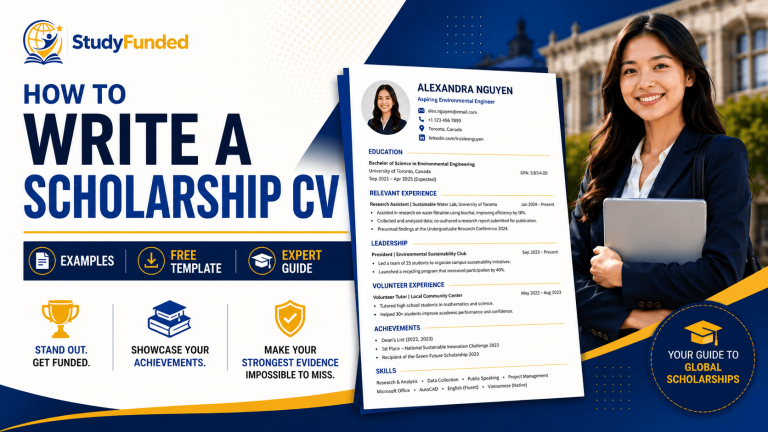
Your scholarship CV and essay should complement each other rather than repeat the same information. If you haven’t created one yet, read our guide on How to Write a Scholarship CV (With Examples & Free Template).
So, what does the essay add?
The scholarship essay is where you explain the story behind the facts. It shows why your experiences matter, what shaped your goals, and how you’ve grown because of the opportunities and challenges you’ve faced.
Rather than repeating your CV or summarising your transcript, it gives meaning to the information in your application and helps the selection committee understand the person behind those documents.
In many ways, your scholarship essay is the piece that gives your entire application a voice.
What Are Scholarship Committees Really Looking For?
One of the biggest misconceptions about scholarship essays is that they’re designed to help committees identify the “best” applicant.
In reality, many applicants have strong grades, relevant experience, and genuine ambition. The real challenge isn’t finding qualified candidates—it’s choosing between them.
That’s where the essay becomes invaluable.
It helps the committee answer questions that no transcript, CV, or recommendation letter can answer on its own.
Questions like:
- Can this applicant be trusted to make good use of this opportunity?
- Do they have a clear sense of purpose?
- Have their experiences genuinely shaped their goals?
- If we invest in this person today, what impact might they create tomorrow?
They’re not asking whether you’re perfect. They’re trying to understand your character, your direction, and your potential.
That’s why two applicants with similar academic records can receive very different outcomes. One may simply present achievements, while the other explains what those achievements reveal about their values, decisions, and ambitions.
Keep these questions in mind as you write. Your essay should provide evidence that helps the committee understand your suitability for the particular scholarship.
Before You Write, Find the Story Worth Telling
Many applicants think the hardest part of writing a scholarship essay is finding the right words.
In reality, the hardest part is deciding which story is worth telling.
That’s why staring at a blank page feels frustrating. You’re trying to write before you’ve discovered the experience that best explains who you are.
Here’s an important shift in perspective:
You don’t build a strong scholarship essay by collecting impressive achievements. You build it by recognising the meaning in experiences you’ve already had.
Ask yourself:
- Which experience changed the way I think?
- What challenge helped me grow?
- What first sparked my interest in this field?
- Which moment best explains the person I’m becoming?
Notice that none of these questions asks about awards or titles. That’s intentional.
Achievements tell the committee what you did. Experiences explain why it matters.
For example, becoming the president of a student association is an achievement. Learning how to lead people with different opinions, resolve conflict, and accept responsibility is the experience behind that achievement.
And that’s usually the part scholarship committees remember.
Before you start writing, don’t ask:
“What’s the most impressive thing I’ve ever done?”
Ask instead:
“Which experience best explains the person I’m becoming?”
That’s where your strongest scholarship essay is likely to begin.
How to Understand What a Scholarship Essay Prompt Is Really Asking
A scholarship essay prompt may look like a simple question.
It rarely is.
Consider a common prompt like:
“Tell us about yourself.”
At first, it sounds incredibly broad, but scholarship committees usually aren’t asking for your entire life story.
They’re asking you to decide what is most important for them to know about you.
That decision reveals what you value, how you think, and what you believe defines you.
Now consider another common prompt:
“Describe a challenge you have overcome.”
Many applicants immediately focus on finding the biggest challenge they can remember.
But size isn’t what makes a challenge meaningful.
The committee is interested in how you responded, what changed because of the experience, and what you learned that still influences the way you think or act today.
Even a relatively ordinary experience can become a compelling essay if it reveals genuine growth.
The same pattern appears in other scholarship applications.
A question about leadership is often trying to understand how you influence others. A question about your future goals explores whether your ambitions are thoughtful and realistic. And a question about community service may be less interested in the activity itself than in the values that motivated it.
This is why strong applicants don’t rush to answer the prompt. They pause long enough to ask a more useful question:
“What is the committee trying to learn about me through this question?”
Once you can answer that, writing your response becomes much easier. You’re no longer responding only to the words on the page; you’re responding to the purpose behind them.
You Don’t Need an Extraordinary Story
One of the biggest myths about scholarship essays is that you need an extraordinary life to write an unforgettable one.
You don’t.
Scholarship committees aren’t looking for the most dramatic story. They’re looking for genuine self-awareness.
Two applicants can describe almost the same experience and leave completely different impressions. One simply explains what happened. The other explains why it mattered.
Imagine two students who volunteered to teach children during a school break.
The first writes:
“I enjoyed helping children learn because education is important.”
The second writes:
“I arrived expecting to teach. By the end of the programme, I realised the children had taught me something even more valuable—that believing in someone’s potential is often the first step towards helping them believe in themselves.”
Both students had the same experience. Only one helps the committee understand the person behind it.
Your story doesn’t become powerful because of what happened. It becomes powerful because of what you understood after it happened.
So before dismissing an experience as “too ordinary,” ask yourself:
“What did this experience teach me that still influences the person I’m becoming today?”
You may discover you’ve been overlooking the very story worth telling.
A Simple Structure That Makes Your Essay Easy to Follow
Now it’s time to organise your ideas into an essay that’s clear, engaging, and easy to follow.
Fortunately, you don’t need a complicated structure. Most scholarship essays follow a simple progression.
Start by giving the reader a reason to care
Open with an experience, observation, or idea that naturally introduces your story. Your goal isn’t to impress the committee in the first sentence—it’s to give them a reason to keep reading.
Develop the experience
Explain what happened, but don’t stop there. Show what you learned, how your thinking changed, and why the experience mattered.
Remember, reflection gives an experience its value.
Connect your experience to your future
Help the committee see where your growth is leading. Explain how your experiences influenced your academic interests or career goals, and why this scholarship matters at this stage of your journey.
Finish with confidence
A strong conclusion doesn’t repeat your essay. It reinforces the person you’ve revealed throughout it and leaves the committee with one clear impression.
If you look closely, each part answers a different question:
- What happened?
- Why did it matter?
- Where is it leading?
- Why are you ready now?
A great scholarship essay simply helps the reader move naturally from understanding your past to believing in your future.
Scholarship Essay Example (With Breakdown)
Reading a scholarship essay can be helpful. Understanding why it works is even more valuable.
The example below is fictional, but it reflects the kind of personal reflection scholarship committees often appreciate. As you read, don’t compare your experiences with the writer’s or look for sentences to copy.
Instead, pay attention to how the writer introduces a meaningful experience, connects it to personal growth, explains future goals, and builds one consistent message from beginning to end.
Sample Scholarship Essay
Growing up, I never thought much about electricity until I realised how much everyday life depended on it. Frequent power outages interrupted my studies, disrupted family routines, and made me wonder why reliable electricity remained out of reach for many communities. What began as a childhood frustration became a question I wanted to answer.
That curiosity followed me into secondary school, where science and mathematics became tools for understanding real-world problems. Rather than accepting unreliable power as normal, I wanted to understand how energy systems worked and how they could be improved.
Studying Electrical Engineering at university turned that curiosity into practical knowledge. Through coursework and projects, I learned that engineering is about more than calculations and technical designs. Every solution affects people’s lives by supporting businesses, healthcare, and education.
A defining experience came when I joined a community project that installed solar-powered lighting in a small learning centre. Watching children continue studying after sunset reminded me that reliable energy creates opportunities many people take for granted. The experience strengthened my commitment to developing sustainable energy solutions.
Since then, I have continued building my knowledge of renewable energy through academic projects, independent learning, and volunteer activities. This scholarship would help me deepen that expertise, learn from leading researchers, and contribute to expanding reliable, sustainable energy in underserved communities.
Looking back, I realise those power outages quietly shaped the direction of my life. They taught me that meaningful ambitions often begin with simple questions, and those questions continue to guide the engineer—and the person—I hope to become.
Why This Essay Works
A strong scholarship essay isn’t memorable because of impressive vocabulary or extraordinary experiences. It’s memorable because every part of the essay has a clear purpose.
As you review the example, focus on what each section accomplishes rather than the exact words the writer uses.
1. It Opens With Motivation
The essay doesn’t begin by introducing the writer. Instead, it introduces the experience that sparked their interest in the field.
Lesson: Begin with the experience that explains why your story matters.
2. It Builds One Continuous Journey
Each experience naturally leads to the next—from childhood curiosity to academic study, practical experience, and future goals.
Nothing feels random because every paragraph builds on the one before it.
Lesson: Your essay should read like one journey, not a collection of unrelated achievements.
3. It Focuses on Reflection Instead of Description
The writer spends less time describing events and more time explaining what those experiences revealed.
That’s what transforms an ordinary experience into a meaningful one.
Lesson: Explain what you learned, not just what happened.
4. It Gives the Scholarship a Clear Purpose
The scholarship isn’t presented as the final goal. Instead, it becomes the next logical step in a much bigger journey.
Lesson: Help the committee understand not only why you need the scholarship, but why this is the right moment for it.
5. It Ends With Identity
The conclusion returns to the opening idea, creating a sense of completion while reinforcing the writer’s purpose.
Rather than repeating earlier points, it leaves the reader with one lasting impression.
Lesson: A strong conclusion reminds the committee who you are becoming, not just what you’ve done.
The Hidden Blueprint Behind This Essay
| What You Read | What the Writer Is Really Doing |
|---|---|
| Opening experience | Establishing motivation |
| Academic journey | Showing growth |
| Practical experience | Demonstrating values |
| Future goals | Showing direction |
| Final reflection | Reinforcing identity |
The details of your story will be different, but the underlying structure can remain the same.
When you understand the purpose behind each section, you stop trying to copy someone else’s essay and start building one that’s authentically yours.
Common Scholarship Essay Mistakes (And How to Avoid Them)
By now, you should have a clear idea of what a strong scholarship essay looks like. Before you start writing your own, consider these common mistakes.
1. Listing Achievements Instead of Revealing the Person Behind Them
Many applicants assume the essay is another place to showcase awards, certificates, and accomplishments.
But scholarship committees already have your CV and academic records. Repeating those achievements tells them very little.
Instead, use your experiences to explain what those achievements taught you, how they shaped your thinking, or why they matter to your future.
Remember: Achievements tell the committee what you’ve done. Reflection helps them understand who you are.
2. Trying Too Hard to Sound Impressive
Some applicants believe sophisticated vocabulary and complex sentences make them appear more intelligent.
In reality, writing that feels forced often makes it harder for your message to come across.
Clear, honest writing is almost always more persuasive than complicated writing. Your goal isn’t to impress readers with your English; it’s to help them understand your journey.
3. Telling Every Story Instead of Choosing the Right One
A scholarship essay isn’t an autobiography.
Trying to include every challenge, achievement, leadership role, and volunteer experience often leaves readers overwhelmed.
Choose the experiences that best support your central message. Every paragraph should strengthen the same story, not compete with it.
4. Describing Events Without Explaining Their Meaning
One of the most common weaknesses in scholarship essays is spending too much time explaining what happened and too little time explaining why it mattered.
Ask yourself:
“What did this experience teach me that still influences who I’m becoming today?”
Your answer can help turn a simple account of events into a meaningful reflection.
5. Writing the Essay Everyone Expects Instead of the One Only You Can Write
It’s tempting to imitate essays you’ve seen online. After all, if they worked for someone else, why not borrow the same style?
Because scholarship committees aren’t looking for copies. They’re looking for people.
No one else has lived your experiences, learned your lessons, or developed your perspective. Use examples to understand effective writing, but let your own experiences and insights shape the final essay.
6. Treating the Scholarship as the Destination
Some essays focus so heavily on receiving the scholarship that they forget to explain what comes next.
Help the committee understand how this opportunity fits into your long-term goals. Show that the scholarship is not the end of your journey—it’s the next step in it.
7. Finishing Without Leaving a Lasting Impression
A conclusion should do more than signal that the essay is over. It should reinforce the central idea you’ve been building from the first paragraph.
When readers finish your essay, they shouldn’t simply remember your experiences. They should understand what those experiences reveal about you.
If you notice any of these mistakes in your first draft, don’t be discouraged. Writing is rarely perfect on the first attempt.
As you revise, keep asking yourself one simple question:
“Does this paragraph help the committee understand me better?”
If the answer is yes, you’re moving in the right direction.
Final Tips for Writing a Strong Scholarship Essay
Before you submit your scholarship essay, keep these practical tips in mind:
- Write first. Edit later. Don’t aim for perfection in your first draft. Focus on getting your ideas onto the page before refining them.
- Reflect more than you describe. Show what you learned and how the experience shaped your perspective.
- Keep one central message. Every paragraph should reinforce the same overall story about who you are and where you’re heading.
- Write in your own voice. Clear, honest writing is more convincing than trying to sound overly formal or impressive.
- Tailor your essay to each scholarship. Adjust your examples and emphasis to match the specific prompt and selection criteria.
- Read your essay aloud. Hearing your words often reveals awkward sentences, repetition, or places where your ideas don’t flow naturally.
- Ask someone you trust to review it. A fresh set of eyes can spot mistakes, unclear ideas, or opportunities to strengthen your message.
You can also consult Purdue University’s Online Writing Lab for additional guidance on essay writing and structure.
If your application also requires a Statement of Purpose, our guide to How to Write a Winning Statement of Purpose (SOP) explains how to present your academic background, career goals, and programme fit in a clear and persuasive way.
Scholarship Essay Submission Checklist
Before you click Submit, take one final look at your essay. If you can confidently answer “Yes” to the questions below, you’re in a strong position.
Content
- ☐ Does my essay answer the prompt completely?
- ☐ Have I explained why my experiences matter, not just what happened?
- ☐ Is there one clear message connecting every paragraph?
- ☐ Have I shown how this scholarship fits into my future goals?
Structure
- ☐ Does my introduction make readers want to continue?
- ☐ Does every paragraph naturally lead to the next?
- ☐ Does my conclusion leave a memorable final impression?
Writing Quality
- ☐ Is my writing clear, honest, and easy to follow?
- ☐ Have I removed unnecessary details that don’t support my main story?
- ☐ Have I checked grammar, spelling, punctuation, and formatting?
Final Review
- ☐ Does this essay sound like me?
- ☐ If someone finished reading today, would they understand the person behind my achievements?
If you can answer yes to these questions, your essay is in a stronger position for submission.
Frequently Asked Questions
How long should a scholarship essay be?
Always follow the scholarship provider’s instructions. If no word count is given, write enough to answer the prompt thoughtfully without adding unnecessary information. A clear, well-developed essay is far more effective than a longer one filled with repetition.
Should I write my scholarship essay in the first person?
Yes. Scholarship essays are personal by nature, so writing in the first person helps you explain your experiences, goals, and reflections naturally. The key is to focus on what your experiences have taught you and how they relate to the prompt.
Can I use the same scholarship essay for multiple applications?
You can reuse your core story, but every essay should be tailored to the specific scholarship. Different organisations value different qualities, so adjust your examples, emphasis, and wording to match each prompt.
Should I use AI to write my scholarship essay?
AI can be helpful for brainstorming ideas, improving grammar, or refining your structure. However, your experiences, reflections, and personal insights should always be your own. Follow the scholarship provider’s rules on AI use, and do not present invented experiences or generated claims as your personal history.
Is it okay to write about failure, challenges, or financial hardship?
Yes, if those experiences genuinely shaped your journey or are relevant to the scholarship. The goal isn’t to gain sympathy but to explain how you responded, what you learned, and how those experiences influenced your goals.
What if I don’t have many achievements?
That’s perfectly okay. Scholarship committees don’t award scholarships based only on long lists of accomplishments. Thoughtful reflection, genuine growth, and a clear sense of purpose can help you present a convincing application even if you have few formal awards or leadership titles.
Final Thoughts
Writing a scholarship essay isn’t about finding the perfect words or trying to sound like the ideal applicant.
It’s about helping another person understand who you are, what has shaped you, and where you’re determined to go next.
The strongest essays aren’t necessarily those that tell extraordinary stories. They’re the ones that reveal a clear sense of purpose through honest reflection and relevant experiences.
When you stop trying to write the essay you think the committee wants and start explaining the story only you can tell, you’ve taken an important step towards a memorable scholarship application.
Once you’ve refined your essay, the next step is finding scholarship opportunities where you can submit a competitive application. Explore our guide to Fully Funded Scholarships in the USA for International Students to discover programmes open to international applicants.