To identify legitimate scholarships online, you need to know not only where to search but also how to verify what you find before investing your time, submitting personal information, or applying.
Scholarship opportunities appear on university websites, government portals, scholarship databases, social media pages, email newsletters, and messaging platforms. While many are genuine, others may be outdated, misleading, or fraudulent.
The safest approach is straightforward: find the opportunity, identify the organization behind it, verify the information independently, and then decide whether to apply.
Where to Find Legitimate Scholarships Online
The safest place to begin is with sources connected to the organization providing the funding.
Start With Official Sources
University websites are a useful starting point if you already have a university or programme in mind. Universities may offer scholarships, tuition awards, assistantships, and other forms of financial support.
Government agencies and official scholarship bodies also publish opportunities through their own websites. These sources typically provide eligibility requirements, deadlines, application procedures, and contact information.
You can also explore established foundations, companies, professional associations, and international organizations that fund students through scholarships or fellowships.
Use Scholarship Databases for Discovery
Scholarship databases bring opportunities from different providers together in one place. They can help you discover funding opportunities that you might otherwise miss.
However, a database listing is a starting point, not final proof of legitimacy. Before applying, identify the original scholarship provider and confirm the opportunity through its official channels.
Use third-party sources to discover scholarships; use the original sponsor to verify them.
Treat Social Media as a Starting Point, Not Proof
Facebook, LinkedIn, WhatsApp, Telegram, and other platforms can help you discover scholarships quickly. However, information shared through these channels can become outdated, altered, or copied from another source.
A widely shared post is not necessarily evidence that an opportunity is genuine. If you discover a scholarship through social media or a messaging group, verify the organization and opportunity independently before applying.
How to Verify a Scholarship Before Applying
Before spending hours preparing an application or submitting personal documents, check the following six areas.
1. Identify the Scholarship Sponsor
Start with one question:
Who is offering this scholarship?
A legitimate opportunity should clearly identify the organization responsible for the funding. This could be a university, government agency, foundation, company, professional association, or another established organization.
Find the organization’s full name and independently confirm that it exists.
Be cautious when an opportunity refers vaguely to an “international education organization” without identifying the institution providing the scholarship.
You are trusting the organization behind the scholarship, not simply the website, social media account, or person who introduced you to it.
2. Confirm the Scholarship on the Official Website
Find the sponsor’s official website independently rather than relying exclusively on a link in an email, social media post, or third-party listing.
Check whether the scholarship appears on the organization’s website or another authoritative source. Compare the available information, including:
- Scholarship name and funding provider.
- Application deadline.
- Eligibility requirements.
- Funding benefits.
- Application instructions.
- Official contact information.
If you cannot find credible evidence of a scholarship supposedly offered by a university or government agency, pause and investigate further.
3. Check Eligibility and Application Details
A credible scholarship should provide enough information for you to determine whether you qualify and how to apply.
Confirm:
- Eligible countries or applicant categories.
- Study level and programme requirements.
- Required academic qualifications or experience.
- Scholarship benefits and conditions.
- Application deadline and required documents.
- Selection process and application procedure.
An attractive funding promise without meaningful eligibility or application information deserves closer scrutiny.
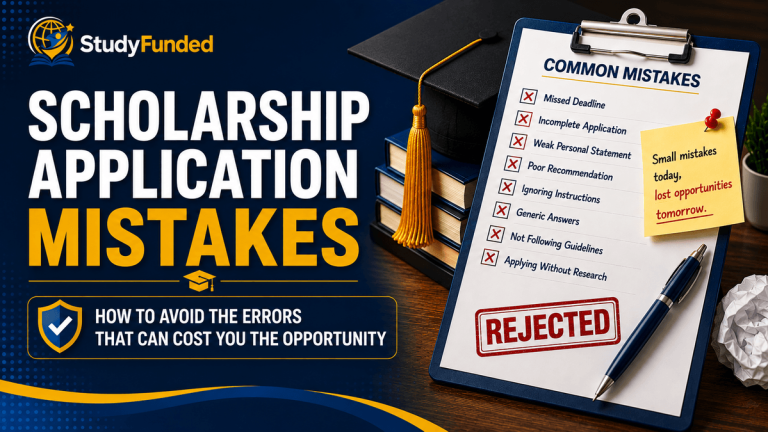
Once you have verified the opportunity, you can focus on preparing a competitive application. Our guide to Common Scholarship Application Mistakes That Lead to Rejection explains preventable errors to avoid.
4. Verify the Application Channel
Pay attention to where the scholarship asks you to submit your application.
An external application platform does not automatically indicate fraud. Universities and organizations sometimes use third-party systems to manage applications. The important question is whether you can establish a legitimate connection between that platform and the scholarship provider.
Take extra care if someone asks you to submit documents through an unrelated website, communicate only with an unexplained individual, or send important documents to a personal account without a clear reason.
Before uploading your passport, transcript, CV, or other personal documents, establish who will receive them and why they need them.
5. Verify Contact Information Independently
If you receive a scholarship offer by email or message, do not rely solely on the contact details in that communication.
Visit the organization’s official website and find its published contact information. If you need clarification, contact the organization through that independently verified channel.
This can help you detect attempts to impersonate universities, government agencies, foundations, and other recognized institutions.
6. Look for Evidence That the Opportunity Is Real
If an organization claims that its scholarship has operated for several years, look for evidence of previous application cycles, such as:
- Previous official announcements.
- Archived programme information.
- Recipient announcements.
- Institutional news.
- References from universities or established organizations.
A new scholarship is not automatically suspicious because it lacks a long public history. Some organizations also choose not to publish recipient information.
Consider the overall evidence. Your aim is to establish that the sponsor, scholarship, and application process make sense when checked independently.
Warning Signs to Watch For
Certain warning signs should make you slow down and investigate further. One unusual detail does not always prove fraud, but several unresolved concerns warrant particular caution.
Guaranteed Scholarship Awards
Be cautious when someone guarantees that you will receive a scholarship simply because you apply.
Legitimate scholarships can explain their eligibility requirements and selection process. An unconditional promise of funding deserves scrutiny, particularly when the opportunity provides little information about how recipients are selected.
Unexplained Payment Requests
Be extremely cautious if someone asks you to pay a fee to:
- Guarantee your selection.
- Release or activate scholarship funds.
- Process an award you supposedly won.
- Claim a scholarship you never applied for.
Not every education-related payment is automatically fraudulent. The important questions are why you are paying, who receives the money, and whether the charge can be independently verified through the organization involved.
The U.S. Federal Trade Commission’s guidance on scholarship and financial-aid scams explains common warning signs, including requests for upfront payments.
Pressure to Act Immediately
A genuine scholarship can have a genuine deadline. Urgency becomes a warning sign when someone uses it to discourage you from checking the opportunity.
Be cautious of messages demanding immediate payment, personal information, or documents before you have had time to verify the scholarship.
A short deadline should encourage you to work efficiently—not abandon basic checks.
Requests for Highly Sensitive Information
Scholarship applications may legitimately require personal and academic information. However, an unfamiliar organization should not receive sensitive information simply because someone requests it.
Never provide passwords, one-time authentication codes, banking credentials, or similar sensitive information to an unverified scholarship contact.
Mismatched Websites and Contact Details
Look closely when a scholarship’s branding or contact information does not match the organization claiming to offer it.
Warning signs include:
- A domain with no clear connection to the organization.
- An email address that does not match the claimed institution.
- Inconsistent organization names.
- Links that redirect to unrelated websites.
- Contact details that cannot be independently verified.
Consider these signs alongside the other evidence rather than treating one unusual detail as conclusive proof of fraud.
An Opportunity You Cannot Independently Verify
If you cannot establish who offers the scholarship, find credible evidence that it exists, or verify how to apply, do not proceed simply because the offer looks attractive.
Your time and personal information are valuable. An opportunity that cannot survive basic verification does not deserve either.
Use the Green–Yellow–Red Test Before You Apply
After checking the sponsor, official source, requirements, and application process, classify the opportunity according to the evidence you have gathered.
Green — Proceed
The scholarship is supported by credible evidence. You can verify the sponsor, scholarship, eligibility requirements, deadline, stated benefits, and application process.
You can proceed while following the normal application instructions.
Yellow — Investigate
The opportunity may be legitimate, but important details remain unclear. For example, the scholarship may be new, information may differ between sources, or the application may use a third-party platform whose connection to the provider has not been established.
A yellow rating does not mean the scholarship is fraudulent. It means you should investigate further before submitting sensitive information or making a payment.
Red — Stop
You cannot verify the sponsor or scholarship, or serious warning signs remain unresolved.
These may include unexplained payment demands, guaranteed selection, an unsolicited claim that you have won, requests for highly sensitive information, obvious impersonation, or an application route unrelated to the supposed provider.
When an opportunity falls into the red category, do not let attractive funding promises convince you to proceed.
What to Do If You Still Cannot Verify a Scholarship
If important questions remain unanswered, stop before sending money or sensitive information.
- Identify the organization behind the scholarship.
- Find its official website independently.
- Check whether the scholarship appears through an authoritative source.
- Compare the official details with the offer you received.
- Verify the application and contact channels.
- Contact the organization through independently verified information if necessary.
If you still cannot establish that the opportunity is genuine, walking away is a reasonable decision. You do not have to prove that a scholarship is fraudulent before deciding not to apply.
Once you have verified that an opportunity is legitimate and suitable for your profile, our guide to How to Increase Your Chances of Winning a Scholarship covers ways to strengthen your application.
Scholarship Verification Checklist
Before you apply, use this checklist to confirm the essential details.
| Verification question | What to confirm |
|---|---|
| Who offers the scholarship? | The sponsor is clearly identified. |
| Does the sponsor exist? | You can independently verify the organization. |
| Is the scholarship genuine? | An authoritative source confirms the opportunity. |
| Are the requirements clear? | Eligibility, benefits, deadlines, and instructions are available. |
| Is the application route legitimate? | You can connect the application platform to the provider. |
| Are the contact details genuine? | You can verify them independently. |
| Is someone asking for money? | You understand the purpose, recipient, and legitimacy of the charge. |
| Can you verify the opportunity? | The available evidence supports its authenticity. |
If important questions remain unanswered, investigate before you apply.
Frequently Asked Questions
How can I tell if a scholarship is legitimate?
Identify the organization offering the scholarship and verify the opportunity independently through its official website or another authoritative source. Check the eligibility requirements, benefits, deadline, application process, and contact information before applying.
Are scholarship websites safe to use?
Some scholarship websites provide useful information, but third-party listings should be treated as discovery tools rather than final proof. Verify important opportunities with the original scholarship provider.
How can I verify a scholarship I found on WhatsApp or Facebook?
Do not rely on the post or message itself. Identify the organization offering the scholarship, find its official website independently, and check whether the scholarship appears there. Contact the organization through independently verified details if necessary.
Do legitimate scholarships charge application fees?
A request for an upfront fee to guarantee, process, release, or activate a scholarship is a major warning sign. If an opportunity involves a payment, verify its purpose, recipient, and legitimacy directly with the organization before paying.
How can I verify a scholarship offer I received by email?
Do not rely only on links or contact details in the email. Find the organization independently, visit its official website, and check whether the scholarship exists there. Contact the organization through its independently verified channels if you still have questions.
What should I do if I suspect a scholarship is not legitimate?
Stop before sending money or sensitive information. Verify the sponsor and scholarship independently. If you determine that the opportunity is fraudulent, avoid further engagement and report it through the appropriate platform or authority.
Conclusion
Finding legitimate scholarships online requires more than knowing where to search. You also need to know how to verify what you find.
Start with credible sources, identify the actual sponsor, confirm the opportunity through an independent authoritative source, examine the application process, and take unresolved warning signs seriously.
A scholarship listing can help you discover an opportunity, but the original provider should be your final reference for confirming its authenticity, requirements, and application process.
Most importantly, do not let an attractive scholarship or urgent deadline push you into skipping basic checks.
Find it. Verify it. Evaluate it. Then apply.
That simple process can help you spend more time pursuing genuine scholarship opportunities—and less time dealing with misleading or fraudulent offers.