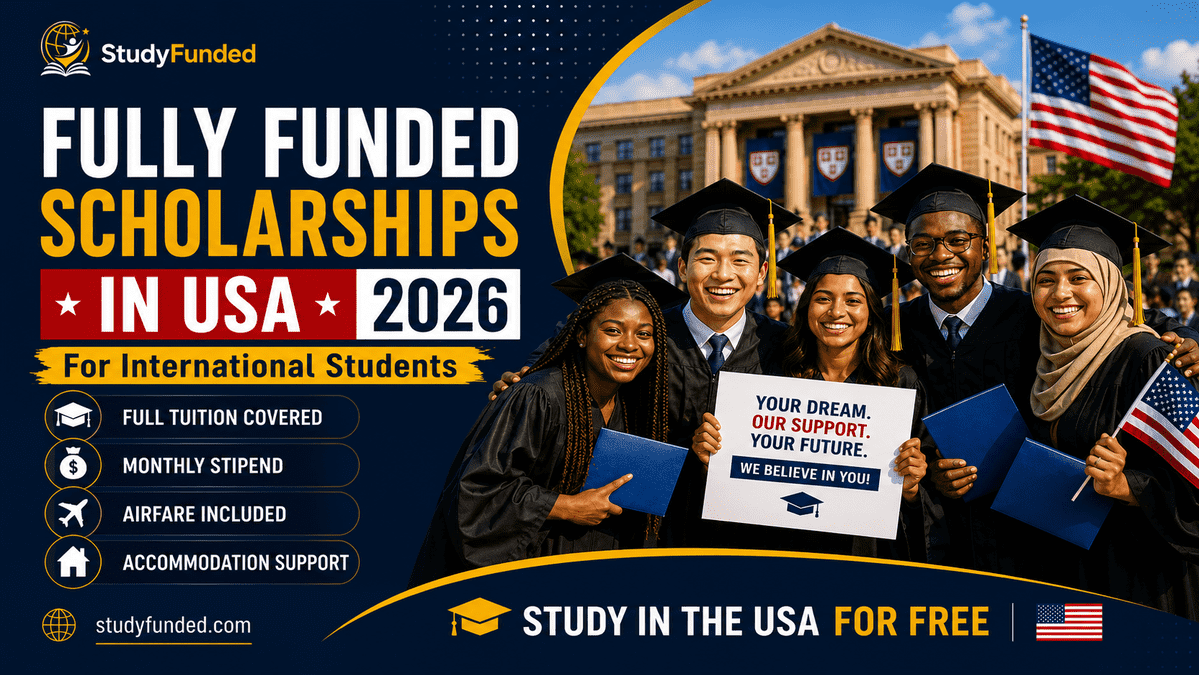
For students searching for fully funded scholarships in the USA, the main challenge is often finding funding that covers the substantial cost of studying in the United States.
Funding can come from governments, universities, private foundations, and other organisations. However, these opportunities do not all work the same way. Some are traditional scholarships, while others are fellowships, need-based financial aid, or funding attached to graduate programmes.
This guide explores major fully funded scholarships and funding opportunities in the USA for international students in 2026, including how they work, who may be eligible, what they may cover, and what to verify before applying.
Whether you are considering a bachelor’s degree, master’s programme, PhD, or professional fellowship, understanding the funding model is just as important as finding the opportunity itself.
Quick Summary of Fully Funded Scholarships in the USA 2026
International students can investigate opportunities such as the Fulbright Foreign Student Program, Knight-Hennessy Scholars at Stanford University, Yale Financial Aid, Harvard Financial Aid, Princeton Financial Aid, MIT Financial Aid, Amherst College Financial Aid, AAUW International Fellowships, and the Hubert H. Humphrey Fellowship Program.
Depending on the opportunity, funding may include:
- Full or substantial tuition support
- Monthly living stipends
- Accommodation support
- Health insurance
- Airfare or travel support
- Research or academic funding
- Professional development opportunities
The exact benefits vary by provider. An opportunity described as “fully funded” should therefore be checked against its official funding terms before you apply.
What Does a Fully Funded Scholarship in the USA Cover?
Not all scholarships and funding programmes cover the same expenses.
A comprehensive funding package may include some combination of:
Academic Costs
- Full or partial tuition fees
- Mandatory university fees
- Research expenses, where applicable
Living Expenses
- Monthly stipend
- Housing allowance
- Meal or living allowance
Travel Costs
- International airfare
- Travel grants or allowances
Health Coverage
- Medical insurance
- Other approved health-related benefits
Additional Support
Some programmes may also provide:
- Conference funding
- Research grants
- Book or academic-material allowances
- Leadership development
- Professional development opportunities
The exact benefits depend on the provider and the individual funding arrangement.
It is therefore important not to assume that every opportunity described as “fully funded” covers exactly the same expenses.
Major Funding Opportunities in the USA for International Students 2026
The opportunities below represent several different funding models available to international students.
| Opportunity | Study Level | Funding Model | International Applicants |
|---|---|---|---|
| Fulbright Foreign Student Program | Master’s, PhD and related programmes | Government-sponsored programme | Eligible applicants from participating countries |
| Knight-Hennessy Scholars | Graduate | Stanford scholarship | Applicants from around the world |
| Yale Financial Aid | Undergraduate | Need-based financial aid | Eligible international students |
| Harvard Financial Aid | Undergraduate | Need-based financial aid | Eligible international students |
| Princeton Financial Aid | Undergraduate | Need-based financial aid | Eligible international students |
| MIT Financial Aid | Undergraduate | Need-based financial aid | Eligible international students |
| Amherst College Financial Aid | Undergraduate | Need-based financial aid | Eligible international students |
| AAUW International Fellowships | Postgraduate | Fellowship | Eligible international women |
| Hubert H. Humphrey Fellowship | Professional | Government-sponsored fellowship | Citizens of eligible countries |
These opportunities should not be treated as identical scholarship packages. Their eligibility requirements, application processes, and funding arrangements differ.
1. Fulbright Foreign Student Program
The Fulbright Foreign Student Program is a U.S. government-sponsored programme that supports eligible students and professionals from participating countries who seek graduate study, research, or related academic opportunities in the United States.
Fulbright operates through country-specific programmes, so eligibility and application procedures can vary depending on the applicant’s country.
What Fulbright May Cover
Funding varies by country and programme, but Fulbright awards may include:
- Tuition and required university fees
- A monthly living allowance
- Health insurance
- International travel support
- Books or academic materials, where applicable
Eligible Study Levels
Fulbright opportunities commonly support:
- Master’s degree programmes
- PhD programmes
- Research programmes
The exact study options depend on the programme serving the applicant’s country.
Who Can Apply?
Requirements vary by country, but applicants may be assessed on factors such as:
- Academic preparation
- Leadership experience
- Community involvement
- Professional or academic goals
- Potential contribution after completing the programme
Applicants should follow the current instructions provided by the official Fulbright programme in their country.
For a detailed guide covering eligibility, documents, essays, recommendations, and the selection process, see our Fulbright Foreign Student Program 2027 Guide.
2. Knight-Hennessy Scholars at Stanford University
The Knight-Hennessy Scholars programme supports eligible graduate students at Stanford University.
The programme is open to applicants from around the world, although applicants must also satisfy the admission requirements of their chosen Stanford graduate programme.
Funding
Support may include:
- Tuition and associated fees
- A living stipend
- Travel funding
- Leadership development opportunities
Eligible Programmes
Knight-Hennessy can support eligible graduate study across Stanford’s schools and programmes, including areas such as:
- Business
- Engineering
- Medicine
- Law
- Education
- Humanities
- Sciences
Applicants should verify whether their intended Stanford degree is eligible under the current programme rules.
An Important Distinction
Knight-Hennessy selection and Stanford graduate admission are separate processes.
Being interested in Knight-Hennessy does not remove the requirement to apply to and satisfy the admission requirements of the relevant Stanford graduate programme.
3. Yale University Need-Based Financial Aid
Yale is an example of why international students should not restrict their search to opportunities carrying the word “scholarship.”
The university provides need-based financial aid to eligible international undergraduate students and states that it meets 100% of demonstrated financial need for admitted students.
This is financial aid rather than a conventional merit scholarship.
The distinction matters.
An academically strong applicant does not automatically receive a full award simply because of high grades. Financial circumstances are evaluated under the university’s financial-aid policies.
For international students seeking undergraduate study in the United States, this type of institutional funding can therefore be an important route to investigate.
4. Harvard University Financial Aid
Harvard University provides need-based financial aid to eligible undergraduate students, including international students.
The amount of assistance is based on the student’s demonstrated financial circumstances rather than a single fixed scholarship amount available to every applicant.
Depending on the individual financial-aid package, support may contribute toward costs such as:
- Tuition
- Housing
- Food
- Other educational expenses
Admission and financial aid are separate considerations. Students must first satisfy Harvard’s admission requirements and then complete the required financial-aid process.
For international applicants, this distinction is important because financial-aid eligibility does not guarantee admission.
5. Princeton University Financial Aid
Princeton University provides need-based financial aid to admitted students, including eligible international students.
The university’s financial-aid model is based on demonstrated financial need rather than a universal merit scholarship available to every applicant.
Depending on the student’s circumstances, financial aid may help cover:
- Tuition
- Housing
- Food
- Other required educational expenses
Students considering Princeton should review the current international admission and financial-aid requirements before applying.
6. Massachusetts Institute of Technology (MIT) Financial Aid
MIT provides need-based financial aid to eligible international undergraduate students.
For undergraduate admissions, the university states that it is need-blind and commits to meeting the demonstrated financial need of admitted students, including international students.
This is another example of why international applicants should investigate university financial-aid policies, not only external scholarships.
Financial support should not be confused with admission. Applicants must first satisfy the university’s admission requirements and complete the required financial-aid process.
MIT may be particularly relevant to students interested in:
- Engineering
- Computer science
- Technology and innovation
- Scientific research
7. Amherst College Financial Aid
Amherst College provides need-based financial aid to eligible students, including international students.
The college’s smaller liberal arts environment may appeal to students who prefer close faculty interaction and a broad undergraduate education.
International applicants should examine both the admission requirements and the financial-aid process because support is based on individual circumstances rather than being a single standard scholarship award.
Potential areas of support may include:
- Tuition
- Housing
- Food
- Other demonstrated financial need
Applicants should verify the current financial-aid policy directly with Amherst before applying.
8. AAUW International Fellowships
AAUW International Fellowships support eligible women who are pursuing postgraduate study in the United States.
The programme is intended for women who are not U.S. citizens or permanent residents and who meet the programme’s academic and eligibility requirements.
Eligible Applicants
Requirements include conditions relating to:
- Citizenship or residency
- Gender
- Academic preparation
- Intended postgraduate study
- Admission or enrolment status
Applicants should review the current programme requirements for the relevant application cycle.
What the Fellowship Supports
The fellowship provides funding for eligible postgraduate study and associated educational expenses.
The exact award amount, eligible study levels, and permitted uses of the funding should be confirmed from the official programme information before applying.
Beyond financial support, the fellowship is intended to support women whose education and professional development can contribute to their communities and wider society.
9. Hubert H. Humphrey Fellowship Program
Unlike a traditional degree scholarship, the Hubert H. Humphrey Fellowship is a non-degree professional development programme.
It brings experienced professionals from eligible countries to the United States for graduate-level study, leadership development, and professional collaboration.
Funding Coverage
The fellowship provides support that may include:
- Tuition and fees
- A living allowance
- International and programme-related travel
- Health coverage
- Professional development funding
- A computer allowance
- Support for approved professional activities
Eligibility
Applicants generally need to satisfy requirements relating to:
- Academic qualifications
- Professional experience
- Leadership potential
- Public or community service
- English-language ability
- Citizenship in an eligible country
The programme is intended for experienced professionals rather than applicants seeking a conventional undergraduate, master’s, or PhD scholarship.
For detailed guidance, see our Hubert H. Humphrey Fellowship Guide.
Funding by Study Level
The most useful funding route can depend heavily on the level of study you intend to pursue.
Undergraduate Study
International undergraduate students can investigate:
- University need-based financial aid
- Institutional scholarships
- Named international scholarships
- External scholarship programmes
Need-based financial aid is particularly important because some U.S. universities provide substantial assistance to admitted international students based on demonstrated financial need.
Master’s Study
Funding for international master’s students varies considerably between universities and programmes.
Potential routes include:
- University scholarships
- External scholarships and fellowships
- Government-sponsored programmes
- Graduate fellowships
- Departmental funding
- Research or teaching assistantships
Some master’s programmes offer limited institutional funding, while others have specific fellowships or assistantship opportunities.
PhD Study
Doctoral applicants should look beyond traditional scholarships.
Many U.S. PhD programmes provide funding through combinations of:
- Tuition support
- Stipends
- Fellowships
- Research assistantships
- Teaching assistantships
- Research grants
For this reason, searching directly for funded PhD programmes in your field can sometimes be more useful than searching only for the phrase “fully funded scholarship.”
Professional Fellowships
Experienced professionals may have funding routes that are not degree programmes.
The Hubert H. Humphrey Fellowship is one example.
Other professional opportunities may focus on leadership, policy, development, public service, research, or professional training.
The eligibility criteria for these programmes can differ significantly from university scholarships.
How Admission and Funding Work Together
One of the most important things international applicants should understand is that admission and funding are not always the same process.
Depending on the opportunity:
- You may apply for admission and financial aid together.
- You may need a separate scholarship application.
- Funding may be considered automatically after admission.
- A department may award funding after accepting you into a graduate programme.
- A fellowship may require an application before university admission.
Never assume that applying to a university automatically means you have applied for every scholarship or funding opportunity available there.
Check the official instructions for both the academic application and the funding application.
What International Students Should Check Before Applying
Before investing significant time in an application, confirm the following:
1. Country Eligibility
Some opportunities are open internationally, while others are restricted to citizens of specific countries.
2. Study Level
Check whether the opportunity supports undergraduate, master’s, PhD, or professional study.
3. Programme Eligibility
A scholarship may support only selected programmes or fields.
4. Funding Coverage
Find out exactly what the award covers.
Do not assume that “fully funded” means every possible expense is covered.
5. English-Language Requirements
Check whether the university accepts IELTS, TOEFL, Duolingo English Test, previous education in English, or another form of evidence.
The scholarship’s requirements and the university’s admission requirements may not be identical.
6. Credential Evaluation
Some universities evaluate international qualifications themselves, while others may request an external credential evaluation.
Follow the requirements of your specific institution and programme before obtaining an evaluation.
7. Application Deadline
Different components of an application may have different deadlines.
Check:
- Admission deadline
- Scholarship deadline
- Financial-aid deadline
- Recommendation deadline
- Test-score deadline
8. Separate Application Requirements
Confirm whether the scholarship or financial-aid process requires an additional application beyond the university admission application.
Preparing Your Application
Application requirements vary between universities and funding providers.
Depending on the opportunity, you may need:
- Academic transcripts
- Degree certificates
- CV or résumé
- Personal statement
- Statement of Purpose
- Recommendation letters
- English-language test results
- Research proposal
- Financial documents
- Passport or identification
- Other programme-specific materials
Do not prepare documents simply because another scholarship applicant was required to submit them. Follow the official requirements for the specific opportunity.
For detailed guidance on individual application documents, see our guides on:
For broader application strategy, see Increase Your Chances of Winning a Scholarship.
If you want to understand common application problems, see our guide to Scholarship Application Mistakes.
Funding for African Students
African applicants can pursue many of the U.S. funding opportunities discussed in this guide, but nationality, country-specific eligibility, and application routes can vary.
For a more focused discussion of opportunities, funding routes, and application considerations relevant to African applicants, see Mastercard Foundation Scholars Program: Eligibility & How to Apply
That guide focuses specifically on African applicants rather than repeating the broader international funding information covered here.
Frequently Asked Questions About Fully Funded Scholarships in the USA 2026
Can international students study in the USA for free?
In some cases, yes.
International students can receive scholarships, fellowships, or need-based financial aid that covers most or all of their educational and living costs.
However, coverage varies by programme, university, and individual financial circumstances.
Examples include the Fulbright Foreign Student Program, Knight-Hennessy Scholars, and need-based financial aid at universities such as Yale, Harvard, Princeton, and MIT.
Students should review the exact funding terms before assuming that an opportunity will cover every expense.
Can I get a fully funded scholarship in the USA without IELTS?
Possibly.
English-language requirements vary by university and programme. Some institutions accept alternatives to IELTS, while others may provide exemptions under specific conditions.
Possible alternatives can include:
- TOEFL
- Duolingo English Test
- Previous education conducted in English
- An institution-approved exemption or waiver
Do not assume that an English-medium degree automatically qualifies you for a waiver. Check the requirements of your intended university and programme.
Can undergraduate students get fully funded scholarships in the USA?
Yes.
Several U.S. universities provide substantial financial aid packages for eligible international undergraduate students.
Examples include:
- Yale University
- Harvard University
- Princeton University
- Amherst College
These institutions have policies that can provide substantial need-based financial aid to admitted international students, with coverage determined by the student’s demonstrated financial need and the institution’s current policy.
Can international students get fully funded master’s scholarships in the USA?
Yes, although funding availability varies significantly between programmes.
Potential routes include university scholarships, external fellowships, government-sponsored programmes, departmental funding, and graduate assistantships.
Applicants should investigate the specific department and programme rather than assuming that every U.S. master’s degree offers the same funding opportunities.
Can international students get fully funded PhD programmes in the USA?
Yes.
Many U.S. doctoral programmes provide funding through combinations of tuition support, stipends, fellowships, teaching assistantships, and research assistantships.
For PhD applicants, searching for funded doctoral programmes in a specific field can therefore be more useful than searching only for standalone scholarships.
Can working professionals apply for fully funded Scholarships in the USA?
Yes.
Programmes such as the Hubert H. Humphrey Fellowship specifically target experienced professionals seeking leadership development and professional growth.
These opportunities often have professional experience requirements that differ from conventional university scholarships.
Final Thoughts
Fully funded opportunities in the USA exist across government programmes, universities, foundations, fellowships, and other funding providers.
The important task is not simply to collect a long list of scholarship names. It is to identify funding that matches your study level, programme, academic background, nationality, and financial circumstances.
Start with the programme you want to study, investigate the funding connected to it, and then consider relevant external opportunities.
Most importantly, verify the eligibility requirements, funding coverage, application process, and deadline with the official provider before applying.
A scholarship listing can help you discover an opportunity, but the official university or funding organisation should be your final source for current application information.
Official Scholarship Resources for Fully Funded Scholarships in the USA
Scholarship requirements, funding coverage, eligibility rules, and application deadlines can change from one application cycle to another.
Before applying, review the official page for each opportunity to confirm the current requirements, available study levels, funding details, and application process.
Use the following official resources to begin your research:
- Fulbright Foreign Student Program
- UC Berkeley Mastercard Foundation Scholars Program
- Yale Financial Aid
- Duke University Financial Aid
- Harvard Griffin GSAS
- MIT Student Financial Services
Scholarship requirements, funding arrangements, eligible programmes, and deadlines can change. Always confirm the current information directly with the scholarship provider or university before submitting an application.