Scholarships in Germany Without IELTS for International Students 2026: Fully Funded Opportunities and Application Guide

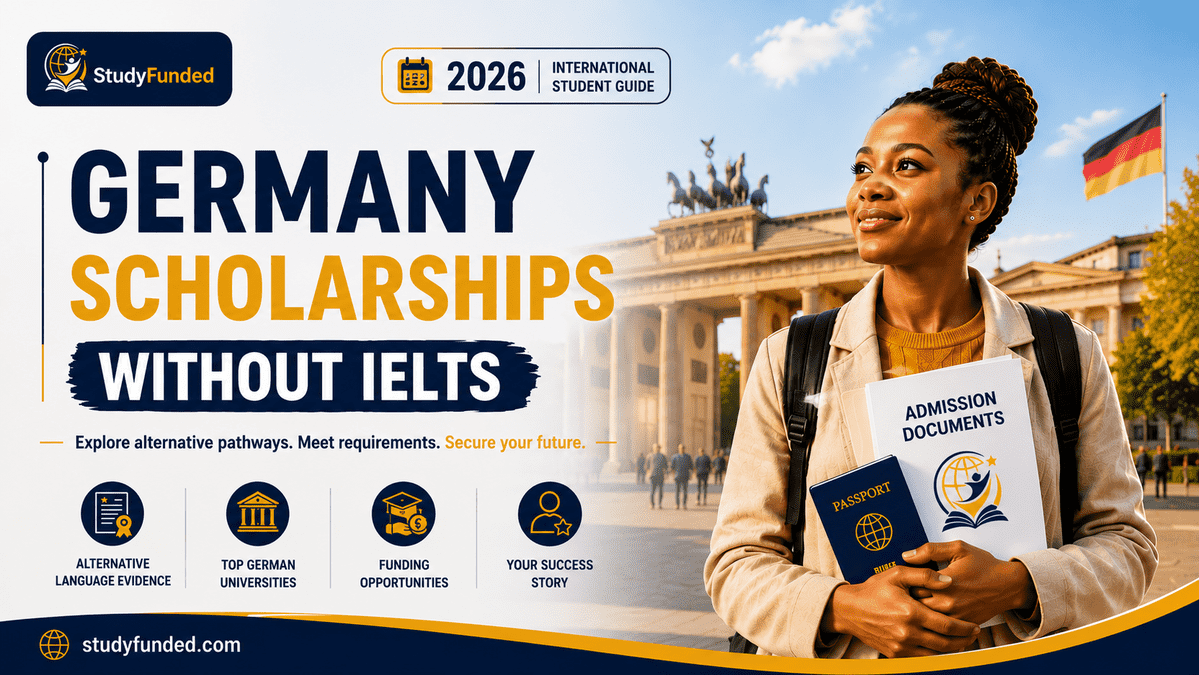
Many international students dream of studying in Europe but assume they need both a high IELTS score and a large budget to make it happen. Fortunately, several scholarships in Germany for international students in 2026 that do not require IELTS may provide an alternative pathway for qualified applicants who can demonstrate English proficiency through other accepted methods.

Germany has become one of the most attractive destinations for international students thanks to its world-class universities, affordable education system, strong research opportunities, and excellent career prospects. In some cases, students who completed previous studies in English may be able to apply using a Medium of Instruction (MOI) certificate, TOEFL scores, Cambridge English qualifications, or other recognized alternatives instead of IELTS.

The challenge is not simply finding scholarships. The real challenge is identifying legitimate opportunities, understanding university language requirements, and preparing an application that stands out among thousands of candidates competing for funding.

This guide explores scholarships in Germany without IELTS, universities that may accept alternative language qualifications, eligibility requirements, and practical steps to improve your chances of securing funding for the 2026 academic cycle.


Can You Study in Germany Without IELTS in 2026?

The short answer is yes, in some situations, studying in Germany without IELTS is possible.

Some universities and scholarship programs may accept alternative proof of English proficiency, such as a Medium of Instruction (MOI) certificate, TOEFL scores, Cambridge English qualifications, or a previous degree taught in English.

However, many students misunderstand what “without IELTS” actually means.

Studying in Germany without IELTS does not mean that universities ignore English proficiency requirements. Instead, some institutions allow applicants to demonstrate their English language ability through alternative methods.

These alternatives may include:

  • Medium of Instruction (MOI) certificates
  • TOEFL scores
  • Cambridge English qualifications
  • Duolingo English Test (where accepted)
  • University-conducted interviews
  • Previous degrees completed in English

Each university and scholarship program sets its own admission requirements. What works for one institution may not apply to another.

What Is a Medium of Instruction Certificate?

A Medium of Instruction (MOI) certificate is a document issued by your previous school or university confirming that your education was conducted in English.

For many international students, especially those from countries where English is widely used in higher education, this document can sometimes serve as an alternative to IELTS.

Before relying on an MOI certificate, always verify whether the specific university and scholarship program accepts it.

Common Misconception

Many websites publish lists claiming that certain German universities “do not require IELTS.”

That statement can be misleading.

A more accurate description is:

Some German universities may accept alternative proof of English proficiency instead of IELTS for eligible applicants.

Always review the latest admission requirements directly from the university before applying.

Why This Matters for Scholarship Applicants

Scholarship committees often evaluate applications based on:

  • Academic performance
  • Leadership potential
  • Research experience
  • Professional achievements
  • Language proficiency
  • Motivation and future goals

Language requirements are only one part of the overall application process.

Students who focus solely on finding “no IELTS scholarships” often overlook the factors that have a much greater influence on scholarship selection.

Your dream scholarship may not be out of reach; it may simply be in a country or program you haven’t considered yet. See our breakdown of: Fully Funded Scholarships in Canada Without IELTS.


Why Germany Is Becoming More Popular Among African Students

Germany has become an increasingly attractive destination for students from Nigeria, Ghana, Kenya, South Africa, and other African countries seeking quality education without the extremely high costs associated with some study destinations.

Several factors contribute to this growing interest:

  • Access to internationally recognized degrees
  • Opportunities for fully funded scholarships
  • Strong demand for STEM and research graduates
  • Affordable public universities
  • Post-study career opportunities
  • A growing international student community

For many African students, Germany offers a rare combination of academic quality, affordability, and career potential. This makes it one of the most practical destinations for students who want a globally respected education while minimizing financial barriers.


Why Germany Is One of the Best Countries for International Students

Germany has steadily built a reputation as one of the most accessible and rewarding study destinations in the world.

Unlike many countries where international students face extremely high tuition fees, Germany offers a large number of affordable programs, particularly at public universities.

This combination of quality education and affordability makes Germany a top choice for scholarship seekers.

World-Class Universities

Germany is home to internationally recognized institutions known for excellence in:

  • Engineering
  • Technology
  • Medicine
  • Business
  • Environmental Sciences
  • Renewable Energy
  • Artificial Intelligence
  • Research and Innovation

Universities such as the Technical University of Munich, RWTH Aachen University, Heidelberg University, and Humboldt University of Berlin consistently attract students from across the globe.

Degrees from German universities are respected by employers and academic institutions worldwide.

Growing Number of English-Taught Programs

A common concern among international students is the German language.

While learning German offers significant advantages, many universities now provide programs taught entirely in English, particularly at the Master’s and PhD levels.

This expansion has opened the door for thousands of international applicants who may not yet be fluent in German.

Affordable Education

One of Germany’s strongest advantages is affordability.

Compared to destinations such as the United States, the United Kingdom, Canada, and Australia, Germany often offers significantly lower educational costs.

Many public universities charge little or no tuition fees for certain programs, although students are generally responsible for semester contributions and living expenses.

For scholarship recipients, this affordability can dramatically reduce the overall financial burden of studying abroad.

Strong Research Opportunities

Germany invests heavily in research and innovation.

Students pursuing advanced degrees often gain access to:

  • Modern laboratories
  • Research institutes
  • Industry partnerships
  • International collaborations
  • Government-funded projects

This makes Germany particularly attractive for Master’s and PhD candidates seeking academic and professional growth.

Excellent Career Prospects

Many international students choose Germany not only for education but also for career opportunities.

Graduates may benefit from:

  • Access to Europe’s largest economy
  • Opportunities in engineering and technology sectors
  • Strong demand for skilled professionals
  • Post-study work options
  • Pathways to long-term employment

For ambitious students, a scholarship can become the first step toward building an international career.

Multicultural Learning Environment

German universities host students from virtually every region of the world.

Studying alongside peers from different cultures provides opportunities to:

  • Build international networks
  • Develop global perspectives
  • Improve communication skills
  • Gain cross-cultural experience

These advantages often continue to benefit graduates long after completing their studies.


Why Many Scholarship Applicants Fail Before They Even Apply

One of the most overlooked realities of scholarship applications is that rejection often begins long before the application is submitted.

Many students make critical mistakes during the preparation stage.

Mistake #1: Focusing Only on Funding

Some applicants spend months searching for scholarships without researching admission requirements.

Remember:

A scholarship application is often connected to university admission.

If you do not meet the academic or language requirements of the program, funding opportunities become irrelevant.

Mistake #2: Waiting Until Deadlines Approach

Strong scholarship applications require time.

Successful candidates typically spend months preparing:

  • Academic documents
  • Recommendation letters
  • Personal statements
  • Research proposals
  • Language certificates

Starting early provides a significant advantage.

Mistake #3: Using Generic Motivation Letters

Scholarship reviewers read thousands of applications.

Generic essays are easy to identify.

Strong applicants explain:

  • Why they selected Germany
  • Why they chose a specific program
  • Their career objectives
  • Their potential impact on society

Mistake #4: Ignoring Scholarship Selection Criteria

Every scholarship provider seeks different qualities.

Some prioritize:

  • Academic excellence

Others value:

  • Leadership
  • Community service
  • Research achievements
  • Professional experience

Understanding these priorities can significantly improve your chances.

Mistake #5: Believing That Good Grades Are Enough

Excellent academic performance helps.

But scholarship committees often look for evidence of:

  • Initiative
  • Leadership
  • Commitment
  • Problem-solving ability
  • Long-term vision

Students who demonstrate these qualities frequently outperform applicants with similar academic records.


Preparing for Scholarship Applications in Germany: A 12-Month Roadmap

Many successful scholarship recipients begin preparing nearly a year before their intended intake.

The earlier you start, the stronger your application can become.

Timeline Recommended Action
12 Months Before Research scholarships and universities
10 Months Before Check language requirements
9 Months Before Request academic transcripts
8 Months Before Obtain recommendation letters
7 Months Before Prepare a personal statement
6 Months Before Gather language proficiency evidence
5 Months Before Shortlist scholarship opportunities
4 Months Before Submit university applications
3 Months Before Complete scholarship applications
2 Months Before Prepare for interviews
1 Month Before Monitor application updates

This preparation timeline may seem extensive, but it dramatically improves the quality of your application and reduces last-minute mistakes.

If studying in the UK is your goal, understanding the scholarship process early can significantly increase your chances of securing full funding. Many students miss out on life-changing opportunities simply because they start too late or overlook key requirements.

Explore our guide on: Fully Funded Scholarships in the UK Without IELTS.


Top Scholarships in Germany Without IELTS for International Students 2026

Germany offers a wide range of scholarship opportunities for international students pursuing Bachelor’s, Master’s, PhD, and research programs. While scholarship providers may not directly state “IELTS not required,” many applicants successfully qualify using alternative forms of English proficiency accepted by their chosen universities.

The key is understanding that scholarship eligibility and university admission requirements often work together. If your university accepts an alternative to IELTS, that acceptance may also support your scholarship application.

The following opportunities are among the most recognized scholarships available to international students planning to study in Germany in 2026.

Quick Comparison of Germany Scholarships Without IELTS

Scholarship Level Funding Type International Students Eligible
DAAD Scholarship Master’s, PhD Fully Funded Yes
Erasmus Mundus Master’s Fully Funded Yes
Heinrich Böll Foundation Master’s, PhD Fully Funded / Partial Yes
Friedrich Ebert Stiftung Bachelor’s, Master’s, PhD Fully Funded / Partial Yes
Deutschlandstipendium Bachelor’s, Master’s Partial Funding Yes
Konrad Adenauer Stiftung Master’s, PhD Fully Funded / Partial Yes
Rosa Luxemburg Foundation Master’s, PhD Fully Funded / Partial Yes

The scholarships below are explained in more detail, including funding benefits, eligibility considerations, and the type of applicants most likely to be selected.


DAAD Scholarship

When discussing scholarships in Germany, the first name most students encounter is the German Academic Exchange Service (DAAD).

The DAAD Scholarship is one of the largest and most respected international scholarship programs in the world.

It supports highly qualified students and researchers from developing and developed countries across various academic disciplines.

Study Levels

  • Master’s Programs
  • PhD Programs
  • Research Fellowships
  • Postgraduate Courses

Funding Benefits

Depending on the program, benefits may include:

  • Monthly stipend
  • Travel allowance
  • Health insurance coverage
  • Research allowance
  • Accommodation support
  • Family benefits (for eligible candidates)

Who Should Consider DAAD?

DAAD is particularly attractive for:

  • Recent graduates
  • Early-career professionals
  • Researchers
  • Development-focused professionals
  • Students seeking fully funded postgraduate education

Language Requirement Considerations

Language requirements vary by program.

Some English-taught programs may accept alternative evidence of English proficiency where permitted by the host university.

Always verify the requirements for your chosen course before applying.

What Makes DAAD Competitive?

Many applicants focus heavily on grades.

DAAD reviewers often look beyond academics and assess:

  • Leadership potential
  • Professional experience
  • Development impact
  • Academic motivation
  • Future career plans

Students who clearly explain how their education will contribute to their home country’s development often stand out.

Understanding what DAAD looks for is only the first step. Choosing the right funding route, confirming programme-specific eligibility, and preparing a strong motivation letter can make a significant difference to your application. These topics are covered in greater detail in the DAAD Scholarship 2026 guide.


Erasmus Mundus Joint Master’s Scholarships

Although Erasmus Mundus is funded by the European Union rather than Germany alone, many participating programs are hosted by German universities.

This scholarship remains one of the most attractive opportunities for international students seeking a fully funded education in Europe.

Study Level

  • Master’s Degree Programs

Funding Benefits

Typically includes:

  • Full tuition coverage
  • Monthly living allowance
  • Travel expenses
  • Installation allowance
  • Insurance coverage

Unique Advantage

Students usually study in multiple European countries during the program.

This creates opportunities to:

  • Build international networks
  • Gain multicultural experience
  • Access multiple universities
  • Improve career prospects

Why Students Love Erasmus Mundus

Unlike many scholarships that focus on one institution, Erasmus Mundus offers exposure to several universities and academic systems.

For students interested in international careers, this experience can become a major advantage.


Heinrich Böll Foundation Scholarship

The Heinrich Böll Foundation supports academically talented students who demonstrate social engagement and commitment to democratic values.

The scholarship is particularly popular among students pursuing:

  • Environmental Studies
  • Sustainability
  • Political Science
  • Social Sciences
  • Development Studies

Study Levels

  • Master’s Programs
  • Doctoral Programs

Funding Benefits

Support may include:

  • Monthly stipend
  • Research support
  • Networking opportunities
  • Academic mentoring

Ideal Candidates

Successful applicants often demonstrate:

  • Strong academic performance
  • Social involvement
  • Leadership activities
  • Community engagement

One mistake many students make is focusing exclusively on academic achievements.

The Heinrich Böll Foundation places significant value on social responsibility and active citizenship.


Friedrich Ebert Stiftung Scholarship

The Friedrich Ebert Foundation is among Germany’s oldest political foundations.

Its scholarship program supports students who demonstrate both academic ability and commitment to social justice.

Study Levels

  • Bachelor’s Programs
  • Master’s Programs
  • PhD Programs

Funding Benefits

Recipients may receive:

  • Monthly financial support
  • Health insurance assistance
  • Family allowances (where applicable)
  • Educational support programs

Strong Candidates Typically Demonstrate

  • Academic excellence
  • Leadership experience
  • Community service
  • Commitment to social development

Applicants from developing countries often find this scholarship particularly relevant because of its focus on societal impact and future leadership.


Deutschlandstipendium

Unlike some scholarships that focus exclusively on international students, the Deutschlandstipendium supports high-achieving students enrolled at participating German universities.

Study Levels

  • Bachelor’s Programs
  • Master’s Programs

Funding Benefits

Students receive:

  • Monthly financial support
  • Industry networking opportunities
  • Professional mentoring

What Makes It Different?

The program combines funding from:

  • Private sponsors
  • Businesses
  • Foundations
  • Federal government contributions

This creates valuable networking opportunities that can benefit students long after graduation.

Selection Criteria

Universities may consider:

  • Academic achievements
  • Personal accomplishments
  • Community involvement
  • Special circumstances
  • Leadership experience

Konrad Adenauer Stiftung Scholarship

The Konrad Adenauer Foundation supports future leaders who demonstrate academic excellence and commitment to public service.

Study Levels

  • Master’s Programs
  • PhD Programs
  • Research Programs

Funding Benefits

Recipients may receive:

  • Monthly stipend
  • Research support
  • Networking opportunities
  • Leadership training
  • Seminar participation

Ideal Applicant Profile

Strong candidates often demonstrate:

  • Leadership experience
  • Political awareness
  • Community engagement
  • Academic achievement

This scholarship is particularly attractive for students interested in governance, public policy, law, economics, and international relations.


Rosa Luxemburg Foundation Scholarship

The Rosa Luxemburg Foundation supports students and doctoral candidates with strong academic records and social engagement.

Study Levels

  • Master’s Programs
  • PhD Programs

Funding Benefits

May include:

  • Monthly financial support
  • Research assistance
  • Educational seminars
  • Networking opportunities

Selection Priorities

The foundation evaluates:

  • Academic merit
  • Social commitment
  • Personal motivation
  • Community involvement

Students with a strong record of civic participation often perform well during the selection process.


Which Scholarship Is Right for You?

Many applicants ask:

“Which scholarship gives me the highest chance of success?”

The better question is:

“Which scholarship best matches my profile?”

Different scholarship providers prioritize different qualities.

Applicant Profile Strong Scholarship Matches
Development Professional DAAD
Future Researcher DAAD, Erasmus Mundus
Social Activist Heinrich Böll, Rosa Luxemburg
Community Leader Friedrich Ebert Stiftung
Policy and Governance Student Konrad Adenauer Stiftung
High Academic Achiever Deutschlandstipendium

Matching your strengths to scholarship priorities can significantly improve your chances of selection.


Hidden Factors Scholarship Committees Often Evaluate

Many applicants focus only on grades.

Scholarship reviewers often examine factors that never appear in scholarship advertisements.

These hidden factors frequently influence final decisions.

Clarity of Career Goals

Strong candidates can explain:

  • What they want to study
  • Why they chose Germany
  • How the degree supports their plans

Vague ambitions often weaken otherwise strong applications.

Evidence of Initiative

Committees look for people who take action.

Examples include:

  • Volunteer projects
  • Community leadership
  • Research work
  • Entrepreneurship
  • Professional achievements

Long-Term Impact Potential

Many scholarship providers invest in future leaders.

Reviewers often ask:

“How will this applicant use their education after graduation?”

Candidates who provide a convincing answer often gain a competitive advantage.

Authentic Motivation

One of the easiest ways to weaken an application is to submit a generic motivation letter.

Scholarship reviewers read thousands of essays.

They can quickly identify applications written solely to obtain funding.

The strongest applicants demonstrate genuine passion for their field, their goals, and the impact they hope to create.

For ambitious students seeking world-class education and research opportunities, Germany has become one of the most attractive scholarship destinations in Europe.

Check out our breakdown of: Fully Funded Scholarships in Germany for International Students.


German Universities That May Accept Alternatives to IELTS

One reason Germany continues to attract international students is the flexibility some universities offer regarding proof of English proficiency.

That said, students should approach this topic carefully.

Many online articles claim that certain German universities “do not require IELTS.” In reality, universities often require proof of English proficiency but may accept alternatives under specific circumstances.

These alternatives can include:

  • Medium of Instruction (MOI) certificates
  • TOEFL scores
  • Cambridge English qualifications
  • Duolingo English Test (where accepted)
  • University language assessments
  • Previous degrees completed in English

Admission requirements can change from one academic year to another, so applicants should always verify the latest requirements directly from the university.

Some universities that have historically offered English-taught programs and may consider alternative language proof include:

Technical University of Munich (TUM)

TUM is one of Germany’s highest-ranked universities and is particularly well known for:

  • Engineering
  • Computer Science
  • Renewable Energy
  • Business
  • Technology

Many international students target TUM because of its strong industry connections and global reputation.

RWTH Aachen University

RWTH Aachen is among Europe’s leading technical universities.

Popular fields include:

  • Mechanical Engineering
  • Electrical Engineering
  • Artificial Intelligence
  • Data Science
  • Industrial Engineering

The university attracts thousands of international applicants annually.

Free University of Berlin

Known for excellence in:

  • Social Sciences
  • Political Science
  • International Relations
  • Humanities

The university offers several English-taught postgraduate programs.

Humboldt University of Berlin

One of Germany’s most historic institutions, Humboldt University attracts students interested in:

  • Research
  • Social Sciences
  • Economics
  • Natural Sciences

University of Hamburg

The University of Hamburg offers a growing number of international programs and research opportunities.

It remains a popular choice among students seeking a balance between academic quality and affordability.

Karlsruhe Institute of Technology (KIT)

KIT is highly respected in:

  • Engineering
  • Energy Systems
  • Computer Science
  • Innovation Research

Its reputation makes it a frequent destination for scholarship applicants.

University of Freiburg

Students interested in environmental science, sustainability, and research-driven programs often consider the University of Freiburg.

Important Note

Universities evaluate language requirements at the program level, not only at the institutional level.

Two programs within the same university may have completely different language requirements.

Always review the admission page for your specific course before assuming IELTS can be replaced.

Even when a programme accepts an alternative to IELTS, your application still needs to show why you are academically prepared, why the course fits your goals, and what you intend to do with the opportunity. A persuasive Winning Scholarship Personal Statement (With Examples) can help you communicate those points clearly to admissions and scholarship committees.


Alternatives to IELTS That Some German Universities May Accept

Many scholarship applicants mistakenly believe there are only two options:

  1. Take IELTS
  2. Give up on studying abroad

The reality is often more flexible.

Below are some of the most common alternatives accepted by certain German universities and programs.

Alternative Description Common Acceptance
Medium of Instruction (MOI) Proof previous education was taught in English Frequently Accepted
TOEFL International English Language Exam Widely Accepted
Cambridge English Qualifications Advanced English certification Accepted by many institutions
Duolingo English Test Online language assessment Accepted by some programs
University Interview Internal language assessment Occasionally Accepted
Previous Degree in English Bachelor’s or Master’s taught in English Often Considered

Medium of Instruction (MOI)

For many international students, the MOI certificate is the most attractive alternative.

The document typically confirms that:

  • Lectures were conducted in English
  • Examinations were completed in English
  • Academic instruction was delivered in English

Some universities may request additional supporting evidence alongside the certificate.

TOEFL

TOEFL remains one of the most widely recognized alternatives to IELTS.

Students who already possess a valid TOEFL score may not need to take IELTS separately.

Cambridge English Qualifications

Certain institutions accept advanced Cambridge English certifications as evidence of language proficiency.

These qualifications may be particularly useful for students who completed secondary education under the British educational system.

Previous Degree Completed in English

If you earned your Bachelor’s or Master’s degree entirely in English, some universities may accept that as sufficient proof of language ability.

This is particularly relevant for applicants from countries where English serves as a major language of higher education.


Documents Required for Scholarship Applications in Germany

A strong scholarship application depends heavily on documentation.

Many otherwise qualified candidates lose opportunities because of incomplete or poorly prepared submissions.

Although requirements vary between scholarships, the following documents are commonly requested.

Academic Transcripts

Universities and scholarship providers want evidence of your academic performance.

Ensure your transcripts:

  • Are complete
  • Are properly translated if necessary
  • Include official certification where required

Degree Certificates

Applicants typically submit:

  • Secondary school certificates
  • Bachelor’s degree certificates
  • Master’s degree certificates

Depending on the level of study being pursued.

Passport

A valid international passport is usually required.

Make sure it remains valid throughout the application process.

Curriculum Vitae (CV)

Your CV should highlight:

  • Academic achievements
  • Work experience
  • Leadership positions
  • Volunteer activities
  • Research experience
  • Awards and recognitions

Avoid turning your CV into a long autobiography.

Focus on relevance and impact.

Motivation Letter

This document often carries more weight than applicants realize.

A strong motivation letter explains:

  • Why you selected Germany
  • Why you chose the program
  • Your academic goals
  • Your career objectives
  • The impact you hope to create after graduation

Many scholarship committees use this document to distinguish between candidates with similar academic records.

Recommendation Letters

Most competitive scholarships require recommendations from:

  • Professors
  • Academic supervisors
  • Employers
  • Professional mentors

The strongest recommendations contain specific examples rather than generic praise.

Language Proficiency Evidence

Depending on the institution, this may include:

  • IELTS
  • TOEFL
  • MOI certificate
  • Cambridge English qualification
  • Other accepted alternatives

Research Proposal (For PhD Applicants)

Doctoral applicants are often required to submit a detailed research proposal.

A strong proposal demonstrates:

  • Research relevance
  • Academic understanding
  • Originality
  • Methodological clarity

Common Documentation Mistakes That Lead to Rejection

Scholarship committees frequently reject applications for avoidable reasons.

Submitting Incomplete Documents

Missing documents can result in automatic disqualification.

Always review application checklists carefully.

Uploading Poor-Quality Files

Blurry scans and poorly formatted documents create a negative impression.

Use clear, professional-quality copies.

Ignoring Translation Requirements

Documents in languages other than those accepted by the institution may require certified translations.

Using Generic Recommendation Letters

Scholarship reviewers can easily identify template recommendations.

Personalized references are significantly more effective.

Rushing the Motivation Letter

Many applicants spend months gathering documents and only a few hours writing the most important part of the application.

The motivation letter deserves serious attention.


Building a Competitive Application Profile Before You Apply

Scholarship success often begins long before application season.

The strongest candidates usually spend months building a profile that demonstrates more than academic performance.

Examples include:

  • Community service
  • Leadership projects
  • Volunteer work
  • Research participation
  • Professional experience
  • Student leadership positions
  • Entrepreneurship initiatives

Scholarship committees are often looking for future leaders, researchers, innovators, and changemakers.

A student with strong grades and meaningful achievements outside the classroom will often outperform a student whose application focuses solely on academics.

For ambitious students seeking world-class education and research opportunities, Germany has become one of the most attractive scholarship destinations in Europe.

Check out our breakdown of: Fully Funded Scholarships in Germany for International Students.


How to Apply for Scholarships in Germany Without IELTS

Finding a scholarship is only the first step. The real challenge is navigating the application process strategically.

Many applicants spend months searching for opportunities but lose out because they fail to prepare a strong application package. The students who receive scholarship offers are usually those who approach the process methodically and start early.

The following roadmap can help you maximize your chances of success.

Step 1: Identify Scholarships That Match Your Profile

Avoid applying to every scholarship you find.

Instead, focus on opportunities that align with:

  • Your academic background
  • Career goals
  • Level of study
  • Research interests
  • Leadership experience
  • Country of origin

A targeted application strategy is often more effective than submitting dozens of generic applications.

For example:

  • Development professionals may be strong candidates for DAAD programs.
  • Socially engaged students may be well suited for Heinrich Böll Foundation scholarships.
  • Future policymakers may fit the profile sought by Konrad Adenauer Stiftung.

Step 2: Research Your Preferred Universities

Before worrying about scholarship funding, confirm that you meet the university’s admission requirements.

Pay close attention to:

  • Academic qualifications
  • Program prerequisites
  • Language requirements
  • Application deadlines
  • Required documents

Many scholarship applications are tied directly to university admission.

Receiving a scholarship becomes difficult if you are not eligible for the academic program itself.

Step 3: Confirm Accepted Alternatives to IELTS

Never assume that a university will automatically accept a Medium of Instruction certificate or another alternative.

Verify:

  • Which language documents are accepted
  • Minimum score requirements
  • Validity periods
  • Program-specific requirements

If anything is unclear, contact the admissions office directly.

A simple email can prevent costly mistakes later.

Step 4: Prepare Your Application Documents Early

Strong applications are rarely assembled at the last minute.

Begin preparing:

  • Academic transcripts
  • Degree certificates
  • Curriculum Vitae (CV)
  • Recommendation letters
  • Motivation letter
  • Research proposal (if applicable)
  • Language proficiency documents

Starting early gives you time to improve the quality of each document.

Step 5: Tailor Every Application

One of the biggest mistakes applicants make is using the same documents for every scholarship.

Scholarship committees can quickly identify generic submissions.

Customize your:

  • Motivation letter
  • Research proposal
  • Personal statement
  • Career objectives

Show reviewers why you are an ideal fit for their specific scholarship program.

A strong personal statement should never feel copied and pasted. It should connect your academic background, relevant experiences, career direction, and future impact to the specific opportunity you are pursuing. Knowing how to write a Winning Scholarship Personal Statement (With Examples) can help you turn those details into a clear, convincing case for funding.

Step 6: Submit Before the Deadline

Late applications are almost always rejected automatically.

Aim to submit several days before the deadline rather than waiting until the final hours.

This reduces the risk of:

  • Website errors
  • Missing documents
  • Technical issues
  • Payment problems where applicable

Step 7: Prepare for Interviews

Some scholarship programs include interviews as part of the selection process.

Common interview topics include:

  • Academic background
  • Leadership experiences
  • Career goals
  • Reasons for choosing Germany
  • Research interests
  • Future impact plans

The strongest candidates communicate their goals clearly and confidently.


What Scholarship Committees Are Really Looking For

Many students assume scholarships are awarded solely on academic performance.

Academic excellence matters, but it is only one part of the evaluation process.

Scholarship committees often assess the complete applicant.

Academic Potential

Reviewers want evidence that you can succeed in a demanding academic environment.

Indicators include:

  • Strong grades
  • Research experience
  • Academic awards
  • Relevant coursework

Leadership Ability

Many scholarship providers invest in future leaders.

Leadership can be demonstrated through:

  • Student organizations
  • Professional projects
  • Community initiatives
  • Volunteer programs
  • Entrepreneurial activities

You do not need a formal leadership title to show leadership potential.

Commitment to Impact

A common question scholarship reviewers ask is:

“What difference will this applicant make after graduation?”

Strong candidates provide clear and realistic answers.

For example:

  • Improving healthcare systems
  • Advancing renewable energy solutions
  • Supporting education access
  • Driving technological innovation
  • Contributing to economic development

Personal Motivation

Scholarship providers want students who are genuinely passionate about their field.

Authentic motivation often distinguishes successful applicants from equally qualified competitors.


Why Scholarship Applications Get Rejected

Understanding common reasons for rejection can help you avoid costly mistakes.

Weak Motivation Letters

This remains one of the most common causes of rejection.

Many applicants write generic essays that could apply to any country, university, or scholarship.

Reviewers want to understand:

  • Why Germany?
  • Why this program?
  • Why this scholarship?
  • Why you?

Specificity matters.

Poorly Chosen Referees

Recommendation letters should come from individuals who know your work well.

A detailed letter from a supervisor who understands your achievements is often more valuable than a generic letter from a senior official.

Lack of Program Alignment

Sometimes applicants pursue scholarships that do not match their background or goals.

Strong applications demonstrate a logical connection between:

  • Past experiences
  • Current studies
  • Future objectives

Incomplete Documentation

Missing documents remain a surprisingly common reason for rejection.

Create a checklist and verify every requirement before submission.

Failure to Follow Instructions

Scholarship providers often receive thousands of applications.

Ignoring simple instructions can create an impression of carelessness.

Always follow:

  • Word limits
  • Formatting requirements
  • Submission guidelines
  • Document specifications

How to Write a Strong Scholarship Motivation Letter

A motivation letter is more than a formality.

For many scholarships, it is the most influential document in the entire application.

Start With a Clear Story

Avoid beginning with generic statements.

Instead, explain:

  • What inspired your academic journey
  • Why you chose your field
  • What challenges or experiences shaped your goals

A compelling story helps reviewers remember your application.

Demonstrate Purpose

Explain:

  • Why you want to study in Germany
  • Why the chosen program fits your goals
  • How the scholarship supports your ambitions

Every paragraph should reinforce your purpose.

Show Future Impact

Many scholarship providers invest in students who will contribute to society.

Describe:

  • The problems you want to solve
  • The communities you want to serve
  • The changes you hope to create

Keep It Authentic

Reviewers read thousands of applications.

Authenticity is easier to recognize than applicants realize.

Focus on your real experiences rather than trying to impress with exaggerated claims.


Recommendation Letter Tips That Many Applicants Overlook

A strong recommendation letter can significantly strengthen your application.

Choose Referees Strategically

Select people who can speak about:

  • Your academic abilities
  • Leadership skills
  • Professional achievements
  • Character and work ethic

Give Referees Enough Time

Last-minute requests often result in weak recommendations.

Provide several weeks of notice whenever possible.

Share Relevant Information

Help referees write stronger letters by sharing:

  • Your CV
  • Scholarship details
  • Academic goals
  • Career objectives

The more context they have, the more specific and persuasive their recommendations can become.


Expert Tips to Improve Your Chances of Winning a Scholarship

Competition for international scholarships continues to increase every year.

The following strategies can help your application stand out.

Apply Early

Early applicants often have more time to refine documents and address weaknesses.

Build Leadership Experience

Scholarship providers frequently reward initiative and leadership.

Look for opportunities to:

  • Lead projects
  • Organize events
  • Mentor others
  • Solve community problems

Develop Relevant Work Experience

Professional experience can strengthen your profile, particularly for postgraduate scholarships.

Participate in Research

Research experience is highly valued by many German universities and scholarship programs.

Focus on Quality Over Quantity

Submitting ten weak applications rarely produces better results than submitting three exceptional ones.

Demonstrate Long-Term Vision

Reviewers want to understand how your education will contribute to your future goals.

The clearer your vision, the stronger your application becomes.


Common Myths About Scholarships in Germany

Many students delay applying because of misinformation.

Let’s address a few common myths.

Myth 1: Only Students With Perfect Grades Receive Scholarships

Reality:

Strong academics help, but leadership, motivation, community involvement, and professional experience also matter.

Myth 2: You Must Speak Fluent German

Reality:

Many programs are taught entirely in English, especially at the Master’s and PhD levels.

Myth 3: Scholarships Are Only for Exceptional Geniuses

Reality:

Scholarship providers seek diverse candidates with different strengths and experiences.

Myth 4: Applying Without IELTS Is Impossible

Reality:

Some universities and programs may accept alternative proof of English proficiency where permitted.

Myth 5: Scholarship Selection Is Pure Luck

Reality:

Preparation, strategy, and application quality often have a much greater impact than luck.


Frequently Asked Questions

Can I study in Germany without IELTS in 2026?

Yes, some German universities may accept alternative proof of English proficiency instead of IELTS. Common alternatives include a Medium of Instruction (MOI) certificate, TOEFL scores, Cambridge English qualifications, or previous degrees completed in English. Requirements vary by university and program, so always verify the latest admission criteria before applying.

Does the DAAD Scholarship require IELTS?

DAAD itself does not have a single language requirement that applies to all programs. Language requirements depend on the specific course and host university. Some programs may accept alternatives to IELTS if the university recognizes them.

Not necessarily.

DAAD does not have a single English-language requirement that applies to every scholarship programme. The language requirements are determined by the specific course and host university, and some programmes may accept recognised alternatives to IELTS where permitted.

Understanding these programme-specific requirements is an important part of preparing a competitive application through the DAAD Scholarship 2026 Guide.

Which German universities may accept students without IELTS?

Several universities have been known to consider alternative forms of English proficiency for certain programs, including:

  • Technical University of Munich (TUM)
  • RWTH Aachen University
  • Free University of Berlin
  • Humboldt University of Berlin
  • University of Hamburg
  • Karlsruhe Institute of Technology (KIT)
  • University of Freiburg

Applicants should check the specific language requirements of their chosen program before applying.

What is a Medium of Instruction (MOI) certificate?

A Medium of Instruction certificate is a document issued by a school or university confirming that a student’s previous education was taught in English. Some German universities may accept this document as evidence of English proficiency.

Are scholarships in Germany fully funded?

Some scholarships are fully funded, while others provide partial financial support.

Examples of fully funded opportunities often include:

  • DAAD Scholarships
  • Erasmus Mundus Scholarships

Funding may cover tuition, living expenses, travel costs, health insurance, and research support, depending on the program.

Can African students apply for scholarships in Germany without IELTS?

Yes. Students from African countries can apply for scholarships in Germany if they meet the eligibility requirements. In cases where universities accept alternative proof of English proficiency, applicants may be able to apply without submitting IELTS scores.

What GPA is required for scholarships in Germany without IELTS?

There is no universal GPA requirement.

Competitive scholarships typically favor students with strong academic records, but many scholarship providers also consider:

  • Leadership experience
  • Professional achievements
  • Research potential
  • Community involvement
  • Personal motivation

Is Germany affordable for international students?

Germany is often considered one of the most affordable study destinations among major developed countries.

Many public universities charge low tuition fees, and scholarship recipients can significantly reduce their overall study expenses.

How long does it take to prepare a strong application for scholarships in Germany without IELTS?

Most successful applicants begin preparing six to twelve months before deadlines.

This allows enough time to:

  • Gather documents
  • Request recommendation letters
  • Improve application materials
  • Research scholarship requirements
  • Prepare for interviews

Can I apply for multiple scholarships at the same time?

Yes. Many students apply for several scholarships simultaneously to increase their chances of receiving funding.

However, applicants should carefully review scholarship conditions, as some programs may have restrictions regarding multiple awards.


Final Thoughts

Germany continues to offer some of the most attractive study opportunities available to international students. With world-class universities, affordable education, strong research infrastructure, and generous funding programs, it remains a leading destination for students seeking academic and professional growth.

For applicants concerned about language testing, the good news is that some universities and programs may accept alternatives to IELTS under specific conditions. While this flexibility can make studying abroad more accessible, success still depends on careful preparation, strong academic credentials, compelling application materials, and a clear sense of purpose.

The most successful scholarship recipients rarely begin their journey a few weeks before a deadline. They start early, research thoroughly, build competitive profiles, and submit applications that clearly communicate their goals and potential impact.

Whether your goal is to pursue a Master’s degree, conduct research, earn a PhD, or develop expertise in a specialized field, Germany offers opportunities that can help transform your academic and professional future.

Begin preparing now, verify requirements directly from official sources, and focus on building the strongest application possible.

Many students assume studying abroad is impossible without IELTS, only to discover later that they have unnecessarily delayed opportunities. If Germany is on your shortlist, start researching universities, gathering documents, and confirming language requirements as early as possible.

The students who secure scholarships are rarely the luckiest applicants—they are usually the most prepared. A scholarship opportunity can change more than where you study; it can shape the direction of your education, career, and future opportunities for years to come.


Official Resources for Scholarships in Germany Without IELTS

For the most accurate and up-to-date information, always rely on official scholarship and university sources.

The following official scholarship websites and university portals provide the most reliable and up-to-date information regarding eligibility requirements, application deadlines, funding coverage, and admission criteria. Applicants should always confirm details directly through these official sources before submitting an application.

DAAD Scholarship

Erasmus Mundus Scholarships

Heinrich Böll Foundation Scholarship

Friedrich Ebert Stiftung Scholarship

Deutschlandstipendium


University of Freiburg

Leave a Comment