
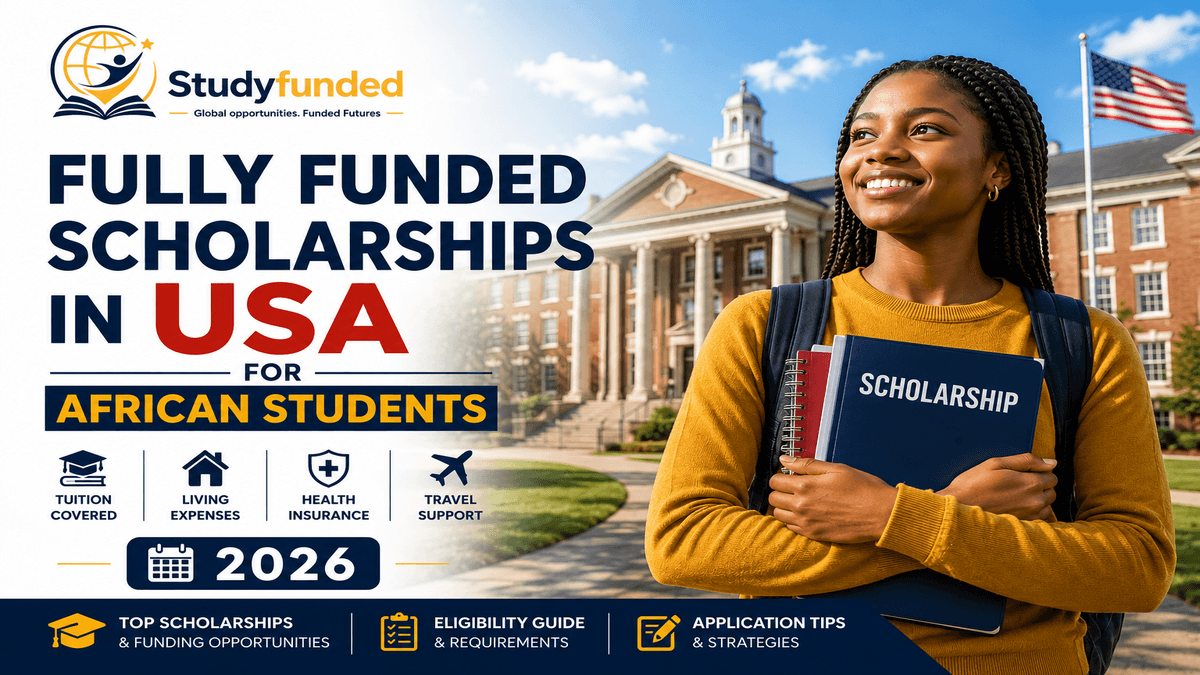
Studying in the United States can be expensive, which is why fully funded scholarships in the USA for African students can provide a more realistic pathway to a U.S. degree. Beyond tuition, students may need to cover housing, health insurance, books, transportation, and everyday living costs.
However, funding is spread across government programmes, universities, foundations, graduate schools, academic departments, and research projects. An opportunity described online as “fully funded” may also cover less than the headline suggests.
This guide explains how U.S. funding works, selected scholarship opportunities to investigate, common eligibility requirements, and practical application steps. It also covers alternative routes such as university financial aid and graduate assistantships.
The goal is not to help you apply for every famous scholarship in America. It is to help you identify funding opportunities that match your study level, academic background, and career direction.
What Does Fully Funded Scholarships in the USA Actually Cover?
A fully funded scholarship should provide substantial support towards the major costs of completing an academic programme.
Depending on the opportunity, funding may cover tuition, mandatory fees, living expenses, health insurance, travel, books, or research-related costs.
However, “fully funded” does not always mean every expense is covered.
A scholarship may pay tuition and provide a living stipend but exclude international travel. A graduate funding package may combine a tuition waiver and stipend with teaching or research responsibilities. Some universities also provide substantial need-based financial aid without calling it a fully funded scholarship.
| Funding Type | What It May Cover | Important Limitation |
|---|---|---|
| Fully funded scholarship | Tuition, living support, and other major study costs | Exact coverage varies |
| Full tuition scholarship | All or most tuition charges | Living and other costs may remain |
| Need-based financial aid | Support based on assessed financial circumstances | University policies vary |
| Graduate fellowship | Tuition support, a stipend, or both | May be programme-specific |
| Teaching or research assistantship | Stipend and possible tuition support | Usually includes defined responsibilities |
| Tuition waiver | Reduces or removes eligible tuition charges | Other study costs may remain |
Scholarships, financial aid, and assistantships therefore operate differently.
A named scholarship usually has defined eligibility and selection criteria. Need-based aid assesses an eligible student’s financial circumstances under a university’s policy. Graduate funding may be attached to a PhD programme, fellowship, or teaching or research appointment.
Before applying, confirm the actual funding coverage, duration, renewal conditions, and costs you must still pay.
A full tuition award should not automatically be treated as full funding. Likewise, a multi-year doctoral package may provide substantial support even when it is not advertised as a named scholarship.
Why Study in the USA?
Funding should not be the only reason you choose a study destination.
The United States may appeal to African students because of its broad range of specialised academic programmes, research environments, and professional networks.
Two universities offering similarly named degrees can have very different curricula, faculty expertise, laboratories, and research priorities. An electrical engineering graduate interested in renewable energy, for example, may compare programmes in power systems, smart grids, energy storage, or microgrids rather than applying to every university offering a general engineering degree.
This level of specialisation can be particularly important for research-focused master’s and PhD applicants. Departmental research, laboratories, funded projects, and faculty expertise may also influence where fellowships or research assistantships are available.
The U.S. funding system is another important factor. Support may come from government programmes, university financial aid, foundations, graduate schools, academic departments, fellowships, or assistantships.
That creates more routes to investigate—but also more complexity.
Do not choose the USA simply because you found a scholarship headline.
Compare the programme and funding together. The right university is one that fits your academic or career direction and offers a funding route you can realistically pursue.
Types of Scholarships and Funding Available to African Students in the USA
There is no single funding route for African students who want to study in the United States.
The most relevant option depends on your study level, nationality, academic profile, financial circumstances, and intended programme.
| Funding Route | Typical Study Level | Who It May Suit | Important Consideration |
|---|---|---|---|
| Government-sponsored programmes | Mainly graduate or programme-specific | Applicants who meet country and programme rules | Application routes may vary by country |
| University scholarships | Undergraduate or graduate | Students meeting award criteria | Funding may be partial or full |
| Need-based financial aid | Mainly undergraduate | Eligible students with demonstrated financial need | International aid policies vary |
| Merit or foundation scholarships | Varies | Applicants matching academic, leadership, or mission-based criteria | Eligibility may be restricted |
| Graduate fellowships | Master’s or PhD | Strong academic or research applicants | Funding and renewal conditions vary |
| Teaching or research assistantships | Graduate | Students suited to teaching or funded research | Usually includes defined responsibilities |
| Departmental funding | Mainly graduate | Students in programmes with internal support | Decisions may occur at department level |
Search for Funding at More Than One Level
Searching only for famous scholarship names can cause you to miss funding built into a university or graduate programme.
For each suitable university, investigate the central scholarship or financial aid information, graduate school, academic department, and individual programme where relevant.
This is particularly important for graduate applicants. A university’s main scholarship page may not show every fellowship, tuition-support arrangement, or assistantship available in an engineering, public health, agriculture, economics, or science department.
Instead of asking only:
“Which fully funded scholarships in USA can I apply for?”
Also ask:
“Which universities and programmes fund international students at my study level and in my field?”
That second question may reveal funding opportunities that never appear on general scholarship lists.
A broader search strategy often uncovers funding opportunities that many applicants overlook. Comparing government scholarships, university-funded awards, graduate fellowships, and programme-specific funding through Fully Funded Scholarships in USA for International Students 2026 can help you identify opportunities that match your academic background and career goals.
Eligibility Requirements for Fully Funded Scholarships in USA for African Students
There is no universal eligibility checklist for every U.S. scholarship.
A government-sponsored programme may consider nationality, professional experience, and leadership. A university may assess academic achievement or financial need, while a funded PhD programme may focus heavily on research preparation and programme fit.
The following factors commonly influence eligibility.
Academic Record and Programme Fit
Universities may review your previous qualification, courses, grades, academic progression, and whether your educational background prepares you for the programme.
Because grading systems differ across African countries and institutions, do not automatically convert your grades to a U.S. 4.0 GPA unless instructed to do so.
Check the programme’s required qualification, minimum academic standard where stated, prerequisite courses, and whether your previous field or experience is relevant.
A strong GPA alone does not make you eligible for every programme.
Nationality and Country Eligibility
Being African does not automatically make you eligible for every opportunity advertised for African students.
Some scholarships are open to applicants from many countries. Others restrict eligibility to citizens, nationals, residents, or applicants from specified African countries or regions.
Read these definitions carefully.
Country-specific programmes may also use different application routes. Fulbright is a good example: applicants generally follow the process designated for their home country, and relying on instructions written for another country can lead to avoidable application mistakes.
Understanding the country-specific requirements, funding benefits, and application process is therefore essential when pursuing the Fulbright Foreign Student Program 2026: Requirements, Benefits and How to Apply.
English-Language and Test Requirements
English-language and standardised test policies vary by university and programme.
Application requirements may include TOEFL, IELTS, the Duolingo English Test, SAT, ACT, GRE, or GMAT.
None of these tests is a universal requirement for every U.S. scholarship or degree.
Create your shortlist first, then check the exact test requirements for each programme. A university may accept an IELTS alternative or provide an English-proficiency exemption under defined conditions.
Leadership, Experience, and Research Preparation
The evidence that matters depends on the opportunity.
Leadership-focused scholarships may assess professional experience, community involvement, initiative, or measurable impact. Research-intensive programmes may place greater weight on previous research, technical preparation, and alignment with the department’s academic strengths.
Use evidence that matches the selection criteria.
Do not force a leadership story into a research programme that primarily assesses academic potential. Likewise, a purely academic profile may not fully answer a scholarship that explicitly prioritises leadership and professional impact.
Research applicants should review the programme’s research areas and application requirements. Do not assume that every U.S. PhD applicant must contact a professor or submit a research proposal unless the programme says so.
Admission and Funding Eligibility Are Separate
Meeting a scholarship’s requirements does not automatically mean you qualify for the university programme.
The reverse is also true.
| Admission Fit | Funding Fit |
|---|---|
| Do I meet the academic requirements? | Is my nationality eligible? |
| Is my previous qualification relevant? | Is my study level supported? |
| Are prerequisites required? | Does the funding cover the costs I need? |
| What tests or English evidence are required? | Is a separate funding application required? |
| What admission documents must I submit? | Are leadership, experience, or financial need assessed? |
Before applying, map the admission and funding process separately.
Some awards require university admission first. Others use a separate scholarship process. Certain university awards automatically consider eligible admission applicants, while some graduate funding decisions are made alongside admission.
Understanding the complete application route can prevent you from preparing the right documents for the wrong process.
Best Fully Funded Scholarships in USA for African Students 2026
The best fully funded scholarships in USA for African students 2026 are not necessarily the awards with the most famous names.
A master’s applicant from Nigeria, a secondary school graduate from Ghana, and a research-focused PhD applicant from Kenya may need completely different funding routes.
The opportunities below include government funding, Africa-focused support, graduate scholarships, undergraduate need-based aid, and funded doctoral study.
| Funding Opportunity | Study Level | Best Suited For |
|---|---|---|
| Fulbright Foreign Student Program | Graduate | Eligible African graduates and professionals |
| Mastercard Foundation Scholars Program at UC Berkeley | Master’s | Eligible Sub-Saharan African students |
| Knight-Hennessy Scholars | Graduate | Stanford applicants with strong leadership potential |
| Yale need-based financial aid | Undergraduate | International students with demonstrated financial need |
| Karsh International Scholars Program | Undergraduate | Outstanding international students with financial need |
| Harvard Griffin GSAS PhD funding | PhD | Research-focused doctoral applicants |
| MIT need-based financial aid | Undergraduate | International students requiring substantial financial aid |
These opportunities do not all operate as identical “full scholarships.” Confirm the current eligibility, supported programmes, funding terms, and application route before applying.
1. Fulbright Foreign Student Program
Best for: Eligible African graduates and professionals pursuing graduate study or research in the United States.
The Fulbright Foreign Student Program supports foreign graduate students, young professionals, and other eligible participants through country-specific processes.
African applicants should follow the Fulbright route designated for their home country because eligibility, available fields, selection procedures, and grant benefits may differ. A Nigerian applicant, for example, should use the official Nigeria process rather than instructions for Ghana, Kenya, or South Africa.
Depending on the country programme and award, support may include tuition, living expenses, travel, and health-related benefits.
The country-specific nature of Fulbright is exactly why applicants should understand the process before preparing their documents. Eligibility rules, required materials, selection stages, and funding benefits may not be identical across participating countries, making the Fulbright Foreign Student Program 2026: Requirements, Benefits and How to Apply an important starting point for applicants who want to approach the opportunity correctly.
2. Mastercard Foundation Scholars Program at UC Berkeley
Best for: Eligible Sub-Saharan African students seeking supported master’s study at UC Berkeley.
The Mastercard Foundation Scholars Program provides comprehensive support to selected students, with a strong focus on Africa. At UC Berkeley, eligible students from Sub-Saharan African countries may receive support for selected master’s programmes.
The scholarship does not cover every Berkeley master’s degree. Applicants must confirm the current eligible programme list and follow Berkeley’s admission and Scholars Program process.
The programme also operates through partner institutions, so eligibility for a degree or application route at one university should not be generalised to another.
3. Knight-Hennessy Scholars at Stanford University
Best for: Graduate applicants with strong academic preparation, purposeful leadership, and a clear reason for pursuing an eligible Stanford degree.
Knight-Hennessy Scholars provides funding for up to three years of eligible graduate study at Stanford under the programme’s funding policy. Citizens and residents of all countries may apply, including eligible African applicants.
However, Knight-Hennessy and Stanford graduate admission are separate application processes. You must apply to the scholarship and satisfy the requirements of your chosen Stanford graduate programme.
Applicants pursuing degrees longer than three years should also examine how the relevant programme normally supports students beyond the Knight-Hennessy funding period.
4. Yale University Need-Based Financial Aid for International Undergraduates
Best for: International undergraduate applicants who require substantial financial support and are competitive for Yale admission.
Yale states that international students are eligible for its need-based financial aid and that the university meets 100% of each admitted student’s demonstrated financial need.
This is need-based aid—not a universal merit scholarship called the “Yale Full Scholarship.”
Excellent grades do not automatically produce a full funding award. Applicants must first compete for admission and complete Yale’s financial aid process. The university then assesses the family’s financial circumstances under its aid policy.
For African students requiring significant undergraduate support, Yale may be financially relevant if the university also fits their academic goals.
5. Karsh International Scholars Program at Duke University
Best for: Outstanding first-year international undergraduate applicants with demonstrated financial need.
The Karsh International Scholars Program provides substantial support to selected international students at Duke University.
Duke states that the programme covers tuition, room and board, mandatory fees, demonstrated need beyond those costs, and funding for three summers of approved research, internships, or other academic opportunities.
The programme is intended for eligible incoming international undergraduates rather than international transfer students. Applicants seeking need-based support must also follow Duke’s financial aid requirements.
This is an undergraduate funding route and should not be confused with graduate scholarships or assistantships.
6. Harvard Griffin GSAS PhD Financial Support
Best for: Research-focused applicants seeking an eligible PhD within the Harvard Kenneth C. Griffin Graduate School of Arts and Sciences.
Harvard Griffin GSAS states that incoming PhD students receive comprehensive financial support covering tuition, health insurance fees, and basic living expenses. Funding may combine grants, stipends, teaching fellowships, research assistantships, traineeships, or other academic appointments.
This is not a general Harvard scholarship for every degree.
It is a doctoral funding structure connected to admission into a Griffin GSAS PhD programme.
African applicants considering doctoral study should therefore begin with the relevant programme, its academic requirements, and research fit rather than searching broadly for a “Harvard fully funded scholarship.”
7. MIT Need-Based Financial Aid for International Undergraduates
Best for: International undergraduate applicants requiring substantial financial support and academically suited to MIT.
MIT states that it is need-blind and full-need for undergraduate applicants, including international students. Under this policy, ability to pay is not considered in the undergraduate admission decision, and MIT commits to meeting 100% of the demonstrated financial need of admitted students.
Again, this is need-based financial aid rather than a merit scholarship automatically awarded for excellent grades.
Funding availability should not be confused with admission probability. MIT belongs on your shortlist only if your academic preparation and interests genuinely fit the institution.
Applicants must also complete the required financial aid process.
Choose the Programme and Funding Together
The seven opportunities above should not become seven automatic applications.
Start with your own profile.
A graduate or professional applicant may investigate Fulbright. An eligible Sub-Saharan African applicant targeting a supported Berkeley master’s programme may consider the Mastercard Foundation Scholars Program. International undergraduates with significant financial need may investigate Yale, MIT, or Karsh, while research-focused PhD applicants should examine funded doctoral programmes such as the Harvard Griffin GSAS model.
For every opportunity, confirm:
- Your nationality or residency eligibility.
- The supported study level.
- Academic or programme requirements.
- The actual funding coverage.
- Whether your intended degree is eligible.
- The admission and funding application route.
- The current deadline.
Do not choose a university by reputation alone.
A university may provide generous undergraduate aid but limited funding for some master’s programmes. Another may have fewer famous university-wide scholarships but provide strong doctoral support through specific departments.
The better question is not:
“Which U.S. university gives full scholarships to African students?”
Ask:
“Which programme fits my background and offers a realistic funding route at my study level?”
For graduate study, look beyond the university’s central scholarship page. Check the graduate school, academic department, and individual programme where relevant.
A shortlist of three carefully matched funding routes can be more useful than 50 scholarship names you have not properly investigated.
How to Apply for Fully Funded Scholarships in the USA
Finding a suitable funding opportunity is only the first step. Your application must also show why your academic background, experience, and future direction fit the programme or scholarship.
There is no single application process for every U.S. scholarship. However, the following strategy can help African students avoid common mistakes.
1. Shortlist Opportunities That Fit Your Profile
Do not apply mainly because a scholarship or university is famous.
Before investing time in an application, confirm:
- Your nationality is eligible.
- The funding supports your study level.
- Your academic background fits the programme.
- You meet any leadership, work experience, or research requirements.
- The funding package addresses the major costs you need covered.
- You understand the admission and scholarship application route.
Applying strategically does not mean avoiding competitive scholarships. It means knowing why you are a plausible applicant before you apply.
2. Build a Clear Academic and Career Story
Your transcript shows what you studied, while your CV presents what you have done. The essays should then help the reader understand how those experiences connect and where you are going next.
For example, an applicant who studied electrical engineering, gained experience in power systems or solar energy, and now wants advanced training in renewable energy or grid integration has a direction that is easy to understand.
Your career does not need to be perfectly linear. However, if you are changing fields, explain what experience, training, or professional goal connects your previous background to the new programme.
A strong application should answer four questions:
- Why this field?
- Why this programme?
- Why now?
- What do you plan to do with the opportunity?
3. Use Evidence Instead of Broad Claims
Statements such as “I am a passionate leader” or “I want to make an impact in Africa” are easy to write.
Evidence is more convincing.
- If leadership matters, explain the responsibility you accepted, the problem you faced, the action you took, and the result.
- If you claim professional impact, show what changed because of your work.
- If you are interested in research, explain the project, technical problem, question, or experience that developed that interest.
Your application does not need the most dramatic story. It needs credible evidence that supports the qualities you claim.
4. Tailor Your Essays to the Actual Prompt
A personal statement, scholarship essay, and statement of purpose may serve different purposes.
A personal statement may explore your background and experiences. A scholarship essay may ask about leadership, community impact, or career plans. A statement of purpose commonly focuses more heavily on academic preparation, programme fit, and future direction.
Do not write one document titled “My SOP” and submit slightly edited versions everywhere.
The way you present your story should also change with the document. Learning How to Write a Winning Scholarship Personal Statement can help you communicate the experiences, motivations, and future impact behind your application, while understanding How to Write a Statement of Purpose for USA Universities can help you build a stronger academic case around your preparation, programme fit, and career direction.
5. Map the Complete Application Route
University admission and scholarship funding may involve separate processes.
Depending on the opportunity, you may need to apply through:
- A university admission portal.
- A separate scholarship portal.
- A university financial aid process.
- A graduate department.
- A Fulbright Commission, Foundation, or U.S. Embassy route.
- Another officially designated application system.
Do not assume that submitting a university application automatically enters you into every scholarship competition.
Record the admission deadline, funding deadline, application portal, required documents, and application sequence for each opportunity.
6. Request Recommendations Early and Submit Correctly
Where recommendation letters are required, choose people who can provide specific evidence about your work, ability, or potential.
A lecturer who supervised an important project may write a stronger letter than a senior professor who barely knows you.
Give your referee the programme name, deadline, submission instructions, your current CV, and enough time to prepare the recommendation.
Before submitting your own application, check the file requirements, time zone where stated, and whether recommendations are submitted separately.
Save your confirmation email, application reference number, and copies of the documents you submitted.
After submission, continue monitoring your email and application portal for document requests, interview invitations, financial aid queries, and status updates.
Documents Required for Fully Funded Scholarships in USA
The exact documents depend on the university, study level, and funding route.
An undergraduate applying for need-based financial aid may need family financial information. A graduate applicant may submit a statement of purpose, while a research programme may request additional academic materials.
Common documents include:
| Document | What to Check |
|---|---|
| Academic transcripts | Whether uploaded, certified, or official records are required |
| Degree certificate | Completion and translation requirements |
| CV or résumé | Relevance to the programme or scholarship |
| Personal statement or essays | The exact application prompt |
| Statement of purpose | Academic preparation, programme fit, and future direction |
| Recommendation letters | Number, referee type, and submission process |
| English-language results | Accepted tests or approved alternatives |
| Passport or identity document | Validity and required document page |
| Financial information | Institution-specific need-based aid requirements |
| Research documents | Whether a proposal, statement, or writing sample is requested |
| Credential evaluation | Whether an external evaluation is specifically required |
Do not order a credential evaluation simply because another international student used one. Some U.S. institutions evaluate international records internally, while others specify the evaluation services they accept.
Likewise, a research proposal is not required for every PhD application. Submit the document the programme actually requests.
For need-based financial aid, provide accurate financial information. If your family’s income comes from self-employment, irregular earnings, or another situation not clearly addressed in the published instructions, contact the university’s official financial aid office for guidance.
Before uploading your documents, confirm that names and dates are consistent, scans are readable, translations follow the institution’s rules, essays answer the correct prompts, and you have not submitted an outdated CV or draft statement.
Scholarship Application Timeline for African Students
There is no single deadline for U.S. scholarships.
Government programmes, universities, financial aid offices, and graduate departments may use different calendars. Use the timeline below as a preparation framework and replace it with the actual deadlines on your shortlist.
| Preparation Period | Priority Actions |
|---|---|
| 12–15 months before study | Research funding routes, programmes, prerequisites, passport validity, and possible test requirements |
| 9–12 months before | Build a shortlist, confirm eligibility, identify referees, and request academic records |
| 6–9 months before | Research programmes deeply, complete required tests, and begin major application statements |
| 3–6 months before | Tailor applications, follow up with referees, complete financial aid requirements, and submit |
| After submission | Monitor email and portals, prepare for interviews, and compare funding offers |
Pay particular attention to tasks that depend on other people or institutions.
Transcripts may take weeks to process. Referees need time. Test dates may be limited. Financial aid applications may require family income information that takes time to organise.
If you have less than six months, work backwards from your earliest realistic deadline. Confirm test availability, request academic records, contact referees, and remove opportunities you clearly cannot complete on time.
A shorter list of complete, well-matched applications is better than ten rushed submissions.
Fully Funded Scholarships in USA Without IELTS for African Students
Yes, it may be possible to secure substantial or fully funded study opportunities in the United States without submitting IELTS.
However, “without IELTS” does not mean “without an English-language requirement.”
Depending on the institution and programme, accepted alternatives may include:
- TOEFL.
- Duolingo English Test or another approved assessment.
- Previous education completed in English.
- A Medium of Instruction document where accepted.
- A university-specific exemption or waiver.
These alternatives are not universal.
Completing your bachelor’s degree in English does not automatically guarantee a test waiver. Nationality alone may also not create an exemption.
Before paying for an English test, check the university, graduate school, and programme requirements where applicable.
Most importantly, do not build your entire shortlist around avoiding IELTS.
The better goal is to find a programme that fits your academic direction, offers a realistic funding route, and has an English-language requirement you can satisfy.
Are Graduate Assistantships a Real Funding Option for African Students?
Yes. Graduate assistantships can be a genuine funding route for eligible international students, including African students.
An assistantship is normally an academic appointment that combines graduate study with teaching, research, or university responsibilities.
| Assistantship | Typical Responsibilities |
|---|---|
| Teaching Assistantship (TA) | Tutorials, laboratory support, grading, office hours, or instructional duties |
| Research Assistantship (RA) | Research, data analysis, experiments, modelling, software, or project support |
| Graduate Assistantship | Academic, laboratory, student service, or departmental support |
Depending on the appointment, support may include a stipend, tuition waiver or remission, health-related benefits, or a combination of these.
The title alone does not tell you how strong the funding package is.
Before accepting an assistantship, confirm:
- The stipend amount.
- Whether tuition is fully or partially covered.
- Mandatory fees you must still pay.
- Health insurance support.
- Appointment duration.
- Expected workload.
- Renewal conditions.
- Whether summer funding is included.
How to Find Graduate Assistantships Strategically
Start with the academic programme.
Check the department’s funding page, graduate handbook, assistantship information, faculty research, laboratories, and funded projects where relevant.
For research assistantships, genuine research fit matters.
Do not send the same message to dozens of professors saying:
“Dear Professor, I am interested in your research and need a fully funded scholarship.”
If faculty contact is encouraged, explain the connection between your academic preparation or research interests and the person’s work.
Faculty contact is not a universal requirement for U.S. graduate applications. Some departments use a central admission and funding process.
Follow the programme’s instructions.
International graduate students may be eligible for assistantships subject to university requirements and applicable U.S. regulations. If you receive an appointment, confirm the terms through the university and follow its international student guidance.
Graduate assistantships are strongest as part of a programme and research-fit strategy—not a mass-email strategy.
Frequently Asked Questions About Fully Funded Scholarships in USA for African Students
Can African students get fully funded scholarships in the USA?
Yes. Eligible African students may receive substantial or fully funded support through government programmes, university financial aid, fellowships, funded PhD programmes, and graduate assistantships.
The right funding route depends on your nationality, study level, academic background, and financial needs.
Can I get fully funded scholarships in the USA with a second-class lower degree?
Possibly.
A second-class lower degree does not have one universal interpretation across U.S. universities and scholarships. Some programmes publish minimum academic requirements, while others consider broader academic preparation, relevant coursework, research, professional experience, and programme fit.
Do not automatically convert your degree classification to a U.S. GPA unless instructed to do so. Check the requirements of the exact programme and funding opportunity.
Are there fully funded undergraduate scholarships in USA for African students?
Yes, but comprehensive undergraduate funding for international students is highly competitive.
Some U.S. universities provide need-based financial aid to eligible international students, while certain named scholarships offer substantial support.
Confirm whether the funding is merit-based, need-based, or linked to separate selection criteria. Also check whether a separate financial aid or scholarship application is required.
Do I need WES to apply for scholarships in the USA?
Not always.
Some U.S. universities evaluate international academic records internally. Others may require an external credential evaluation and specify the services they accept.
Do not order a WES evaluation simply because another international student used one. Check the transcript and international credential requirements of your exact university or graduate programme first.
When should I start applying for USA scholarships for 2026?
Start researching as early as possible.
Beginning about 12 to 15 months before your intended study period gives you more time to compare programmes, investigate funding routes, arrange academic records, identify referees, and complete required tests.
If you are already inside that preparation window, build a shortlist immediately and work backwards from the actual deadlines of realistic opportunities.
There is no single “USA scholarship deadline” for every application.
Final Thoughts on Fully Funded Scholarships in USA for African Students 2026
Finding fully funded scholarships in USA for African students is not about collecting the longest possible list of scholarship names.
The stronger approach is to start with your profile.
What do you want to study? At what level? Which programmes match your academic preparation and career direction? How much funding do you genuinely need?
Then investigate the funding routes designed for applicants like you.
Your best option may be a major scholarship, university financial aid, a funded PhD programme, or a graduate assistantship.
Whatever the route, verify the opportunity on the official website, follow the correct application process, and tailor your materials to the actual selection criteria.
The goal is not to apply everywhere.
It is to move from searching randomly to applying deliberately.
Choose realistic opportunities, understand how the funding works, and give each serious application the preparation it deserves.
Official Resources for Fully Funded Scholarships in USA
Finally, use the official resources below to verify current eligibility, funding terms, application requirements, and deadlines for the seven featured opportunities: